
Moonlighting and Dual Employment: How to Write a Policy That Holds Up
No single Indian law bans moonlighting for private-sector employees. Employment contracts, confidentiality and conflict-of-interest rules decide it. Dual employment can show up in PF contributions and tax records. A fair policy states what side work is allowed, requires disclosure, bans work for competitors, and sets out an inquiry process.

Remote work made it easy to hold two jobs at once. Some employers ban all side work; others allow it openly. Either way, employers need a written policy, because the law alone does not settle it.
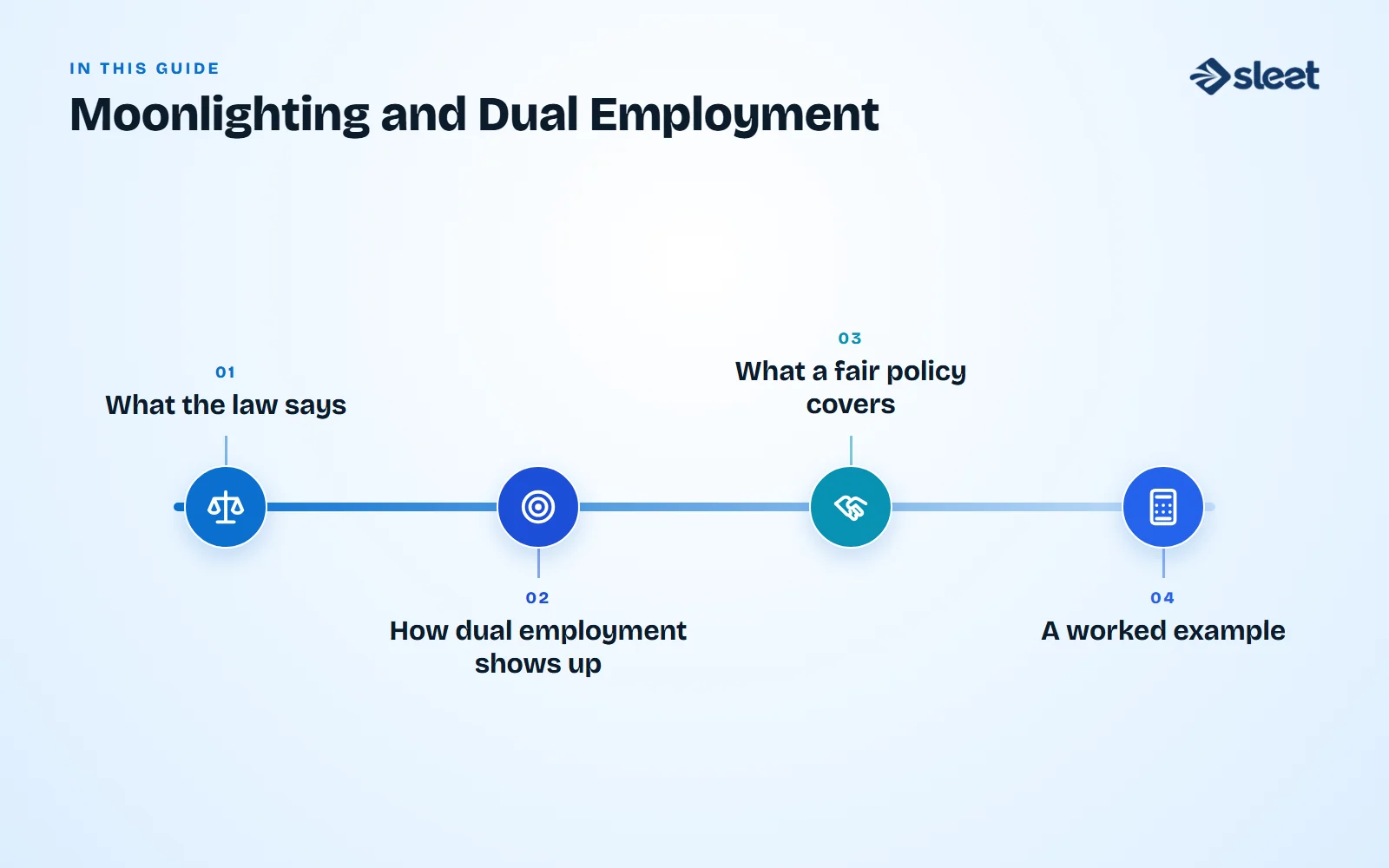
What the law says
- ✓No single Indian law bans moonlighting for private-sector employees.
- ✓Employment contracts decide most cases. A clause requiring full-time, exclusive service, or permission for outside work, is generally enforceable during employment.
- ✓Confidentiality and conflict-of-interest rules apply whatever the contract says. Working for a competitor or using company information is a serious breach.
- ✓Some labour laws restrict double employment for factory workers on the same day. Check what applies to your establishment.
How dual employment shows up
- ✓PF: if two employers contribute to the same UAN in the same month, it shows in the PF account. Employees with two UANs at once is also a warning sign.
- ✓Tax: the annual tax statement and Form 130 data show salary from more than one employer.
- ✓Work patterns: missed meetings, unusual hours, or the same person appearing on another company's website.
Use these signs to start a conversation, not to reach a conclusion.
What a fair policy covers
- What is allowed: for example, teaching, writing, family business, or freelancing in an unrelated field, with disclosure.
- What is not allowed: a second full-time job, work for competitors, clients or vendors, or work during agreed hours.
- How to disclose: a simple form, and who approves.
- Use of company assets: no company laptops, data or time for side work.
- What happens if the policy is breached: a fair inquiry, the chance to explain, and proportionate action.
A worked example
A Pune software company found an engineer's PF passbook showing contributions from another employer for three months. HR met the engineer, who admitted to a full-time contract role with a client's competitor. Under the policy, which banned work for competitors, the company held an inquiry and ended his employment. In another case, an employee who taught weekend classes had disclosed it, and nothing was done.
Frequently asked questions
Can we check an employee's PF records?
You can see contributions you make. Ask the employee to explain any concerns, rather than looking for their other records yourself.
Is a blanket ban enforceable?
A ban on outside employment during working hours or with competitors is generally enforceable. A ban on all activity in personal time is harder to defend, so keep it reasonable.
Do we have to pay notice if we end employment for moonlighting?
That depends on your contract and the inquiry. A proved serious breach may justify termination without notice; take legal advice.
Sources
This is a summary, not legal advice. Confirm with an employment lawyer before acting on a case.

Written by
HR Manager, Airwix Technologies (Sleet)
Nihit Dobariya is the HR Manager at Airwix Technologies in Ahmedabad, where he runs HR and payroll for the team behind Sleet. He writes about payroll, PF and ESIC, professional tax, the labour codes and everyday HR practice for Indian employers, and checks each rule against the official notification before it is published.
LinkedIn profile →