
Grievance Handling: A Fair Process for Employee Complaints
Handle grievances in four levels: an informal talk with the manager, a written complaint to HR, an investigation, then a senior review or appeal. Acknowledge within two working days, finish ordinary investigations in two to three weeks and give the outcome in writing. Sexual harassment complaints must go to the POSH Internal Committee.

A grievance is a complaint by an employee about work, conditions, treatment or a decision. Unresolved grievances turn into disengagement, resignations and sometimes legal disputes. A clear process shows people that raising a concern is safe and effective.
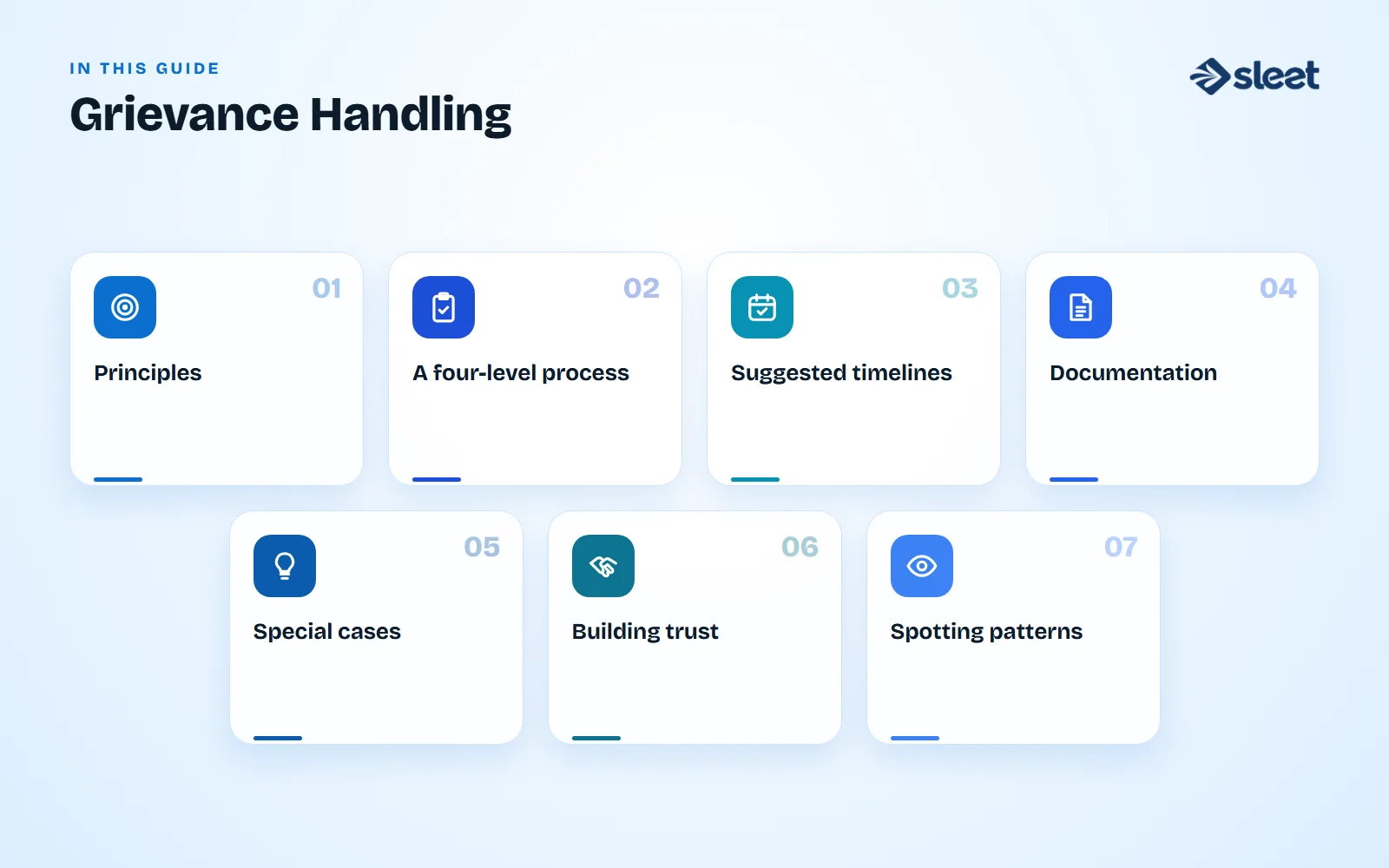
Principles
- ✓Accessibility: Everyone should know how to raise a concern.
- ✓Fairness: Listen to all sides before deciding.
- ✓Speed: Set timelines and keep to them.
- ✓Confidentiality: Share information only with those who need it.
- ✓No retaliation: Protect those who raise concerns in good faith.

A four-level process
- ✓Level 1, informal discussion: The employee talks to their manager, who tries to resolve it quickly.
- ✓Level 2, formal complaint: A written complaint to HR with details of the issue.
- ✓Level 3, investigation: HR or a committee gathers facts, hears the employee, and meets relevant people.
- ✓Level 4, review or appeal: A senior leader reviews the decision if the employee is not satisfied.
Suggested timelines
Acknowledge a complaint within two working days, complete an investigation within two to three weeks for ordinary matters, and communicate the outcome in writing. Complex cases such as harassment must follow the timelines set by law.

Documentation
- ✓Date and nature of the complaint.
- ✓Steps taken, people interviewed and evidence collected.
- ✓Decision and reasoning.
- ✓Follow-up actions and review date.
Special cases
Complaints about sexual harassment must go through the Internal Committee under the POSH Act. Whistleblower reports about fraud or serious misconduct may need a separate channel and, in some companies, an independent reviewer.
Building trust
- ✓Publicise the policy and the names of contacts.
- ✓Offer more than one channel, including anonymous options.
- ✓Share anonymised outcomes to show that complaints lead to action.
- ✓Check back with the employee after resolution.
Spotting patterns
Review grievances by team, manager and theme every quarter. A cluster of complaints in one area usually points to a deeper problem.
A grievance process is an early warning system, if you pay attention to it.
Train managers to listen, to avoid defensiveness and to escalate appropriately when needed.

Written by
HR Manager, Airwix Technologies (Sleet)
Nihit Dobariya is the HR Manager at Airwix Technologies in Ahmedabad, where he runs HR and payroll for the team behind Sleet. He writes about payroll, PF and ESIC, professional tax, the labour codes and everyday HR practice for Indian employers, and checks each rule against the official notification before it is published.
LinkedIn profile →