
Employee Self-Service Portals: Why They Matter
An employee self-service portal lets staff view payslips, apply for leave, update their details and download tax documents without asking HR. That removes repetitive requests for balances, payslips, Form 16 and detail changes. Adoption depends on the mobile app working reliably on a basic Android phone.

An employee self-service portal, or ESS, lets staff view payslips, apply for leave, update personal details and download tax documents without asking HR. It looks like a small convenience, but across a few hundred employees it removes a large amount of repetitive work.
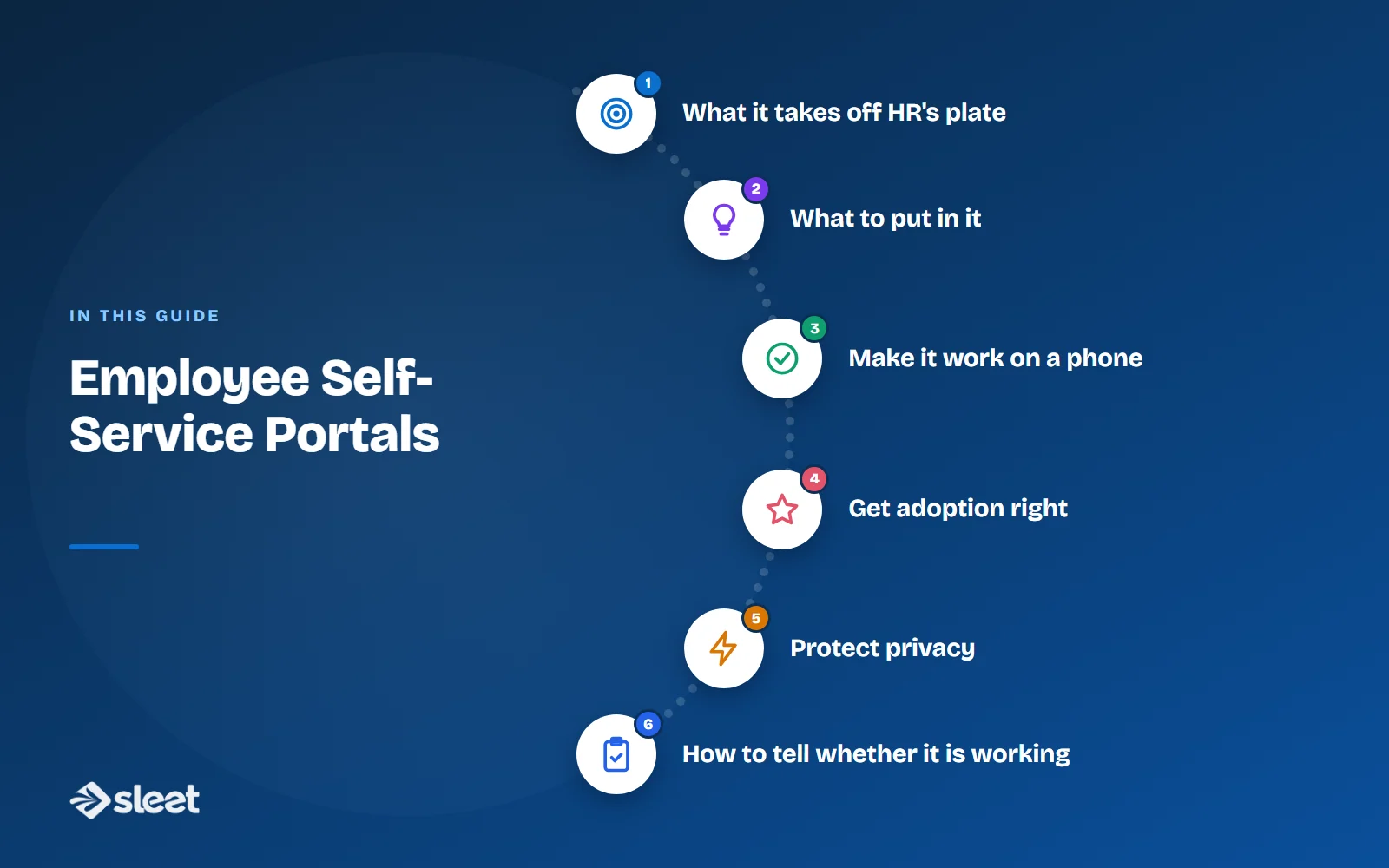
What it takes off HR's plate
- ✓Leave and attendance questions. Employees see their balance and apply directly.
- ✓Payslip and Form 16 requests. Documents are available whenever they are needed.
- ✓Detail changes. Address, bank account or emergency contact updates go through an approval workflow instead of an email.
- ✓Policy lookups. Policies and templates sit in one searchable place, not scattered across PDFs.

What to put in it
| Section | Employee can |
|---|---|
| Attendance | Mark attendance, see records, raise a missed punch |
| Leave | See balances, apply, track status |
| Payslips and tax | View payslips, declare investments, upload proofs, download Form 16 |
| Profile | Update details, with approval where needed |
| Requests | Ask for letters and reimbursements |
| Policies | Read current policies and acknowledge them |
Make it work on a phone
For most Indian workforces the mobile app matters more than the desktop version. Field staff and factory teams will only use self-service if it works reliably on a basic Android phone, in their language, with limited data.

Get adoption right
- Launch with the three tasks people ask for most, usually payslips, leave and attendance.
- Show people how, in a short demo on the shop floor or in team meetings.
- Stop handling those requests by email. If you keep answering them, people will keep asking.
- Ask managers to approve in the app, since a portal is only as good as the approvals behind it.
Protect privacy
Set access by role. An employee should see only their own data, and managers should see only their team. Log changes to bank details and salary.
How to tell whether it is working
Count the HR queries about payslips, leave and attendance before launch and again after two or three months. Fewer queries, quicker approvals and fewer corrections near payroll cut-off all show it is being used.

Written by
Founder, Airwix Technologies (Sleet)
Vatsal Sutariya is the founder of Airwix Technologies in Ahmedabad, the company that builds Sleet: SleetHR for HR and payroll, and Sleet Accounting for GST billing and books. He writes about GST, invoicing, business tax and choosing software for Indian businesses, and checks each rule against the official notification before it is published.
LinkedIn profile →