
Guiding Principles for a Healthier Work-Life Balance
Work-life balance is protected by structural rules, not wellness events. Give every meeting a purpose and an end time, approve or clarify leave requests within a set number of days, never make "always available" an unwritten expectation, and have leaders model it. Track leave actually taken, not just leave balances.

Work-life balance is protected by a few rules a company keeps to, not by wellness events. A yoga session is easy to announce and easy to forget. What changes people's weeks is how meetings, leave and expectations are handled every day.
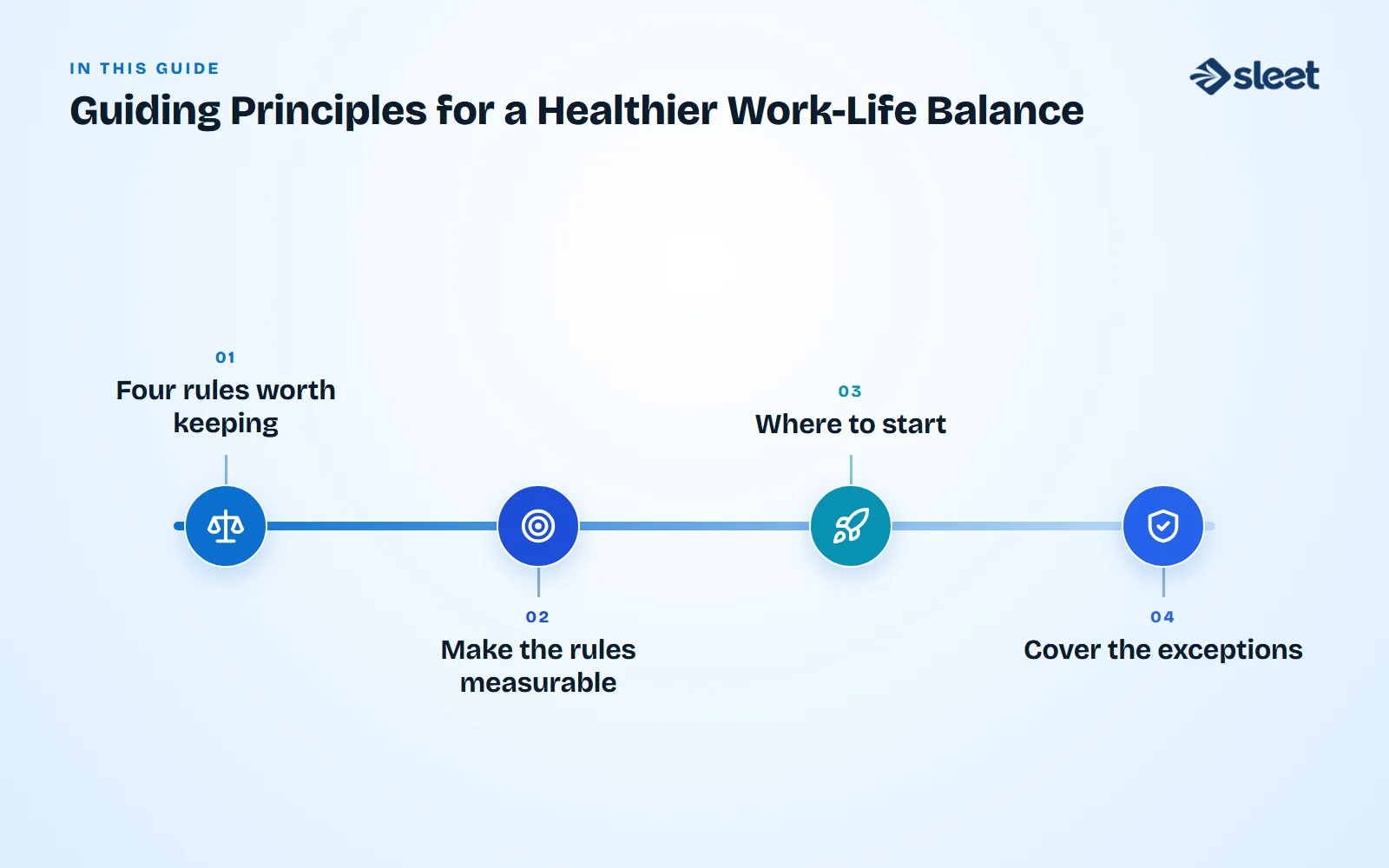
Four rules worth keeping
- ✓Every meeting has a purpose and an end time before it is scheduled, and not after it has already overrun.
- ✓Leave requests get a decision within a set number of working days. A request left pending until someone chases it teaches people not to ask.
- ✓"Always available" is never an unwritten expectation, for any role, however senior.
- ✓Leaders behave the way they want others to. If senior people reply at midnight, "we value balance" reads as decoration.

Make the rules measurable
Balance sounds soft, but you can track it.
| What to track | What it tells you |
|---|---|
| Leave actually taken, not just balance | Whether people feel safe using leave |
| Messages sent after working hours | Whether "always on" is the real norm |
| Hours in meetings per person | Whether people have time to do the work |
| Average time to approve leave | Whether managers are responsive |
A company where employees pile up leave they never take is not good at balance. It is postponing the problem. Whatever policy exists on paper should be one that people feel safe using.
Where to start
- Pick two rules and announce them, with a date.
- Ask managers to model them and to report what is hard.
- Review the numbers after a quarter and adjust.
Cover the exceptions
Some roles, such as support, operations and on-call work, cannot switch off at five. For them, set a roster, pay for out-of-hours work and give time off in return. Fairness matters more than the exact rule.

Written by
HR Manager, Airwix Technologies (Sleet)
Nihit Dobariya is the HR Manager at Airwix Technologies in Ahmedabad, where he runs HR and payroll for the team behind Sleet. He writes about payroll, PF and ESIC, professional tax, the labour codes and everyday HR practice for Indian employers, and checks each rule against the official notification before it is published.
LinkedIn profile →