
Building Real Employee Accountability Without Micromanaging
Accountability is clarity that makes constant checking unnecessary, while micromanagement is oversight standing in for trust. Give every task one named owner, write commitments down where everyone can see them, and review outcomes against what was agreed on a schedule, instead of asking how it is going every day.

Accountability and micromanagement can look similar from a distance, but they work in opposite ways. Micromanagement is oversight standing in for trust. Real accountability is clarity that makes constant checking unnecessary.
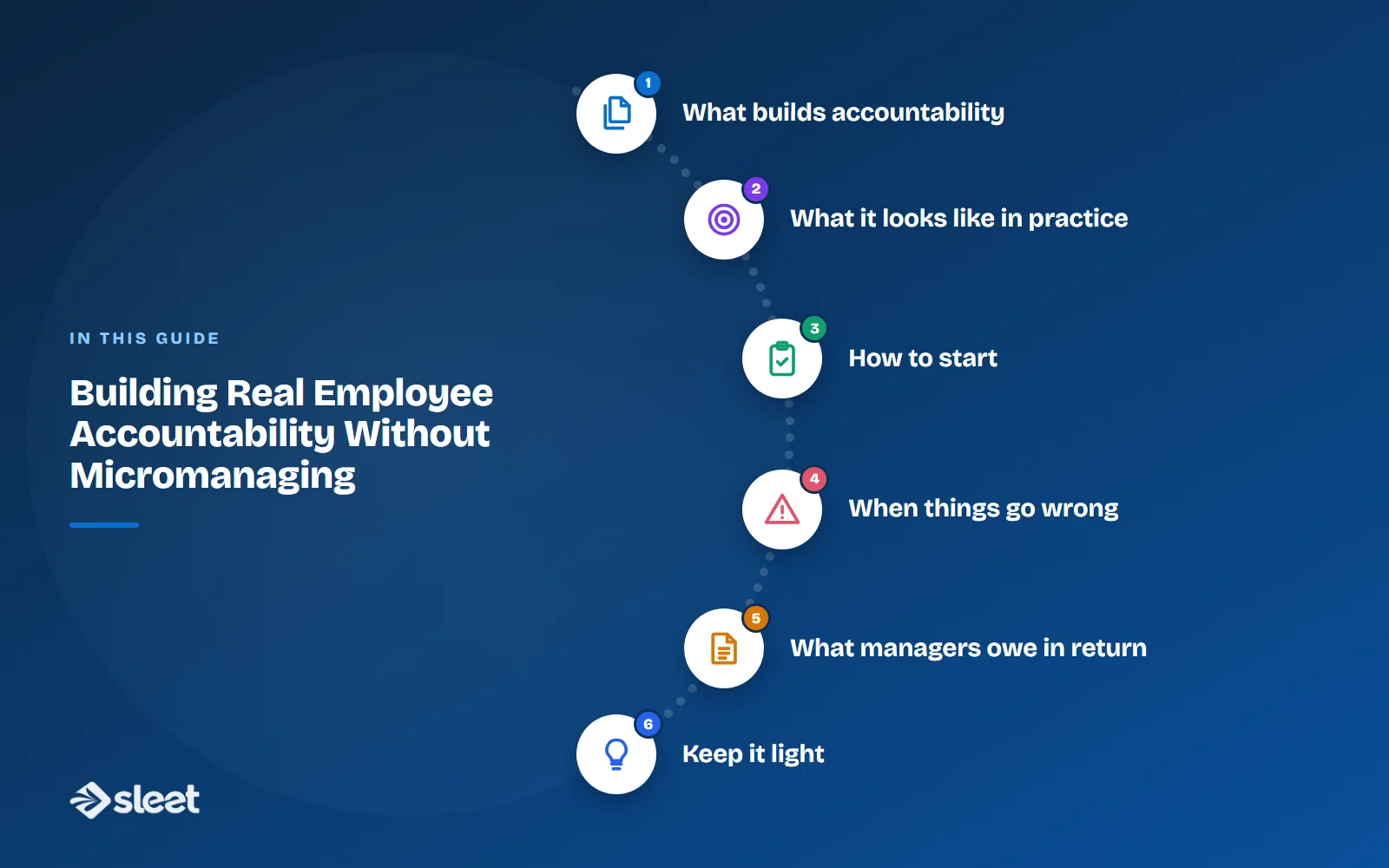
What builds accountability
- ✓One named owner for each task or goal. "The team" does not own anything. A person does.
- ✓Commitments written down in a shared place, with a date. Verbal promises are forgotten by Friday.
- ✓Managers who follow up. If commitments go unchecked, again and again, people learn that accountability is optional.
- ✓Clear standards. People can only be held to a result they understand.

What it looks like in practice
| Micromanaging | Accountable |
|---|---|
| "How is it going?" every day | "Let's review the outcome on Thursday against what we agreed" |
| Approving every small decision | Setting limits and trusting people inside them |
| Fixing the work quietly | Giving specific feedback and letting the owner correct it |
| Checking activity | Checking results |
How to start
- For the next project, write the goal, the owner, the deadline and the measure of done in one place.
- Agree when you will review it, before it begins.
- At the review, talk about results first, then what got in the way.
- If a commitment was missed, ask what happened and what support is needed, before you ask who is to blame.
- If the same thing happens again, treat it as a performance conversation.

When things go wrong
People miss commitments for reasons that are not about attitude: unclear priorities, hidden dependencies, too much work. Find out which it is. Accountability without support turns into blame.
What managers owe in return
Clear priorities, the authority needed to do the work, a quick answer when someone is stuck and credit when it goes well. A person cannot be accountable for something they cannot influence.
Keep it light
You need a short list, a clear owner and a regular check. A heavy tracking system for small tasks gets in the way and brings back the micromanagement you wanted to avoid.

Written by
HR Manager, Airwix Technologies (Sleet)
Nihit Dobariya is the HR Manager at Airwix Technologies in Ahmedabad, where he runs HR and payroll for the team behind Sleet. He writes about payroll, PF and ESIC, professional tax, the labour codes and everyday HR practice for Indian employers, and checks each rule against the official notification before it is published.
LinkedIn profile →