
Quiet Quitting: Meaning, Warning Signs and What Managers Can Do
Quiet quitting means doing exactly what the role requires and nothing more. It can be healthy boundary-setting or a sign of disengagement, so look for change: silence in meetings, minimal-quality work, turning down new projects. Hold a candid one-to-one, ask what changed, listen without defending, then review workload, recognition and growth.

Quiet quitting describes employees who do exactly what their role requires and nothing more. They have not resigned and they are not breaking rules, but they have stopped giving discretionary effort. Sometimes it is healthy boundary setting. Often it is a sign of disengagement.
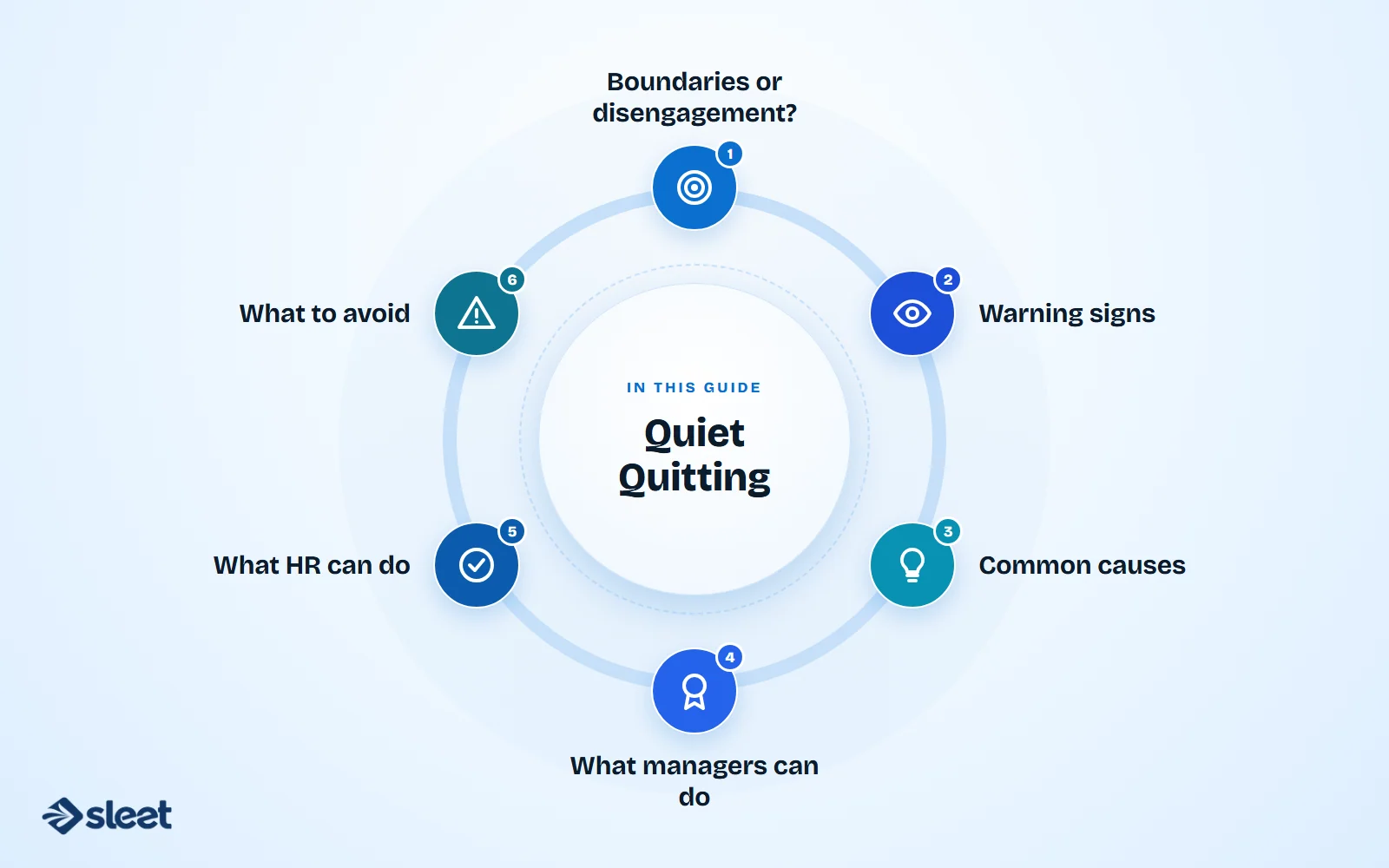
Boundaries or disengagement?
Declining to answer emails at midnight is a reasonable boundary. Withdrawing from collaboration, ideas and interest in the team's success is something different. Managers need to tell the two apart before reacting.

Warning signs
- ✓Staying silent in meetings where they used to contribute.
- ✓Meeting deadlines but with minimal quality.
- ✓Declining new projects or stretch tasks.
- ✓Leaving exactly at closing time, every day, after a change.
- ✓Reduced interaction with colleagues.
- ✓Less enthusiasm for training and growth.
Common causes
- ✓Burnout: Sustained overwork without relief.
- ✓Lack of recognition: Effort that nobody notices.
- ✓Unclear growth: No visible path or promotion for years.
- ✓Poor management: Micromanagement, unfairness or lack of communication.
- ✓Misalignment: Pay or workload that has not kept pace with responsibility.
- ✓Broken trust: Layoffs, unkept promises or favouritism.

What managers can do
- ✓Hold a candid one-on-one and ask what has changed.
- ✓Listen without defending.
- ✓Review workload and priorities.
- ✓Reconnect the work to a purpose, not only a deadline.
- ✓Offer a development opportunity that interests them.
- ✓Recognise contributions specifically.
What HR can do
- ✓Use pulse surveys to detect trends early.
- ✓Train managers to notice and respond.
- ✓Review pay, promotion cycles and workload across teams.
- ✓Offer wellbeing support such as counselling and flexible schedules.
What to avoid
Do not punish people for working within their role, and do not label them. Pushing harder often makes the withdrawal worse.
Disengagement is a message. The question is whether anyone is listening.
Measure engagement regularly, act on what you learn and treat discretionary effort as something that is earned by good management, not demanded.

Written by
HR Manager, Airwix Technologies (Sleet)
Nihit Dobariya is the HR Manager at Airwix Technologies in Ahmedabad, where he runs HR and payroll for the team behind Sleet. He writes about payroll, PF and ESIC, professional tax, the labour codes and everyday HR practice for Indian employers, and checks each rule against the official notification before it is published.
LinkedIn profile →