
Performance Improvement Plan (PIP): How to Write One That Is Fair and Effective
A PIP is a formal plan that states where an employee is falling short, what good looks like and what support they will get. Use it when coaching has failed and the gap is clear, not for misconduct. Include dated problems, measurable 30, 60 and 90 day goals, regular check-ins and the outcome either way.

A performance improvement plan, or PIP, is a formal document that sets out where an employee is falling short, what success looks like and what support will be provided. It should be a genuine chance to improve, not a paper trail for dismissal.
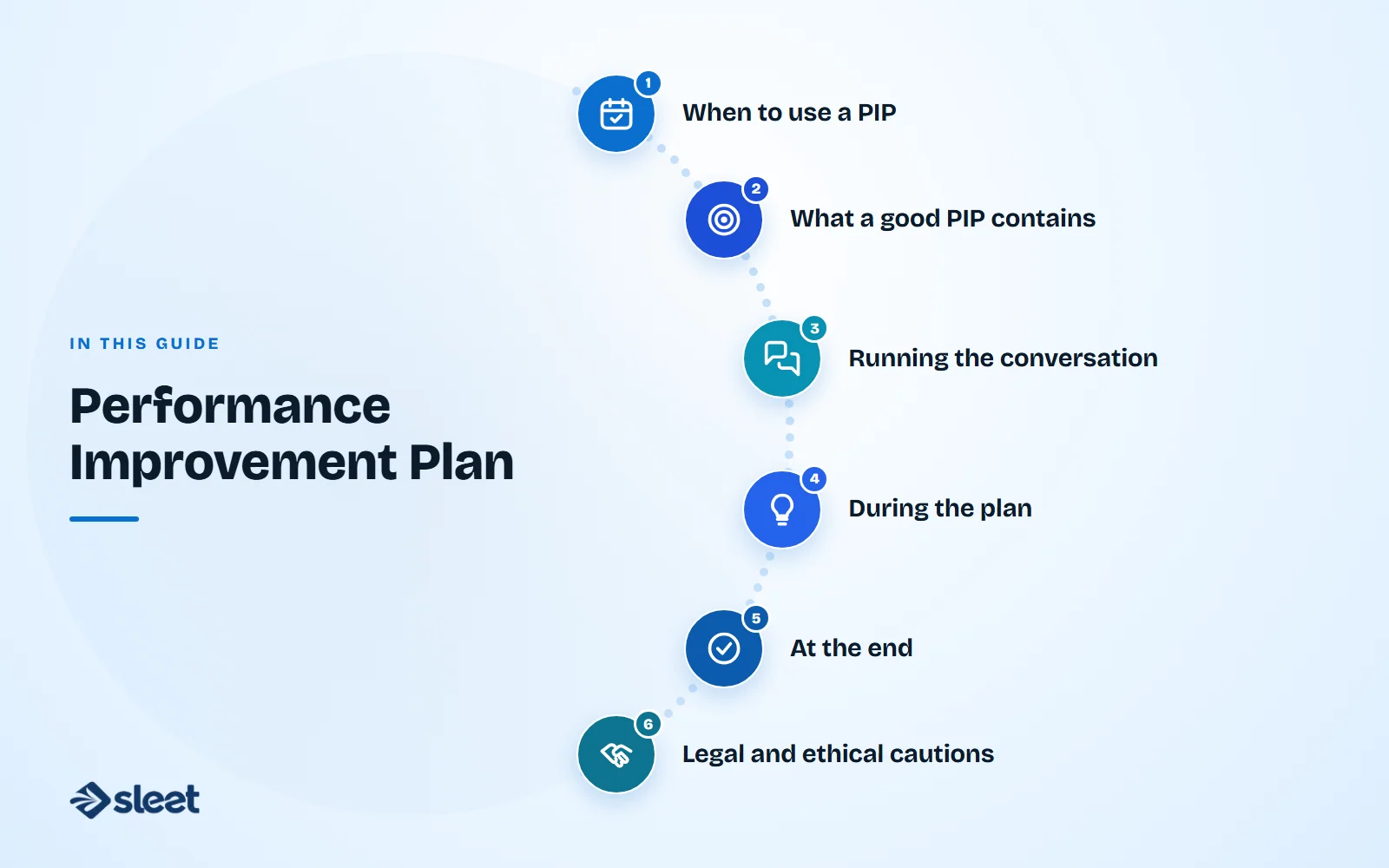
When to use a PIP
Consider one when informal coaching has not worked, the gap is clear and significant, and you believe the employee can improve with focus and support. Do not use it for conduct issues that require disciplinary action, or as a way to push someone out.

What a good PIP contains
- ✓Specific problems: Concrete examples with dates and impact, not general complaints.
- ✓Expected standards: What good performance looks like, in measurable terms.
- ✓Goals and milestones: Clear targets for 30, 60 and 90 days.
- ✓Support: Training, mentoring, tools or time that the company will provide.
- ✓Review schedule: Weekly or fortnightly check-ins to discuss progress.
- ✓Outcomes: What happens if the targets are met and if they are not.
Running the conversation
- ✓Prepare facts and avoid labels such as lazy or careless.
- ✓Explain the purpose honestly and invite the employee's view.
- ✓Agree on the plan together where possible.
- ✓Give the employee a copy and ask them to acknowledge receipt.

During the plan
- ✓Meet regularly and document each conversation.
- ✓Offer feedback in real time, not only at the review meeting.
- ✓Adjust support if the employee raises genuine obstacles.
- ✓Recognise progress, even if partial.
At the end
If targets are met, close the plan formally and confirm the improvement in writing. If not, decide on the next step, which may be an extension, a role change or separation, following your policy and the law.
Legal and ethical cautions
- ✓Treat similar cases in the same way.
- ✓Check for health, personal or workplace issues that may explain the drop.
- ✓Avoid discrimination of any kind.
- ✓Keep records and share them only with those who need them.
A fair PIP leaves both sides knowing exactly where they stand and what happens next.
Involve HR from the start, and make sure the plan can be defended as reasonable if it is ever reviewed by a third party.

Written by
HR Manager, Airwix Technologies (Sleet)
Nihit Dobariya is the HR Manager at Airwix Technologies in Ahmedabad, where he runs HR and payroll for the team behind Sleet. He writes about payroll, PF and ESIC, professional tax, the labour codes and everyday HR practice for Indian employers, and checks each rule against the official notification before it is published.
LinkedIn profile →