
Attendance Regularization: Why Manual Processes Break at Scale
Every attendance system has missed punches, so the test is how painful fixing them is. Email and chat requests leave no audit trail and pile up before payroll cut-off. A self-service flow, where the employee flags the punch in the app, the manager approves with one tap and the correction goes straight into that cycle's payroll, scales and keeps a record.

Every attendance system will have missed punches. A phone dies, a biometric device loses its network, someone forgets to clock out. What makes a system scale is how much effort it takes to fix those exceptions.
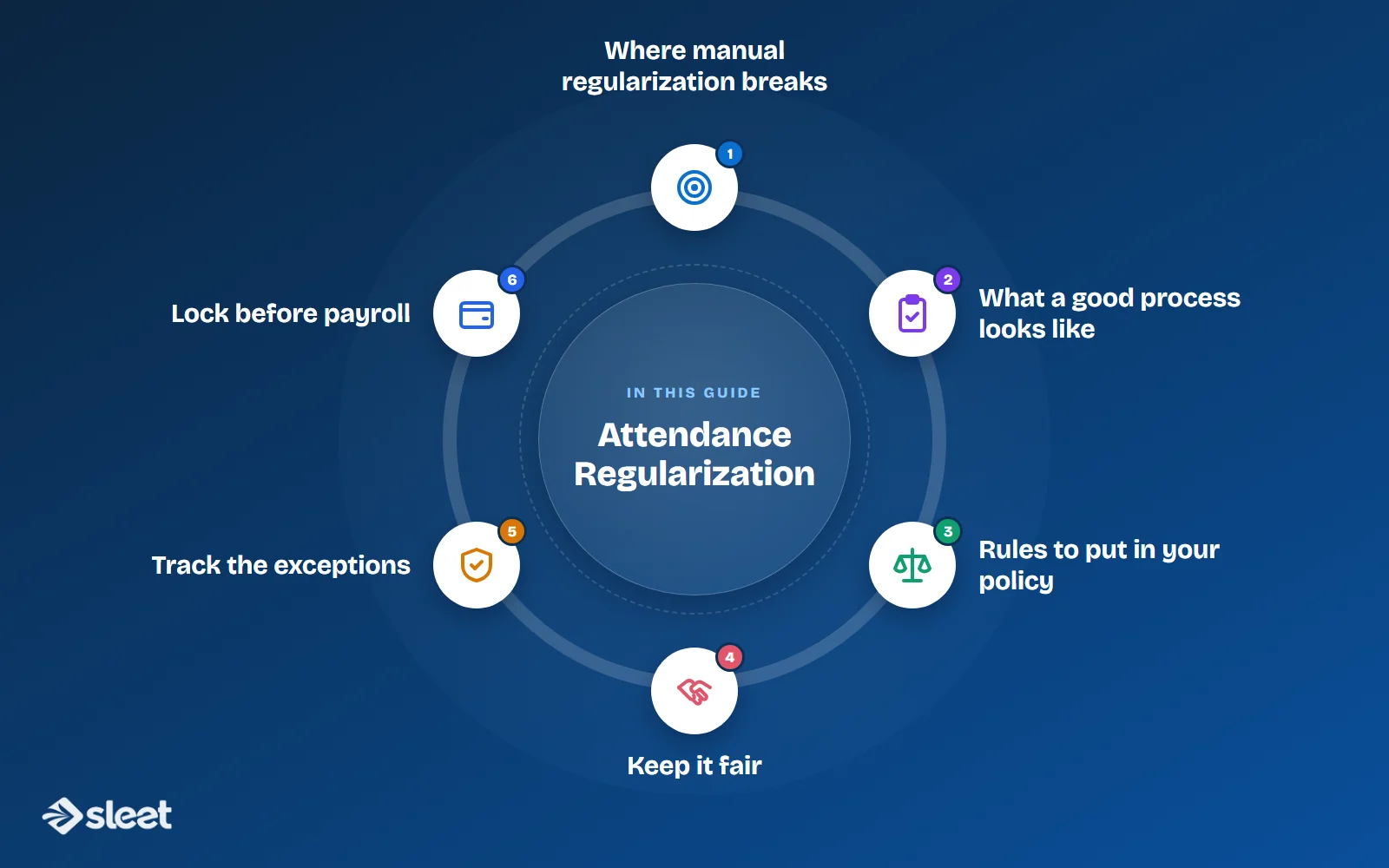
Where manual regularization breaks
- ✓Email requests. An employee emails HR, HR edits a record, and nobody can later see who approved what or why.
- ✓Manager bottleneck. If each correction needs a manager's sign-off routed through chat, approvals pile up just before payroll cut-off, when everyone is busiest.
- ✓Late corrections. Fixes that arrive after payroll has run are either missed or paid in an extra cycle, and both damage trust.
At 20 employees, a message to HR to fix a missed punch is manageable. At 200, it means dozens of untracked requests each cycle.

What a good process looks like
- The employee flags the missed punch in the app, with a reason.
- The manager approves or rejects it with one tap, from the notification.
- The approved correction updates attendance and flows into that cycle's payroll.
- The system keeps a record of the request, the approver and the change.
Rules to put in your policy
| Rule | Example |
|---|---|
| Who can request | Any employee, for their own record |
| Reasons accepted | Missed punch, device failure, on official duty, work from home |
| Time limit | Within three days of the date |
| Monthly limit | A set number of requests per month |
| Approver | Reporting manager, with HR as the backup |
| Cut-off | No changes after attendance is locked for payroll |

Keep it fair
Apply the limits and the cut-off to everyone. If repeated requests come from one person or one team, look at whether a device or a shift pattern is the cause.
Track the exceptions
| Measure | What it tells you |
|---|---|
| Requests per employee per month | Whether someone is gaming it or a device is failing |
| Requests by location or device | Faulty hardware or network problems |
| Average time to approve | Manager responsiveness |
| Corrections after payroll lock | Process discipline |
Lock before payroll
Set a date after which attendance is final for the month. Late changes move to the next cycle, with a clear adjustment line. This one habit removes many payroll disputes.

Written by
Founder, Airwix Technologies (Sleet)
Vatsal Sutariya is the founder of Airwix Technologies in Ahmedabad, the company that builds Sleet: SleetHR for HR and payroll, and Sleet Accounting for GST billing and books. He writes about GST, invoicing, business tax and choosing software for Indian businesses, and checks each rule against the official notification before it is published.
LinkedIn profile →