
Withdrawing a Job Offer After the Candidate Accepted: Contract Risk and How to Limit It
Once a candidate accepts an offer, there is a contract, and withdrawing it without a reason the offer letter allows is a breach. Courts will not force you to employ the person, but they can award damages under Section 73 of the Indian Contract Act for losses such as lost salary and notice pay. Clear written conditions limit that risk.

A role gets frozen, a client contract falls through, or a background check throws up a problem, and HR has to tell a candidate who already accepted that the job is gone. Whether that is a lawful change of plan or a breach of contract depends on timing and on what the offer letter said. This post explains the legal position under the Indian Contract Act, 1872, how to draft offer letters that protect you, and how to communicate a withdrawal.
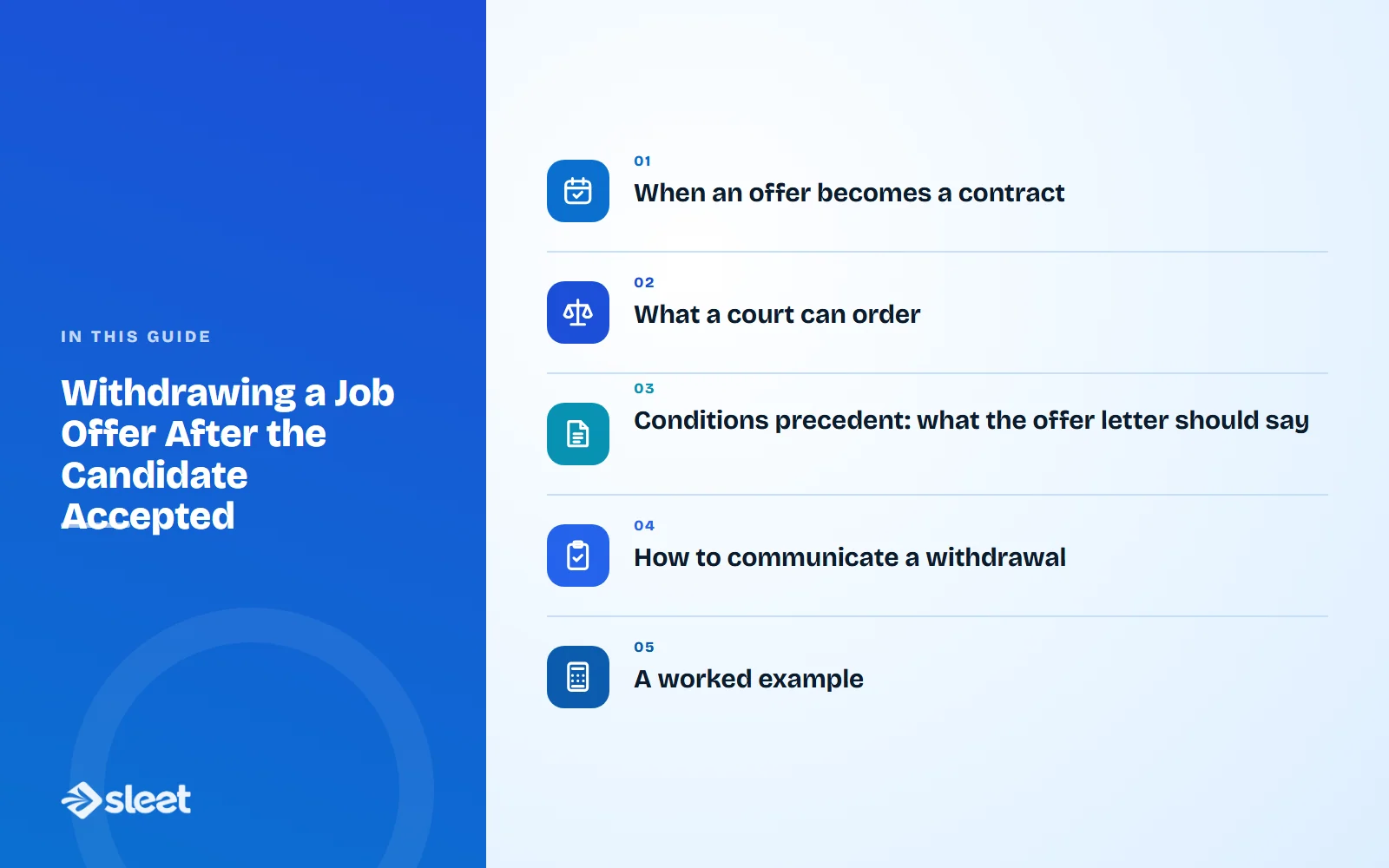
When an offer becomes a contract
- ✓An offer letter is a proposal (Section 2(a)). When the candidate accepts it without changing its terms, it becomes a promise and, with consideration, a contract.
- ✓Under Section 4, acceptance is complete against the employer once the candidate puts it in the course of transmission, for example by sending a signed copy or an acceptance email.
- ✓Under Section 5, a proposal can be revoked only before acceptance is complete, not afterwards.
So the window to change your mind freely closes when the candidate sends the acceptance. After that, withdrawing is not revoking an offer; it is refusing to perform a contract.
| Stage | Can you withdraw? | Risk |
|---|---|---|
| Verbal discussion, no written offer | Yes | Low, unless the candidate acted on firm promises |
| Written offer sent, not yet accepted | Yes, by communicating revocation before acceptance | Low |
| Offer accepted, a condition not met | Yes, if the condition is written and genuinely unmet | Low to moderate |
| Offer accepted, no condition applies | Only by breaching the contract | Damages |
What a court can order
It will not make you hire the person. Section 14 of the Specific Relief Act, 1963 bars specific performance of contracts that depend on personal qualifications or are by nature determinable, which covers employment. In Nandganj Sihori Sugar Co. Ltd. v. Badri Nath Dixit (1991), the Supreme Court said a contract of employment cannot ordinarily be enforced by or against an employer, and that the remedy is to sue for damages.
It can award damages under Section 73. Compensation covers loss that arose naturally from the breach or that both sides knew was likely. In an offer withdrawal, that typically means:
- ✓salary lost from the joining date until the candidate could reasonably find similar work;
- ✓notice-period salary the candidate paid to leave the previous job early;
- ✓relocation costs incurred because you asked the candidate to move.
The candidate must mitigate: the Explanation to Section 73 takes into account the means of remedying the loss, so someone who makes no effort to find work cannot claim open-ended salary. Courts rarely award damages for mental distress in such cases. A civil suit must be filed within three years of the breach.
Conditions precedent: what the offer letter should say
A condition precedent is an event that must happen before the obligation to employ arises. Under Sections 31 and 32, a contingent contract cannot be enforced until the event happens. Write the conditions clearly:
- Satisfactory background verification, naming the checks.
- Proof of qualifications and experience as stated in the application.
- Medical fitness, where the role genuinely requires it.
- Relieving letter or proof of exit from the previous employer.
- Joining by a fixed date, failing which the offer lapses.
- Any regulatory approval the role needs, such as a work permit.
Avoid two traps. A clause allowing withdrawal "at the company's discretion for any reason" may be enforceable, but if you use it in bad faith or give a false reason, it can still be challenged. And a condition you never actually test, or one you invoke only after the real reason was a budget cut, offers little protection.
How to communicate a withdrawal
- Decide the ground first. Is a written condition unmet, or is this a business decision? Do not dress up one as the other.
- Tell the candidate quickly, by phone and then in writing. Every day of delay adds to reliance losses.
- State the reason in neutral, factual terms. For a failed check, say which condition was not met, and give the candidate a chance to explain a discrepancy before deciding.
- Offer a settlement where you are in breach. One or two months' offered salary, plus documented notice-pay or relocation costs, is often cheaper than litigation. Take a written release in return.
- Offer to reconsider for future roles, if that is genuine.
- Delete or retain data properly. Keep only what you need to defend a claim.
A worked example
A Pune fintech offers a candidate a ₹14,40,000 annual CTC (₹1,20,000 a month), with joining on 1 November. The candidate accepts on 10 September, pays ₹60,000 to buy out the last part of her notice period, and spends ₹40,000 relocating from Indore. On 20 October the company freezes the role. The offer letter's only condition is background verification, which she cleared.
Possible exposure:
- ✓She finds a similar job after two months: 2 × ₹1,20,000 = ₹2,40,000
- ✓Notice buyout: ₹60,000
- ✓Relocation: ₹40,000
- ✓Total = ₹2,40,000 + ₹60,000 + ₹40,000 = ₹3,40,000
Settlement option: the company pays one month's salary of ₹1,20,000 plus the documented ₹1,00,000 of costs, a total of ₹2,20,000, against a written release. That is ₹1,20,000 less than the exposure above, and it closes the matter without a suit. A court could award more or less depending on her job search and evidence.
Frequently asked questions
Is a letter of intent the same as an offer letter?
Not always. A letter of intent that says a formal offer will follow may be only an invitation to negotiate, so read its wording before treating it as binding.
Can we withdraw if the candidate lied in the application?
Yes, if the offer was conditional on accurate information, or if the misstatement is material. Record what was false and give the candidate a chance to respond.
Can the candidate go to the labour court?
A person who never joined is generally not a workman with a dispute under labour law. The usual remedy is a civil suit for damages, or arbitration if the offer letter provides for it.
Sources
- ✓The Indian Contract Act, 1872, India Code
- ✓Nandganj Sihori Sugar Co. Ltd. v. Badri Nath Dixit, Supreme Court, 1991, Indian Kanoon
- ✓Job offer revoked after acceptance: what you can claim, S Jain Law
This is a summary, not legal advice. Have an employment lawyer review your offer letter template and any withdrawal before you act.

Written by
HR Manager, Airwix Technologies (Sleet)
Nihit Dobariya is the HR Manager at Airwix Technologies in Ahmedabad, where he runs HR and payroll for the team behind Sleet. He writes about payroll, PF and ESIC, professional tax, the labour codes and everyday HR practice for Indian employers, and checks each rule against the official notification before it is published.
LinkedIn profile →