
Unconscious Bias at Work: Types, Examples and How to Reduce It
Unconscious bias is the automatic assumption we make about people based on gender, age, caste, region, college or accent, and it shapes who gets hired, rated and promoted. Reduce it with structured interviews, blind early screening, mixed panels, calibration across managers and regular checks of pay and promotions by group. Training alone is not enough.

Unconscious bias refers to the automatic assumptions people make about others based on gender, age, caste, region, accent, college, appearance or background. They are not necessarily intentional, but they influence decisions about who gets hired, praised or promoted.
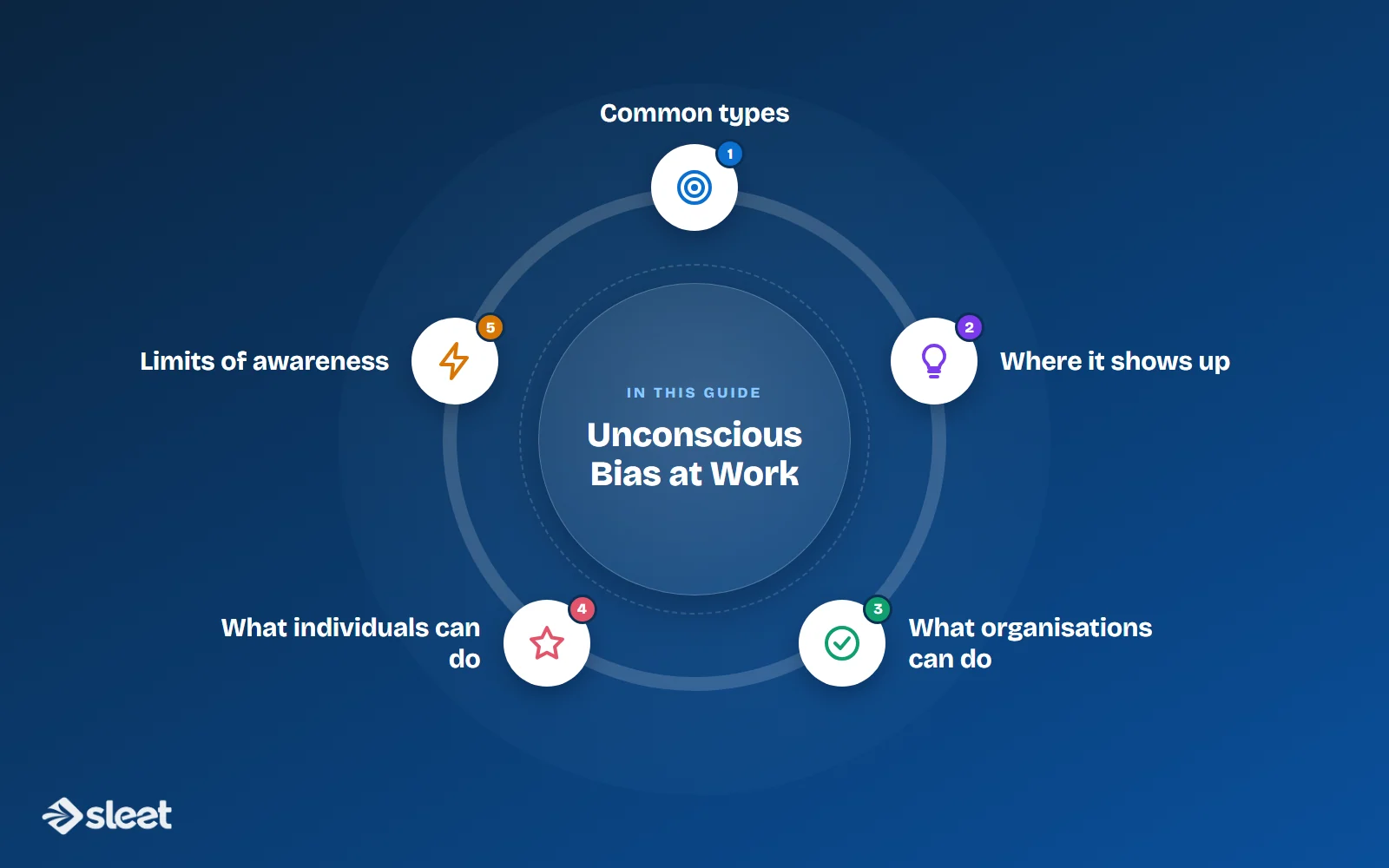
Common types
- ✓Affinity bias: Preferring people similar to ourselves.
- ✓Confirmation bias: Looking for evidence that supports our first impression.
- ✓Halo effect: One positive trait colours our view of everything.
- ✓Horn effect: One negative trait overshadows strengths.
- ✓Recency bias: Giving too much weight to recent events.
- ✓Gender bias: Assuming certain roles suit certain genders.
- ✓Attribution bias: Explaining success and failure differently for different people.
Where it shows up
- ✓Hiring: Shortlisting based on a name, college or previous employer.
- ✓Interviews: Rating confident speakers higher than skilled thinkers.
- ✓Appraisals: Describing the same behaviour as assertive for one person and aggressive for another.
- ✓Assignments: Giving stretch projects to the people we already like.
- ✓Pay and promotion: Negotiation gaps and unequal sponsorship.
What organisations can do
- ✓Standardise: Use structured interviews with the same questions and scoring criteria.
- ✓Blind the process: Remove names, photos and other identifying details from early screening.
- ✓Diversify panels: Include different perspectives in hiring and promotion decisions.
- ✓Calibrate: Compare ratings across managers and look for patterns.
- ✓Use data: Review pay, ratings and promotions by gender and other groups.
- ✓Train: Awareness sessions help, but only when paired with changes in process.
What individuals can do
- ✓Slow down on important decisions.
- ✓Seek evidence that challenges your first impression.
- ✓Ask whether you would judge the same behaviour differently in someone else.
- ✓Invite feedback about your blind spots.
Limits of awareness
Training alone rarely changes behaviour. The strongest results come from redesigning decisions, so that bias has less room to operate.
Fairness is something you design into the process, not something you hope for.
Review your recruiting and appraisal workflows this quarter and fix the one step where individual judgement has the most influence.

Written by
HR Manager, Airwix Technologies (Sleet)
Nihit Dobariya is the HR Manager at Airwix Technologies in Ahmedabad, where he runs HR and payroll for the team behind Sleet. He writes about payroll, PF and ESIC, professional tax, the labour codes and everyday HR practice for Indian employers, and checks each rule against the official notification before it is published.
LinkedIn profile →