
Standing Orders Under the IR Code: The 300-Worker Trigger, Model Orders and Certification Timeline
Certified standing orders are mandatory only for industrial establishments that employ, or employed on any day in the preceding 12 months, 300 or more workers. Until their own orders are certified, the Central Government's Model Standing Orders, 2026 apply by default. Smaller units are not bound, but still need written service rules on the same matters.

Standing orders are the written service rules of an industrial establishment: classification, shifts, leave, misconduct, termination. The Industrial Relations Code, 2020 raised the threshold to 300 workers and added a default set of model orders. This post covers who is covered, the certification steps and deadlines, and what smaller employers should still have on paper.
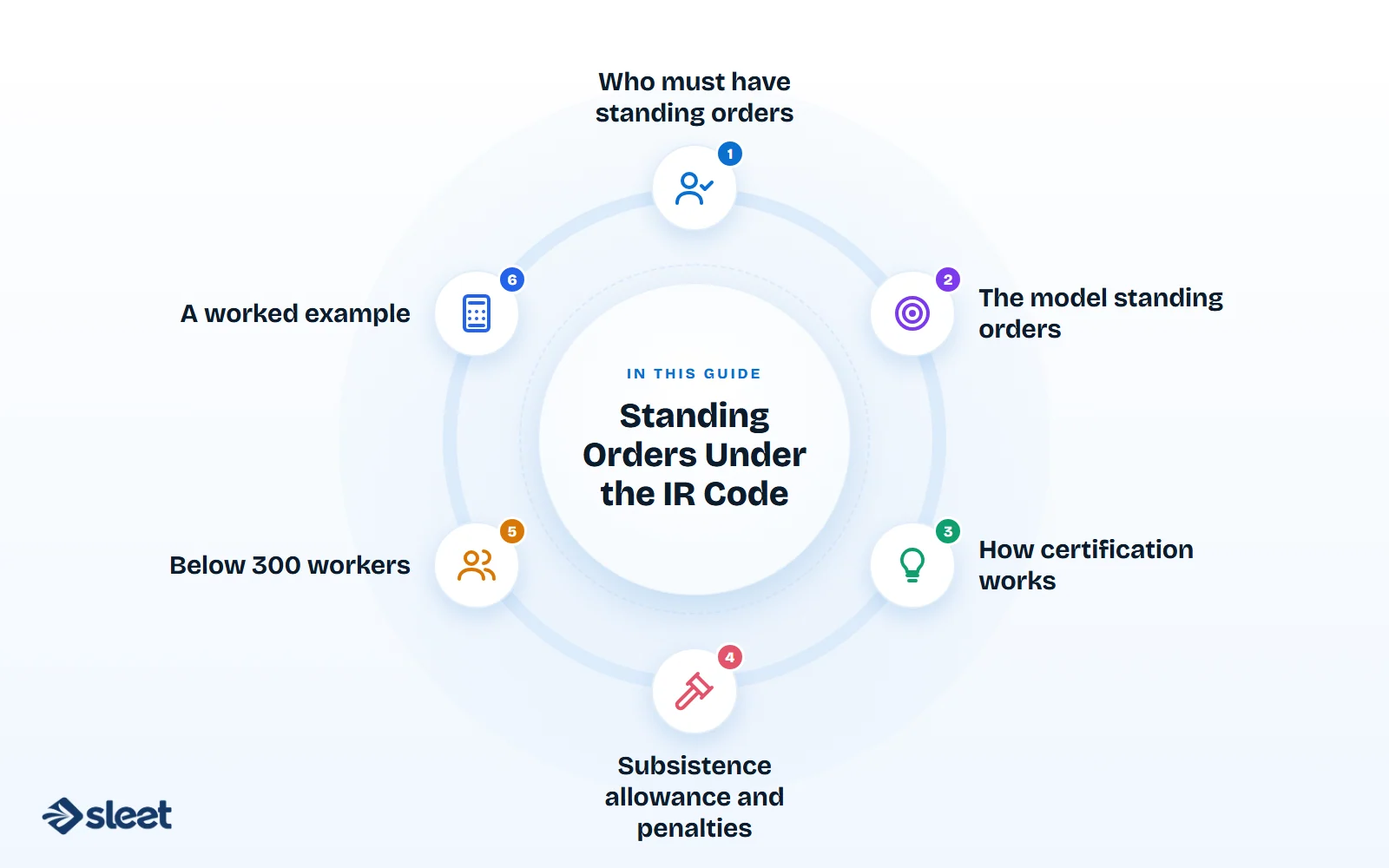
Who must have standing orders
Section 28 applies Chapter IV to every industrial establishment where 300 or more workers are employed, or were employed on any day of the preceding twelve months.
- ✓The count is workers, not all employees. Managers and supervisors outside the "worker" definition are not counted.
- ✓One day at 300 is enough. A seasonal peak triggers the chapter for the next 12 months.
- ✓Establishments whose staff are governed by government service rules (such as the CCS rules or the Railway Establishment Code) are excluded.
- ✓The appropriate government can exempt establishments by notification (section 39).
The model standing orders
The Central Government notified the Model Standing Orders, 2026 (S.O. 2312(E), 8 May 2026) under section 29. There are three schedules: mining, manufacturing and services.
Key points in the manufacturing and mining schedules:
| Matter | Model rule |
|---|---|
| Classes of workers | Permanent, temporary, apprentice, probationer, badli, fixed-term, casual |
| Probation | Six months, extendable by up to three months |
| Notice by employer | One month or pay in lieu for a permanent worker |
| "Habitual" misconduct | Three or more instances in the preceding 12 months |
| Suspension enquiry | Ordinarily to finish within 90 days |
| Shift change notice | 21 days |
| Appeal against punishment | Within 21 days; decided within 15 days |
Under section 29(2), these model orders are deemed adopted in a covered establishment until its own standing orders are certified.
How certification works
| Step | Rule | Time limit |
|---|---|---|
| Prepare draft based on model orders | Section 30(1), (4) | Within 6 months: section 30(1) counts from the Code's commencement and section 30(4) from the chapter applying, so a newly covered unit should confirm its date with the certifying officer |
| Consult trade union or negotiating union | Section 30(2) | Before sending the draft |
| Or adopt model orders as they are | Section 30(3) | Intimate the certifying officer; deemed certified |
| Certifying officer seeks comments, hears both sides | Section 30(5) | Decide within 60 days, or deemed certified |
| Copies of certified orders sent | Section 30(8) | Within 7 days of certification |
| Appeal by either side | Section 32 | Within 60 days of the order |
| Orders come into operation | Section 33(1) | 30 days after copies are sent (7 days after an appeal order) |
| No change by the employer | Section 35(1) | For 6 months after coming into operation, except by agreement |
Standing orders certified before 21 November 2025 under the 1946 Act continue as certified, to the extent they are consistent with the Code (section 30(11)).
The draft must cover every matter in the First Schedule: classification of workers; how hours, holidays, paydays and wage rates are notified; shift working; attendance and late coming; leave; gate entry and search; temporary stoppages; termination and notice; suspension, dismissal and the list of misconduct; and redress against unfair treatment.
Subsistence allowance and penalties
Section 38 requires standing orders to provide subsistence allowance during suspension pending enquiry: 50% of wages for the first 90 days and 75% after that, if the delay is not due to the worker.
| Default | Fine |
|---|---|
| Not submitting draft standing orders, or changing them outside section 35 | ₹50,000 to ₹2 lakh, plus ₹2,000 a day while it continues |
| Acting against certified standing orders | ₹1 lakh to ₹2 lakh |
| Repeat of the above after conviction | ₹2 lakh to ₹4 lakh, or up to 3 months' imprisonment, or both |
Below 300 workers
Chapter IV does not bind you, but you still need written rules, because:
- ✓disciplinary action without a written misconduct list and procedure is hard to defend before a tribunal;
- ✓the Code still requires a grievance redressal committee at 20 workers and a works committee at 100;
- ✓state Shops and Establishments Acts may require written service conditions.
The practical answer is to adopt the relevant model schedule as your HR policy, adjusted for your size, and give each worker a copy in a language they read.
A worked example
A Pune auto-component plant had 260 workers from April to November 2026. For a December export order it hires 55 more on fixed-term contracts, taking it to 315 workers on 10 December 2026.
- Chapter IV applies from 10 December 2026, and for 12 months after the last day at 300 or more, even if headcount falls in March.
- The Model Standing Orders, 2026 (manufacturing schedule) apply by default at once.
- The plant chooses its own draft and must submit it within 6 months of 10 December 2026, so by 10 June 2027.
- A worker earning ₹24,000 a month is suspended for 120 days pending an enquiry, and the delay is not his fault:
- ✓First 90 days: 50% × ₹24,000 × 3 months = ₹36,000
- ✓Next 30 days: 75% × ₹24,000 × 1 month = ₹18,000
- ✓Total subsistence allowance: ₹36,000 + ₹18,000 = ₹54,000
Frequently asked questions
Do we have to file anything if we simply adopt the model standing orders?
Yes. Section 30(3) treats adopted model orders as certified, but you must inform the certifying officer in the prescribed manner.
Do fixed-term and casual workers count towards 300?
They are workers, so count them on any day they are employed. Exclude only staff outside the Code's definition of worker.
What if the certifying officer does not decide in time?
The draft is deemed certified on the expiry of 60 days from receipt.
Can a worker rely on an oral promise that contradicts the standing orders?
No. Section 36 bars oral evidence that adds to or contradicts certified standing orders.
Sources
- ✓Industrial Relations Code, 2020 (Gazette text, sections 28 to 39), Ministry of Labour and Employment
- ✓Model Standing Orders, 2026, S.O. 2312(E), Ministry of Labour and Employment
- ✓Industrial Relations Code, 2020 (sections 28 to 39, First Schedule), PRS India
- ✓Industrial Relations (Central) Rules, 2026: analysis, PRS Legislative Research
- ✓Model Standing Orders, 2026, S.O. 2312(E), TaxHeal
This is a summary, not legal advice. Confirm with the certifying officer of your state labour department, or a labour lawyer, before you submit or adopt standing orders.

Written by
HR Manager, Airwix Technologies (Sleet)
Nihit Dobariya is the HR Manager at Airwix Technologies in Ahmedabad, where he runs HR and payroll for the team behind Sleet. He writes about payroll, PF and ESIC, professional tax, the labour codes and everyday HR practice for Indian employers, and checks each rule against the official notification before it is published.
LinkedIn profile →