
Foreign Nationals on Indian Payroll: PF on Full Salary, SSA Certificates and When They Can Withdraw
A foreign passport holder working for a PF-covered Indian establishment is an international worker. They join EPF from day one and contribute on full salary, with no ₹25,000 ceiling, unless a certificate of coverage under a social security agreement excludes them. Withdrawal is allowed only at 58, on permanent incapacity, or on leaving if an agreement allows.

Hiring a foreign national onto Indian payroll brings a PF rule that surprises most employers: the wage ceiling that limits contributions for Indian staff does not apply. A senior expatriate on ₹3 lakh a month can cost the company ₹36,000 a month in PF alone. This post explains who counts as an international worker, how much is payable, who is exempt, and when the money can come out.
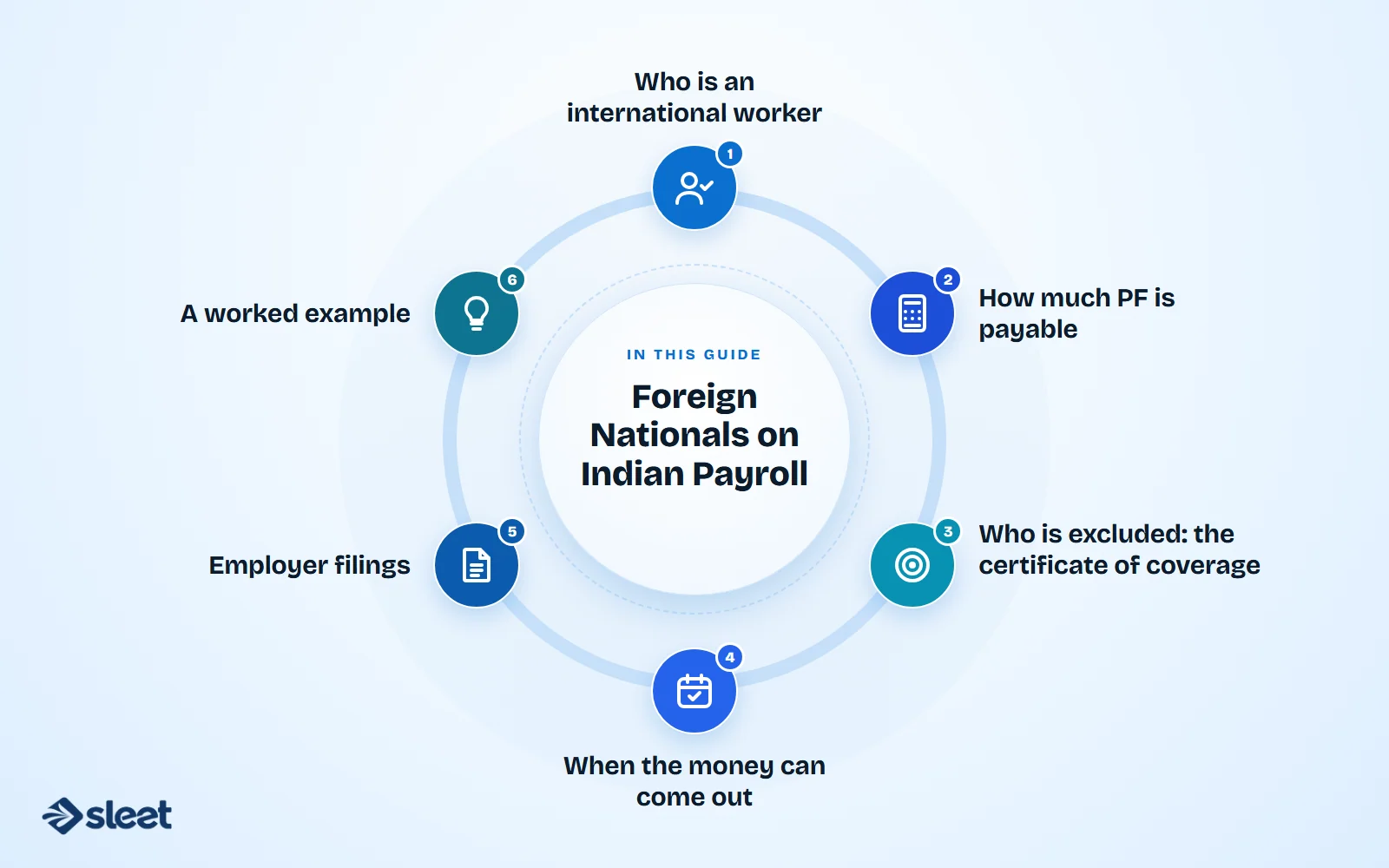
Who is an international worker
The Employees' Provident Funds Scheme, 2026 defines an international worker as:
- ✓an employee holding a passport other than an Indian passport, working for an establishment in India covered by the Code on Social Security; or
- ✓an Indian employee who has worked, or is going to work, in a country with which India has a social security agreement (SSA) and is eligible for that country's benefits.
Nepalese and Bhutanese nationals are treated as Indian workers because of the friendship treaties, so the domestic rules apply to them.
An international worker is entitled and required to become a member from the date of joining. There is no minimum period and no salary threshold.
How much PF is payable
| Point | Indian employee | International worker |
|---|---|---|
| Wage base | PF wages up to ₹25,000 a month (from 17 September 2026) | Full PF wages, no ceiling |
| Employee share | 12% | 12% |
| Employer share | 12% | 12% |
| Pension (EPS) | 8.33% of capped wages | Usually nil if the worker joined after 1 September 2014 on wages above the ceiling, so the full 12% goes to EPF |
| Salary paid in foreign currency | Not applicable | Converted at SBI's telegraphic transfer buying rate on the last working day of the wage month |
PF wages are still basic, DA and retaining allowance, plus any excess added back under the 50% rule. Contributions on full salary for international workers have been the rule since 2008.
A drafting question in 2026. Some provisions of the new Scheme read as if the ordinary wage ceiling could also apply to international workers. Reports in July 2026 said EPFO had no proposal to change the international-worker contribution framework and called these drafting inconsistencies. Until a correction is notified, keep calculating on full salary.
The court split. The Karnataka High Court in 2024 (Stone Hill Education Foundation) struck down the international-worker provisions as discriminatory. In November 2025 the Delhi High Court (the SpiceJet and LG Electronics petitions) upheld them. The question awaits a final answer, so most employers outside Karnataka continue to contribute.
Who is excluded: the certificate of coverage
An international worker is an excluded employee if they contribute to their home country's social security programme and enjoy detached-worker status under an SSA with India, for the period and terms in that agreement. The proof is a certificate of coverage issued by the home country's social security agency. Keep a copy on file for each such employee and diarise its expiry.
EPFO lists 20 operational social security agreements, with 19 countries and the Canadian province of Quebec:
| Europe | Elsewhere |
|---|---|
| Belgium, Germany, Switzerland, Luxembourg, France, Denmark, Netherlands, Hungary, Finland, Sweden, Czech Republic, Norway, Austria, Portugal | South Korea, Canada, Quebec, Japan, Australia, Brazil |
The EPF Scheme, 2026 also lists the United Kingdom for detachment, under which a worker who opts for detachment benefits pays Indian PF on total wages along with the employer. Each agreement has its own detachment period and scope (some, such as the German agreement, are limited in scope), so read the country page on the EPFO site before you rely on it. There is no SSA with the United States or the UAE.
When the money can come out
An international worker may withdraw the full balance:
- on retirement after reaching 58;
- on retirement due to permanent and total incapacity, certified by a medical officer, with tuberculosis, leprosy and cancer treated as permanent incapacity;
- on ceasing employment in India, if covered by an SSA that allows it.
A worker from a non-SSA country who leaves India at 35 cannot take the money out until 58. Payment under an SSA goes to the payee's bank account as the agreement allows. In other cases it is paid into a bank account in India. Tell candidates this at the offer stage.
Employer filings
- ✓A consolidated return of international workers within 15 days of first employing one, showing nationality and wages, or a nil return.
- ✓A monthly return of international workers joining, transferring in and leaving, alongside the ECR.
- ✓KYC with passport details for the UAN.
A worked example
A Sriperumbudur electronics plant near Chennai hires two engineers.
Engineer 1, a US citizen, PF wages ₹2,50,000 a month. The US has no SSA with India, so there is no exclusion.
- Employee PF: 12% x ₹2,50,000 = ₹30,000 a month.
- Employer PF: 12% x ₹2,50,000 = ₹30,000 a month, all to EPF because he is not an EPS member.
- A year's contributions: (₹30,000 + ₹30,000) x 12 = ₹7,20,000, plus EDLI and administration charges.
- If he leaves after three years, the balance stays until he turns 58.
Engineer 2, a Japanese national seconded by her Japanese employer for two years with a certificate of coverage. She is an excluded employee for the certificate's period. No PF is deducted. The plant files her in the international-worker return and keeps the certificate on file.
Frequently asked questions
Does the joint option to contribute on lower wages apply to expats?
No. The full-salary rule applies unless the worker is excluded under an SSA.
What if the certificate of coverage expires while the worker is still in India?
From that date the worker becomes a member and PF starts on full salary, unless the home agency extends the certificate.
Can a foreign employee opt out of PF by signing a declaration?
No. Only an excluded employee under a social security agreement, with a valid certificate of coverage, stays out. A declaration or a clause in the contract does not.
Sources
- ✓International workers and social security agreements, EPFO
- ✓Employees' Provident Funds Scheme, 2026, full text via TaxGuru
- ✓EPF Scheme, 2026 and international workers, Lakshmikumaran & Sridharan
- ✓Provident fund for international workers in India, India Briefing
This is a summary, not legal advice. Confirm SSA terms on the EPFO international workers pages and with a cross-border payroll adviser.

Written by
HR Manager, Airwix Technologies (Sleet)
Nihit Dobariya is the HR Manager at Airwix Technologies in Ahmedabad, where he runs HR and payroll for the team behind Sleet. He writes about payroll, PF and ESIC, professional tax, the labour codes and everyday HR practice for Indian employers, and checks each rule against the official notification before it is published.
LinkedIn profile →