
Shift Allowance: Meaning, Calculation, and Tax Treatment
Shift allowance pays for night or rotational shifts and is set by company policy, not by one statutory formula. It is usually a flat amount per shift, a percentage of basic or a night premium (often for 10 pm to 6 am). It is fully taxable salary, so show it as its own line on the payslip.

Shift allowance compensates employees who work outside normal daytime hours, usually at night or on rotating shifts. It is common in manufacturing, call centres, hospitals and logistics. How it is calculated is a matter of company policy, as there is no single statutory formula.
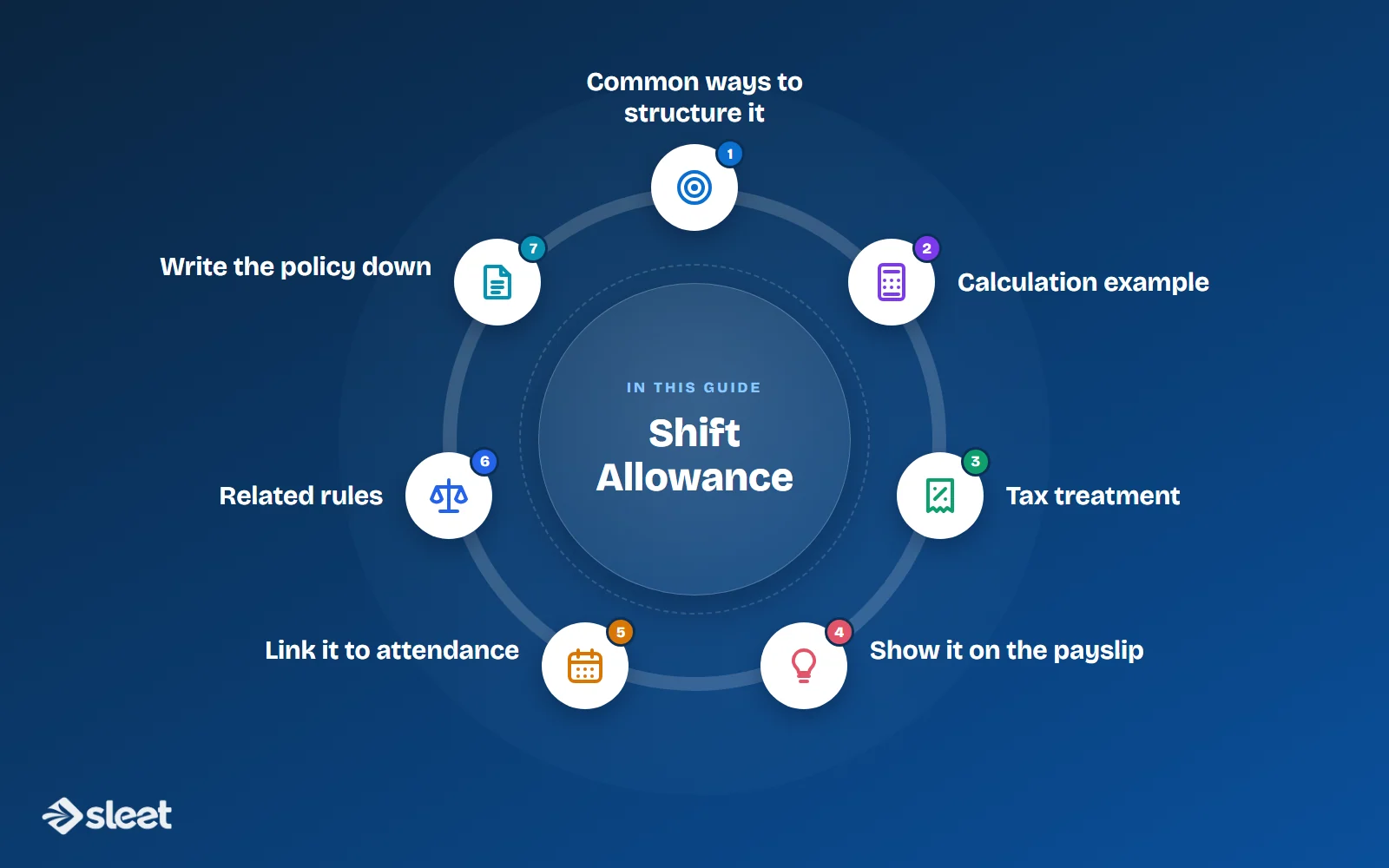
Common ways to structure it
| Structure | How it works | Example |
|---|---|---|
| Flat amount per shift | A fixed sum for each qualifying shift | ₹250 for each night shift worked |
| Percentage of basic | A percentage of basic pay for shift days | 10 percent of basic for the days on night shift |
| Night premium | A higher rate for hours within defined night hours, often 10 pm to 6 am | Extra hourly rate for the night window |
| Monthly fixed amount | A single amount for those on a rotating roster | ₹3,000 a month |
Some states and sectors have rules about night work and the extra pay or facilities that go with it, so check them for where you operate.

Calculation example
An employee is paid ₹250 for each night shift and works 14 night shifts in a month. The shift allowance is 14 × ₹250 = ₹3,500.
Tax treatment
Shift allowance is generally taxable salary. There is no special exemption for it, unlike HRA or LTA.

Show it on the payslip
Show shift allowance as its own line, and do not merge it into a vague special allowance. When an employee asks about their tax in March, they can see what was paid and why it was taxed.
Link it to attendance
The calculation depends on knowing which shifts someone actually worked. A system that captures shift and attendance, from biometric or mobile punches, gets this right. A manual roster, rebuilt from memory at month end, does not.
Related rules
- ✓Overtime. Shift allowance and overtime are different things. A person can earn both.
- ✓Women on night shifts. The law allows this in many settings, with consent and safety measures such as transport and security. Check the rules that apply to your state.
- ✓Rest and hours. Keep to the limits on hours and rest between shifts.
Write the policy down
State who qualifies, which hours count, how the amount is worked out, and whether it is paid during leave. Apply it the same way to everyone on the same roster.

Written by
HR Manager, Airwix Technologies (Sleet)
Nihit Dobariya is the HR Manager at Airwix Technologies in Ahmedabad, where he runs HR and payroll for the team behind Sleet. He writes about payroll, PF and ESIC, professional tax, the labour codes and everyday HR practice for Indian employers, and checks each rule against the official notification before it is published.
LinkedIn profile →