
Gratuity Calculation & Statutory Math Explained
Gratuity equals last drawn monthly basic plus DA, times 15, divided by 26, times completed years of service. It is payable after five years of continuous service on retirement, resignation, death or disablement. With a ₹30,000 basic and 8 years, that is ₹30,000 × 15 ÷ 26 × 8, or about ₹1,38,462.

Gratuity is a lump sum an employer pays when someone has served long enough. For employees covered by the Payment of Gratuity Act, 1972, it is calculated as last drawn monthly basic plus dearness allowance, times 15, times the completed years of service, divided by 26. To work out your gratuity amount, use the free calculator.
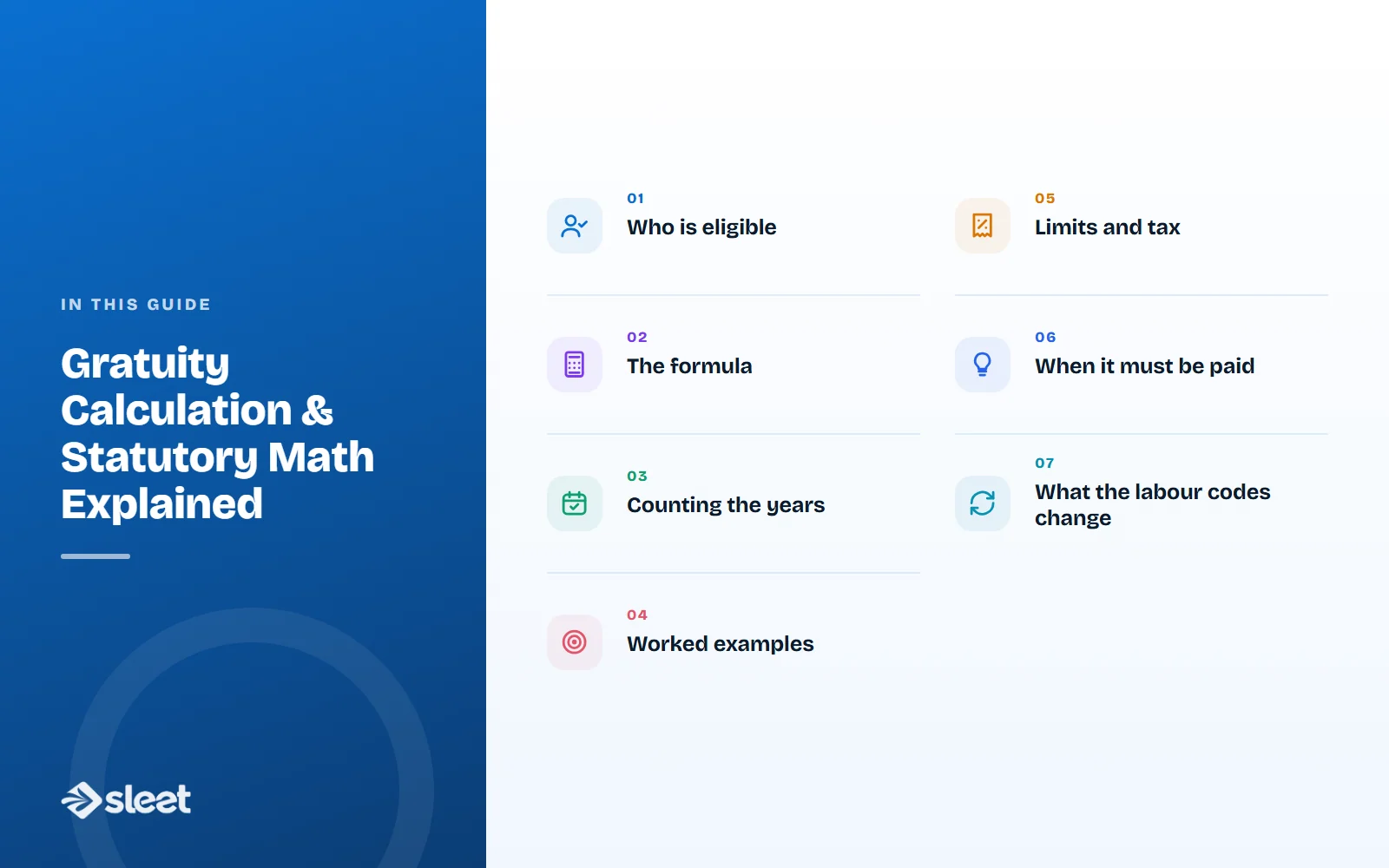
Who is eligible
- ✓The employee has completed five years of continuous service with the employer.
- ✓Payment is due on retirement, resignation, death or disablement. The five-year condition is waived on death or disablement.
- ✓Under the Code on Social Security, effective 21 November 2025, fixed-term employees become eligible after one year, on a pro rata basis.

The formula
Gratuity = last drawn (basic + DA) × 15 × completed years of service ÷ 26
The 26 stands for the working days in a month. The 15 means fifteen days of wages for each year of service.
Counting the years
A part year of more than six months is rounded up to a full year. Seven years and seven months counts as eight years. Seven years and four months counts as seven.

Worked examples
| Basic + DA per month | Service counted | Gratuity |
|---|---|---|
| ₹25,000 | 5 years | ₹72,115 |
| ₹40,000 | 8 years (7 years 7 months, rounded up) | ₹1,84,615 |
| ₹60,000 | 12 years | ₹4,15,385 |
| ₹1,00,000 | 20 years | ₹11,53,846 |
Check the second row: ₹40,000 × 15 × 8 = ₹48,00,000, and ₹48,00,000 ÷ 26 is about ₹1,84,615.
Limits and tax
The maximum gratuity payable under the Act is ₹20 lakh. For private-sector employees, gratuity is tax-exempt up to ₹20 lakh across a lifetime, and anything above that is taxed as salary. Government employees are exempt in full.
When it must be paid
The employer should pay within 30 days of the gratuity becoming payable. Late payment can attract simple interest, so include it in your full and final settlement process and not as an afterthought.
What the labour codes change
Gratuity is based on wages, and the new definition requires at least half of total pay to count as wages. If your basic has been kept low, your gratuity liability will rise. Ask your payroll team to model it before you close your books.
Employees not covered by the Act follow a different formula, so confirm with your advisor if that applies to you.

Written by
HR Manager, Airwix Technologies (Sleet)
Nihit Dobariya is the HR Manager at Airwix Technologies in Ahmedabad, where he runs HR and payroll for the team behind Sleet. He writes about payroll, PF and ESIC, professional tax, the labour codes and everyday HR practice for Indian employers, and checks each rule against the official notification before it is published.
LinkedIn profile →