
Payroll Journal Entries: How to Account for Salaries, PF, TDS and Reimbursements
Record payroll by debiting salary expense for gross pay and employer contributions, and crediting salary payable plus PF, ESI, TDS and professional tax payable. Paying salaries debits salary payable and credits bank; depositing dues debits each liability and credits bank. In the worked example, ₹10,00,000 gross leaves ₹8,92,000 net.

Payroll is both an HR process and an accounting process. Once the salary is calculated, the finance team needs to record the cost and the liabilities correctly. This guide shows a basic structure; your chart of accounts and auditor's preferences may vary.
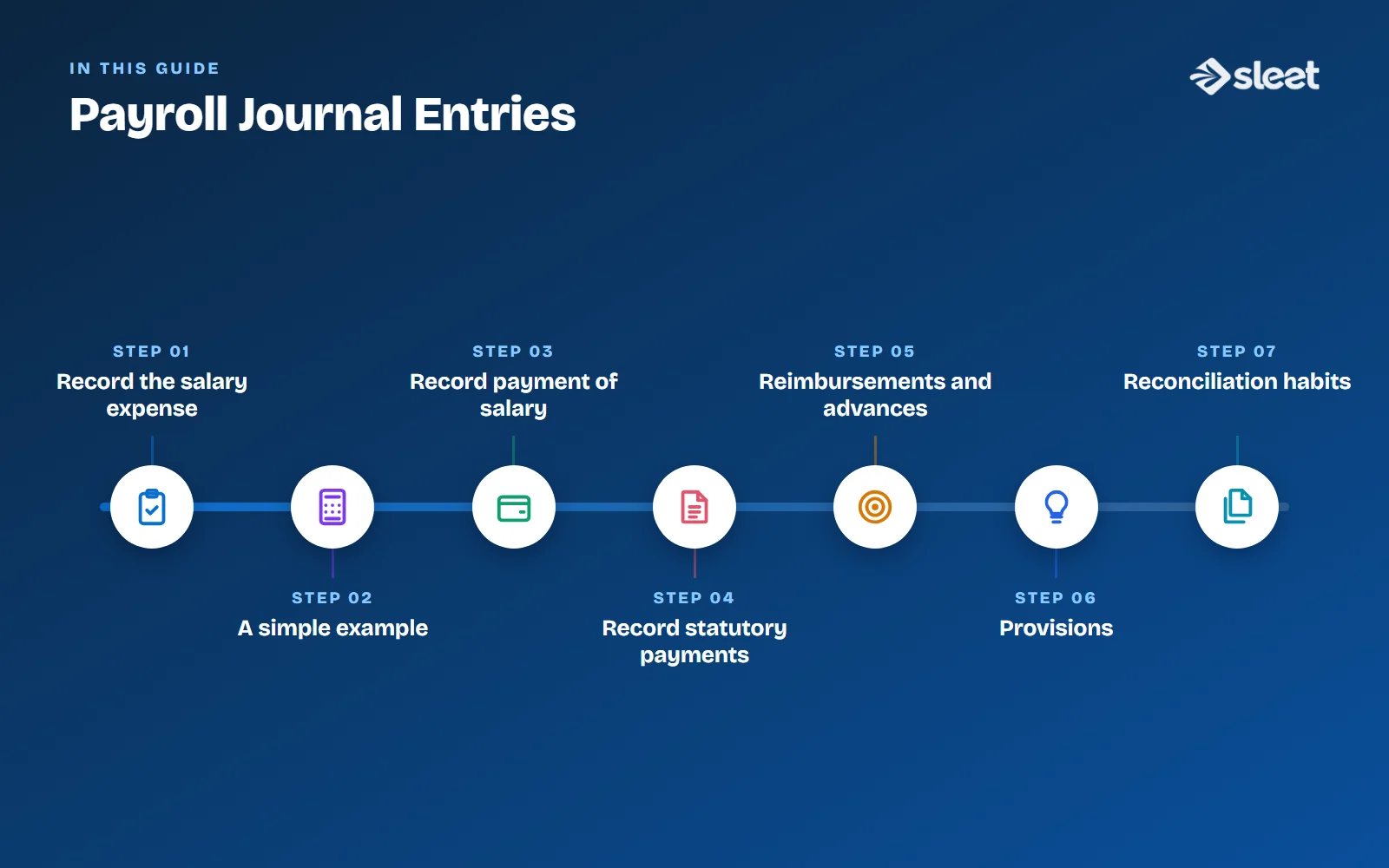
Step 1: Record the salary expense
At month-end, debit the expense accounts and credit the liabilities.
- ✓Debit Salary and wages expense for gross earnings.
- ✓Debit Employer PF, ESI and other contributions as expense.
- ✓Credit Salary payable for net pay.
- ✓Credit PF payable for employee and employer share.
- ✓Credit ESI payable, TDS payable and professional tax payable as applicable.

A simple example
Gross salary of ₹10,00,000, employee PF ₹40,000, employee ESI ₹3,000, TDS ₹60,000, professional tax ₹5,000, employer PF ₹40,000 (employer ESI ignored to keep the example short). Net pay is ₹8,92,000.
The entry debits salary expense ₹10,00,000 and employer contribution expense ₹40,000. It credits salary payable ₹8,92,000, PF payable ₹80,000, ESI payable ₹3,000, TDS payable ₹60,000 and professional tax payable ₹5,000.
Step 2: Record payment of salary
When the bank transfer is made, debit salary payable and credit bank.

Step 3: Record statutory payments
When PF, TDS, ESI and professional tax are deposited, debit each liability account and credit bank. Compare these with the payroll register to be sure nothing is left outstanding.
Reimbursements and advances
- ✓Reimbursements paid against bills are an expense or an adjustment to a prepaid account, not salary.
- ✓Salary advances are a receivable from the employee, cleared through deductions.
- ✓Loans given to employees need interest and perquisite checks.
Provisions
Accrue expenses such as bonus, leave encashment and gratuity based on actuarial or policy-based calculations, as per accounting standards, so the year-end numbers are not a surprise.
Reconciliation habits
- ✓Match the payroll register to the general ledger every month.
- ✓Clear liability accounts to zero after deposits, apart from legitimate timing differences.
- ✓Investigate every unexplained balance.
If payroll and accounts do not tie out, one of them is wrong.
Integrating payroll with your accounting software to post journals automatically saves time and avoids transcription mistakes.

Written by
HR Manager, Airwix Technologies (Sleet)
Nihit Dobariya is the HR Manager at Airwix Technologies in Ahmedabad, where he runs HR and payroll for the team behind Sleet. He writes about payroll, PF and ESIC, professional tax, the labour codes and everyday HR practice for Indian employers, and checks each rule against the official notification before it is published.
LinkedIn profile →