
One-on-One Meetings: A Checklist and 30 Questions for Managers
A good one-on-one is a regular 30 to 45 minute private meeting, weekly or fortnightly, where the employee sets most of the agenda. Cover how they are doing, blockers, goals, feedback both ways and growth, then agree next steps. Avoid doing all the talking or cancelling casually, and use the 10 sample questions listed.

A one-on-one is a recurring private conversation between a manager and a direct report. It is the best place to build trust, catch problems early and support growth. Treated as a status update, it wastes time. Treated as the employee's meeting, it becomes the most useful hour of the week.
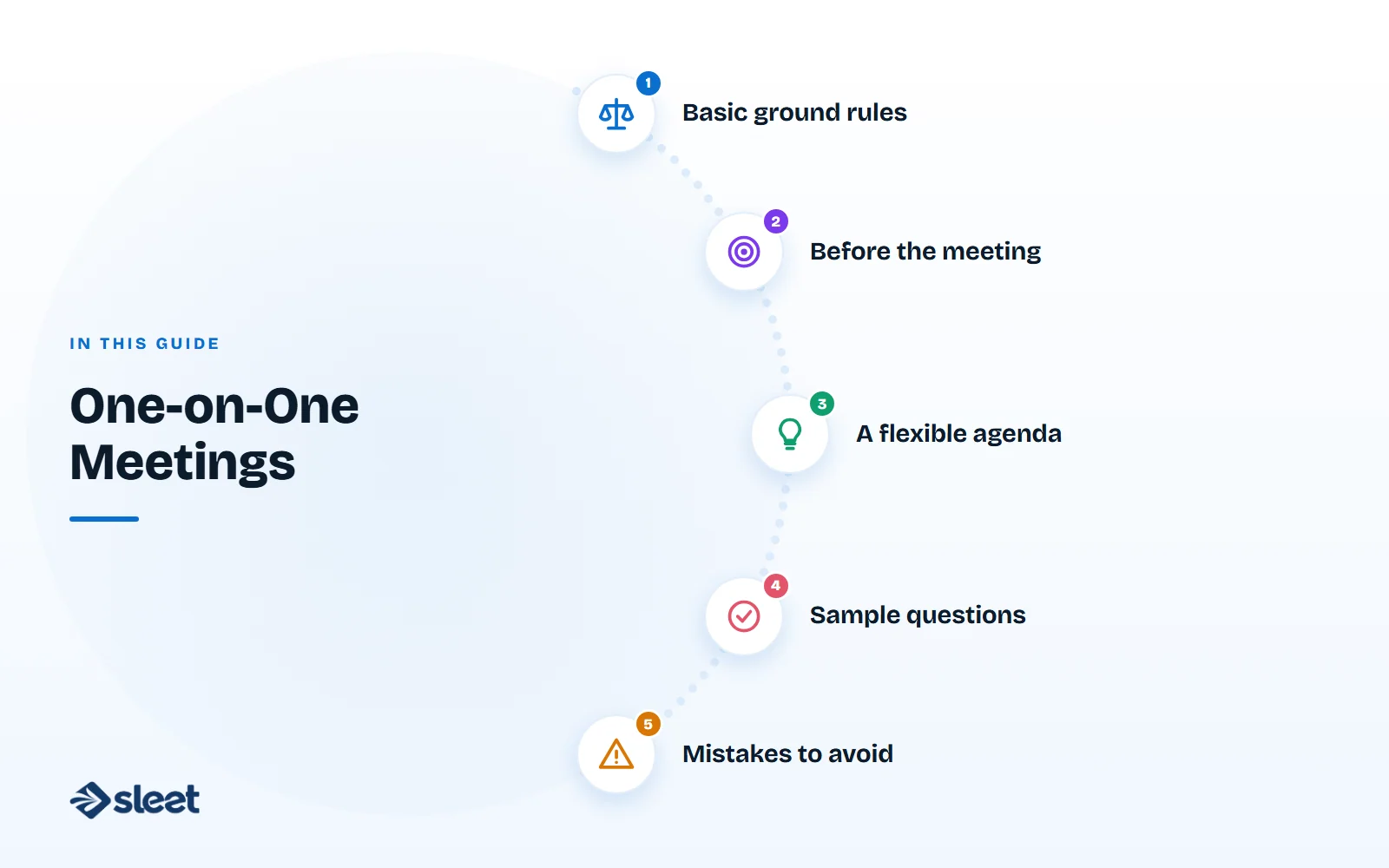
Basic ground rules
- ✓Hold it regularly, weekly or fortnightly, at a fixed time.
- ✓Keep it to 30 to 45 minutes.
- ✓Let the employee set most of the agenda.
- ✓Never cancel casually, because it signals that the person is a low priority.
- ✓Take short notes and share action items.

Before the meeting
- ✓Review notes from the last session.
- ✓Think of one piece of recognition and one piece of feedback to share.
- ✓Ask the employee to add topics to a shared document.
A flexible agenda
- ✓Warm-up and check-in on how they are doing.
- ✓Their topics and blockers.
- ✓Progress on goals and priorities.
- ✓Feedback in both directions.
- ✓Career and development.
- ✓Agreed next steps.

Sample questions
- ✓What is going well this week, and what is not?
- ✓Is there anything blocking you that I can remove?
- ✓What part of your work gives you the most energy?
- ✓Do you have enough clarity on your priorities?
- ✓How is your workload right now, on a scale of one to ten?
- ✓What is one thing I could do differently as your manager?
- ✓Which skill would you like to build next?
- ✓What do you want to be doing in two years?
- ✓How is the team working together?
- ✓Is there anything you have been hesitant to bring up?
Mistakes to avoid
- ✓Doing all the talking.
- ✓Using the time only to review tasks you could discuss over chat.
- ✓Ignoring personal circumstances that affect work.
- ✓Forgetting to follow up on commitments.
The best one-on-one leaves the employee feeling heard and clear on what happens next.
Keep a running record in an HR tool so that appraisal conversations are based on a year of notes, not on memory.

Written by
HR Manager, Airwix Technologies (Sleet)
Nihit Dobariya is the HR Manager at Airwix Technologies in Ahmedabad, where he runs HR and payroll for the team behind Sleet. He writes about payroll, PF and ESIC, professional tax, the labour codes and everyday HR practice for Indian employers, and checks each rule against the official notification before it is published.
LinkedIn profile →