
360-Degree Feedback: How to Run It Without Turning It Into Gossip
A 360-degree review collects feedback on one person from their manager, peers, direct reports and themselves. It works best as a development tool for leaders, not as a basis for pay. Use six to ten raters, keep individual answers anonymous, report in groups of three or more, and follow up after three to six months.

A 360-degree review collects feedback about a person from several directions: their manager, peers, direct reports and sometimes customers, as well as their own self-assessment. Done well, it reveals blind spots that a single manager cannot see.
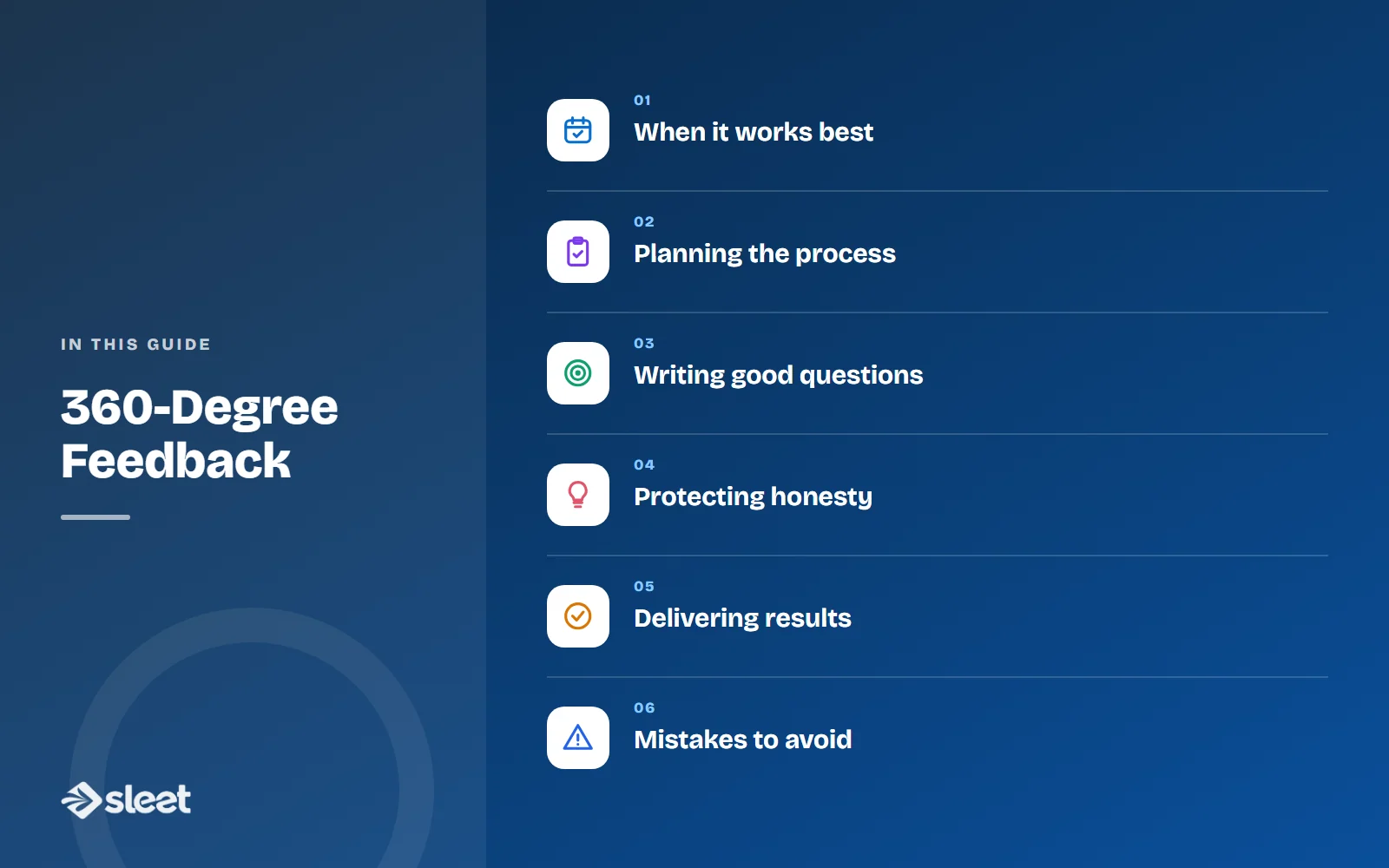
When it works best
360 feedback is strongest as a development tool for managers and leaders. It is weaker as a basis for pay decisions, because raters may soften or sharpen their comments when they know it affects money.
Planning the process
- ✓Purpose: Say clearly whether results are for development or for evaluation.
- ✓Participants: Pick people who work closely with the subject, usually six to ten raters.
- ✓Competencies: Choose four to six behaviours, for example communication, ownership, collaboration and decision making.
- ✓Timeline: Give raters a week or two to respond.
Writing good questions
Use a mix of rating questions and open comments. Ask about observable behaviour, not personality.
- ✓How often does this person share information the team needs?
- ✓What should this person keep doing?
- ✓What is one thing that would make them more effective?

Protecting honesty
Keep individual rater responses anonymous, except for the manager's. Report results in groups of at least three people per category, so nobody can be identified. Explain how the data will be used before you ask for it.
Delivering results
- ✓Give a short report that highlights themes, not raw comments only.
- ✓Hold a private session with a trained coach or manager.
- ✓Help the person choose two or three actions for the next quarter.
- ✓Follow up after three to six months.
Mistakes to avoid
- ✓Using it as a punishment.
- ✓Collecting feedback and doing nothing with it.
- ✓Too many questions, which leads to rushed answers.
- ✓Letting rating inflation hide real issues.
The purpose of 360 feedback is a better conversation, not a bigger spreadsheet.
Digital tools simplify rater selection, anonymity and reporting, and let you compare results over time to see whether development efforts are working.

Written by
HR Manager, Airwix Technologies (Sleet)
Nihit Dobariya is the HR Manager at Airwix Technologies in Ahmedabad, where he runs HR and payroll for the team behind Sleet. He writes about payroll, PF and ESIC, professional tax, the labour codes and everyday HR practice for Indian employers, and checks each rule against the official notification before it is published.
LinkedIn profile →