
OKRs vs SMART Goals: Which Framework Should Your Team Use?
OKRs pair an ambitious objective with three to five measurable key results, usually reviewed quarterly and visible across the company, where hitting 70 percent can count as success. SMART goals are single, achievable targets, usually personal and tied to appraisals. Use OKRs for alignment and SMART goals for role-based targets, or both.

Both OKRs and SMART goals aim to make goals clear and trackable. They differ in what they emphasise. Understanding the difference helps you choose the right approach for each part of your organisation.
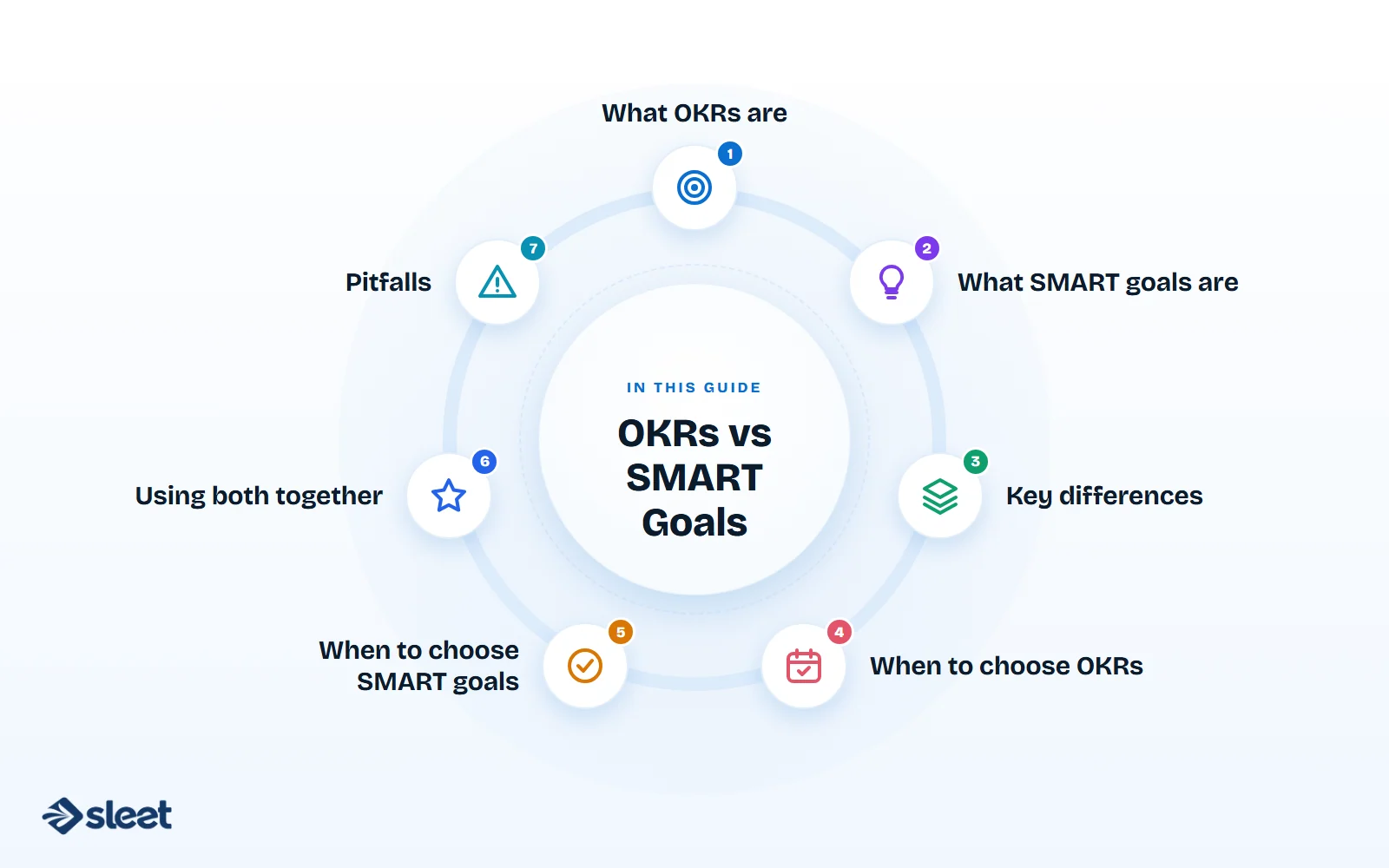
What OKRs are
OKR stands for objectives and key results. An objective is an inspiring qualitative aim, such as become the most trusted payroll partner for small firms. Key results are three to five measurable outcomes that show whether you got there, such as reach a 95 percent on-time filing rate or reduce support response time to two hours.

What SMART goals are
A SMART goal is a single goal that is specific, measurable, achievable, relevant and time-bound. It is well suited to individual performance targets and development plans.
Key differences
- ✓Ambition: OKRs encourage stretch targets where achieving 70 percent can be a success. SMART goals are meant to be achievable.
- ✓Cadence: OKRs are usually quarterly and reviewed often. SMART goals commonly run for a year with periodic check-ins.
- ✓Alignment: OKRs cascade and are visible across the company. SMART goals are typically personal.
- ✓Link to pay: OKRs are often kept separate from compensation to encourage ambition, while SMART goals commonly feed into appraisals.

When to choose OKRs
Use OKRs when you want alignment across teams, a focus on a few priorities and a culture of transparency. They suit growing companies, product teams and strategic programmes.
When to choose SMART goals
Use SMART goals for role-based targets, individual development and teams with stable, well-understood work.
Using both together
Many companies set company and team OKRs and then let each employee write one or two SMART goals that support them. The OKR sets the direction, and the SMART goal sets the personal commitment.
Pitfalls
- ✓Writing OKRs that are just a to-do list.
- ✓Setting too many objectives.
- ✓Skipping check-ins and reviewing only at the end of the quarter.
- ✓Linking OKR scores directly to bonuses, which encourages safe targets.
Frameworks do not create focus; choosing fewer things does.
Pick one approach, train managers in it and review after two cycles whether it improved clarity and results.

Written by
HR Manager, Airwix Technologies (Sleet)
Nihit Dobariya is the HR Manager at Airwix Technologies in Ahmedabad, where he runs HR and payroll for the team behind Sleet. He writes about payroll, PF and ESIC, professional tax, the labour codes and everyday HR practice for Indian employers, and checks each rule against the official notification before it is published.
LinkedIn profile →