
Management by Objectives: Does the Classic Framework Still Hold Up?
Management by objectives has managers and employees agree specific objectives together and measure performance against them. The collaborative goal-setting still works, but annual cycles are too slow and the method does not separate stretch goals from committed ones. Run it quarterly and label each goal as committed or stretch.
Management by objectives, or MBO, was popularised by Peter Drucker. A manager and an employee agree a small number of specific objectives for a period, and performance is judged against them. Much of what OKR frameworks do today comes from this idea.
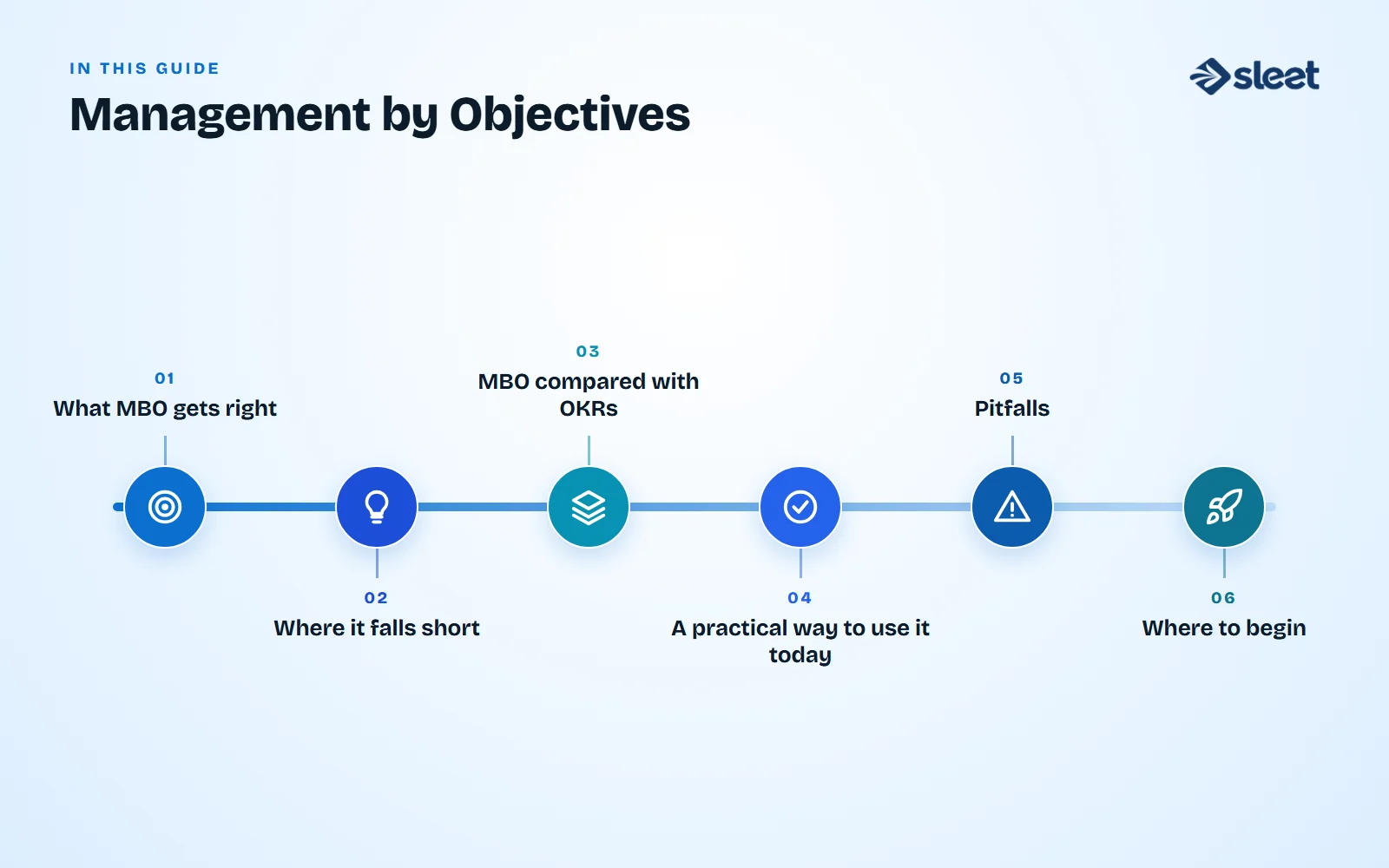
What MBO gets right
- ✓Goals are set together. People who help set their goals are more likely to commit to them than people who are handed targets.
- ✓Objectives are specific. "Be more proactive" gives way to "reduce invoice errors to under 2 percent by June".
- ✓Reviews have an anchor. A conversation about results against agreed objectives is less subjective than one based on impressions.

Where it falls short
Classic MBO sets objectives once a year and reviews them at the same pace. That is slow when priorities change every few months. It also does not separate ambitious "stretch" goals from commitments the business depends on. When people are judged on hitting every target, they set targets they are certain to hit.
MBO compared with OKRs
| MBO | OKRs | |
|---|---|---|
| Cadence | Usually annual | Usually quarterly |
| Ambition | Targets should be achievable | Some goals are stretch, and 70 percent can count as success |
| Visibility | Often between manager and employee | Shared across the company |
| Link to pay | Often direct | Often kept separate |

A practical way to use it today
- Agree three to five objectives with each person, each with a measure.
- Run the cycle every quarter, not every year.
- Mark each objective as committed or stretch. Judge commitments strictly and stretch goals generously.
- Check progress monthly in the one-to-one.
- At the end of the period, discuss what was learned, then set the next ones.
Pitfalls
- ✓Too many objectives. If everything is a priority, nothing is.
- ✓Measures that people can game, such as counting calls and not sales.
- ✓Objectives that depend on other teams without any agreement from them.
Where to begin
Pick one team, run two quarters and compare it with a team that did not change. Keep what helps and drop the rest.

Written by
HR Manager, Airwix Technologies (Sleet)
Nihit Dobariya is the HR Manager at Airwix Technologies in Ahmedabad, where he runs HR and payroll for the team behind Sleet. He writes about payroll, PF and ESIC, professional tax, the labour codes and everyday HR practice for Indian employers, and checks each rule against the official notification before it is published.
LinkedIn profile →