
Input Service Distributor Is Now Mandatory: Sharing Head Office Costs Across State Branches
From 1 April 2025, businesses with more than one GSTIN under the same PAN must distribute credit on common third-party services through an Input Service Distributor registration. Vendors bill the ISD, which shares the credit among branches by state turnover and files GSTR-6 monthly. Cross-charge remains for services between your own branches.

A company with a head office in Ahmedabad and branches in Mumbai and Bengaluru buys an ERP subscription, an audit and an advertising campaign for the whole business. The invoices come to Ahmedabad, but the benefit is shared. Since 1 April 2025, the GST credit on such services must be distributed through an Input Service Distributor (ISD).
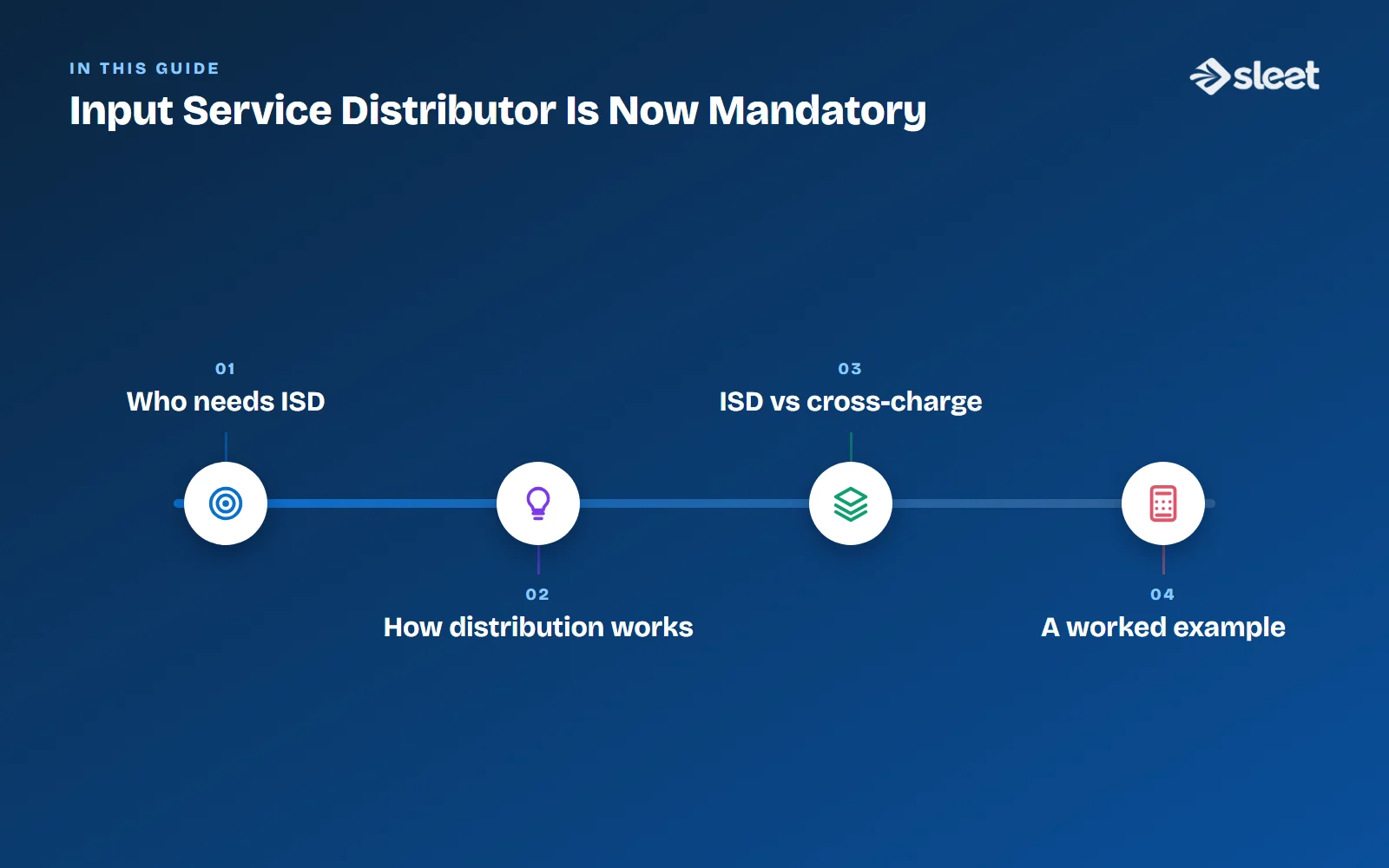
Who needs ISD
You need an ISD registration if:
- ✓you have more than one GSTIN under the same PAN (registrations in different states, or several in one state); and
- ✓you receive third-party services used by more than one GSTIN, such as software, consulting, legal, audit, advertising or insurance.
ISD is a separate registration, in the state where the invoices are received.
How distribution works
- Vendors of common services bill the ISD GSTIN.
- The ISD distributes the credit to the branches that use the service, in proportion to their turnover in the state during the relevant period, unless the service is used by one branch only, in which case it goes to that branch.
- The ISD issues an ISD invoice to each branch.
- The ISD files GSTR-6 monthly, by the 13th.
- Each branch sees its share in its own credit statement.
ISD vs cross-charge
| ISD | Cross-charge | |
|---|---|---|
| Used for | Third-party services common to several branches | Services provided by one branch of your own business to another, such as head office management or staff |
| Document | ISD invoice | Tax invoice, with GST charged |
| Return | GSTR-6 | Normal GSTR-1 |
Since April 2025, cross-charge is no longer an option for third-party common services.
A worked example
An Ahmedabad head office receives a ₹10 lakh audit fee invoice plus ₹1.8 lakh GST. Branch turnover: Gujarat ₹60 crore, Maharashtra ₹30 crore, Karnataka ₹10 crore.
| Branch | Share | Credit |
|---|---|---|
| Gujarat | 60% | ₹1,08,000 |
| Maharashtra | 30% | ₹54,000 |
| Karnataka | 10% | ₹18,000 |
Frequently asked questions
What about goods?
ISD is only for services. Goods are transferred between branches with a tax invoice.
Do we need ISD if we have one GSTIN?
No.
What if a vendor bills the normal GSTIN instead of ISD?
Ask for a corrected invoice. Credit on common services billed to the wrong GSTIN can be challenged.
Sources
- ✓Mandatory ISD compliance from 1 April 2025, GSTZen
- ✓Cross-charge or ISD? TaxGuru
- ✓FAQs on Input Service Distributor, ClearTax
This is a summary, not legal advice. Confirm with your chartered accountant.

Written by
Founder, Airwix Technologies (Sleet)
Vatsal Sutariya is the founder of Airwix Technologies in Ahmedabad, the company that builds Sleet: SleetHR for HR and payroll, and Sleet Accounting for GST billing and books. He writes about GST, invoicing, business tax and choosing software for Indian businesses, and checks each rule against the official notification before it is published.
LinkedIn profile →