
GST E-Invoicing in 2026: Who Must Do It, the ₹5 Crore Limit and the 30-Day Rule
E-invoicing is mandatory if your turnover exceeded ₹5 crore in any financial year since 2017-18, unless you are in an exempt category such as banks, insurers, goods transport agencies or SEZ units. From 1 April 2025, taxpayers with turnover of ₹10 crore or more must report each invoice to the portal within 30 days of its date.

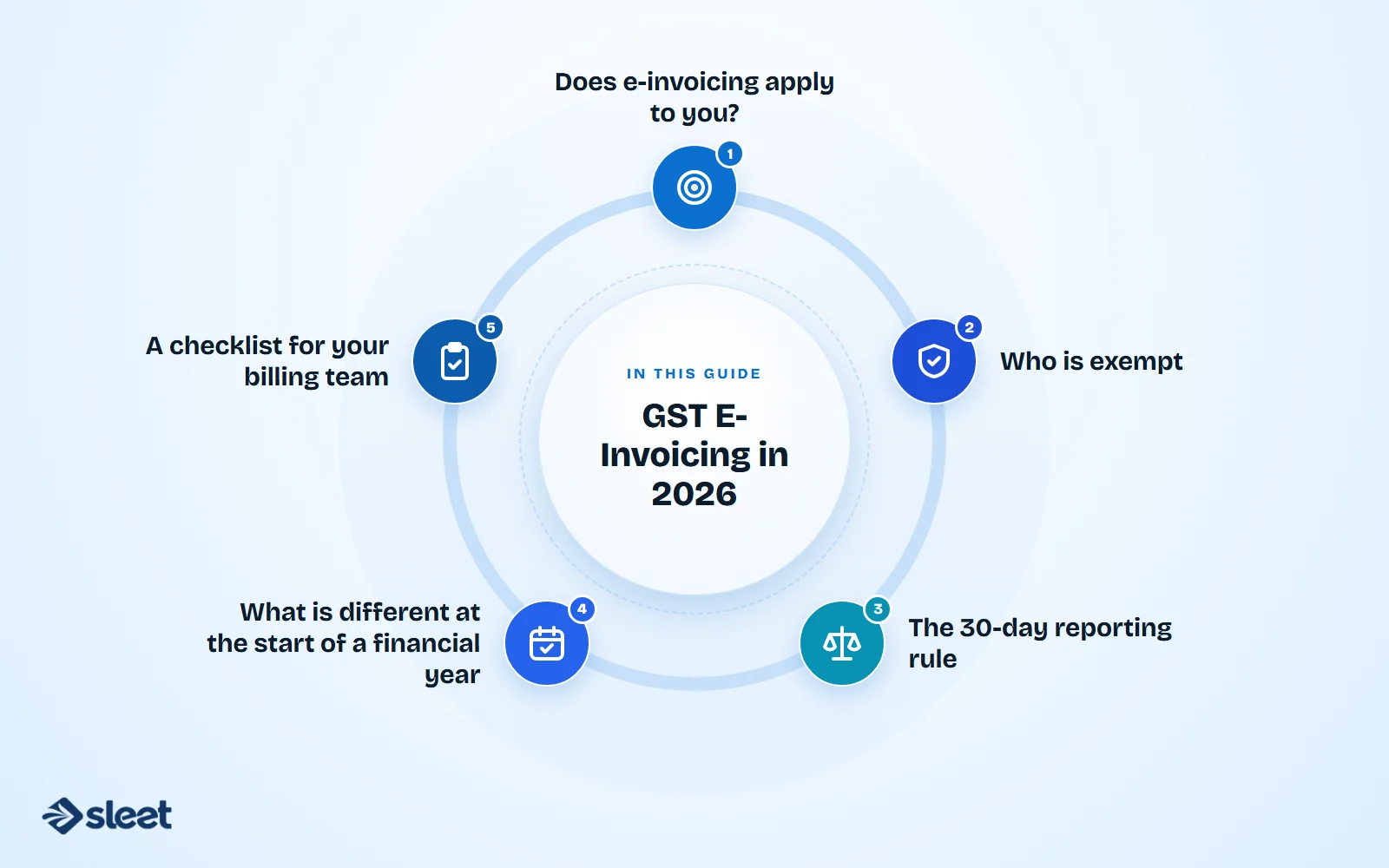
E-invoicing under GST has a short list of rules, and most of the confusion comes from three questions: does it apply to you, how fast must you report, and what happens at the start of a new financial year. This post answers each, and links to a tool that checks your own case in seconds. In a hurry? Check whether e-invoicing applies to you.
Does e-invoicing apply to you?
E-invoicing is mandatory if your aggregate annual turnover (AATO) exceeded ₹5 crore in any financial year from 2017-18 onwards. The limit has come down in steps since it began at ₹500 crore in October 2020, and it has been ₹5 crore since 1 August 2023.
Three details trip people up:
- ✓Any year counts. If you crossed ₹5 crore in one year since 2017-18, e-invoicing applies to you from then on, even if turnover later drops below it.
- ✓Turnover is counted at PAN level. Add up every GST registration the PAN holds, across states.
- ✓It covers business sales, not consumer sales. E-invoices are for supplies to other businesses, to the government and for exports. Invoices to unregistered consumers (B2C) are not reported to the portal.
Not sure where you stand? Use the E-Invoice Applicability Checker.
Who is exempt
These categories are exempt under Notification 13/2020-Central Tax, as amended:
| Category | Note |
|---|---|
| Insurers, banking companies and financial institutions (including NBFCs) | For their services |
| Goods transport agencies | For transport of goods by road |
| Passenger transportation services | |
| Cinema admission in multiplex screens | |
| Units in a Special Economic Zone (SEZ) | |
| Government departments and local authorities | Added by Notification 23/2021-Central Tax |
If you are in an exempt category you still need a proper GST tax invoice. You just do not register it on the Invoice Registration Portal (IRP).
The 30-day reporting rule
From 1 April 2025, taxpayers with AATO of ₹10 crore or more cannot report an invoice, credit note or debit note to the IRP more than 30 days after its date. The portal rejects it. An invoice dated 1 April must be reported by 30 April.
This is why late billing now has a real cost. If your team raises invoices in a batch at month-end, or issues credit notes weeks after the original sale, some of them can fall outside the window. Report each document the day you create it, ideally from your billing software, so the IRN comes back immediately.
Below ₹10 crore there is no such cut-off for now.

What is different at the start of a financial year
Each April, three things need attention:
- Invoice series. The serial number must be unique within the financial year. Most businesses start a fresh series on 1 April, for example INV-2026-27/0001. Check that your software has rolled over.
- Letter of Undertaking (LUT) for exporters. An LUT is valid for one financial year. Renew it before your first zero-rated export of the new year, or you may have to pay IGST up front.
- Reconciliation. Match your books to the returns monthly rather than at year end. Input tax credit that does not reconcile is the most common source of notices.
A checklist for your billing team
- ✓Confirm in writing whether e-invoicing applies, and from which year.
- ✓Use billing software that talks to the IRP by API, so the IRN and QR code are added automatically.
- ✓Send credit notes and debit notes through the same flow. They need an IRN too.
- ✓Report each invoice on the day you create it, not in a batch.
- ✓Keep a record of the IRN for every invoice. Buyers will ask for it when claiming credit.
- ✓Re-check the rules each April. They have changed more than once.
Sources
- ✓E-invoice turnover limit and compliance summary, Gimbooks
- ✓GSTN advisory: 30-day time limit for IRP reporting, Taxmann
- ✓Notification 13/2020-Central Tax: who is exempt, Taxheal
- ✓Notification 23/2021: government departments and local authorities exempt, IRIS GST
This is a summary, not legal advice. Rules can change by notification, so confirm with your chartered accountant or the GST portal before you rely on it.

Written by
Founder, Airwix Technologies (Sleet)
Vatsal Sutariya is the founder of Airwix Technologies in Ahmedabad, the company that builds Sleet: SleetHR for HR and payroll, and Sleet Accounting for GST billing and books. He writes about GST, invoicing, business tax and choosing software for Indian businesses, and checks each rule against the official notification before it is published.
LinkedIn profile →