
Books & Periodicals Allowance: Rules and Tax Exemption
A books and periodicals allowance reimburses the cost of professional books, journals and subscriptions against bills. Under the old tax regime the reimbursed amount is generally exempt, with the cap set by company policy, commonly ₹6,000 to ₹24,000 a year. Most such exemptions are not available under the new regime.

A books and periodicals allowance reimburses the cost of professional books, journals, newspapers and subscriptions that help an employee do their job. It is a small benefit, but where it applies it can be tax-efficient, which makes it popular in flexible benefit plans.
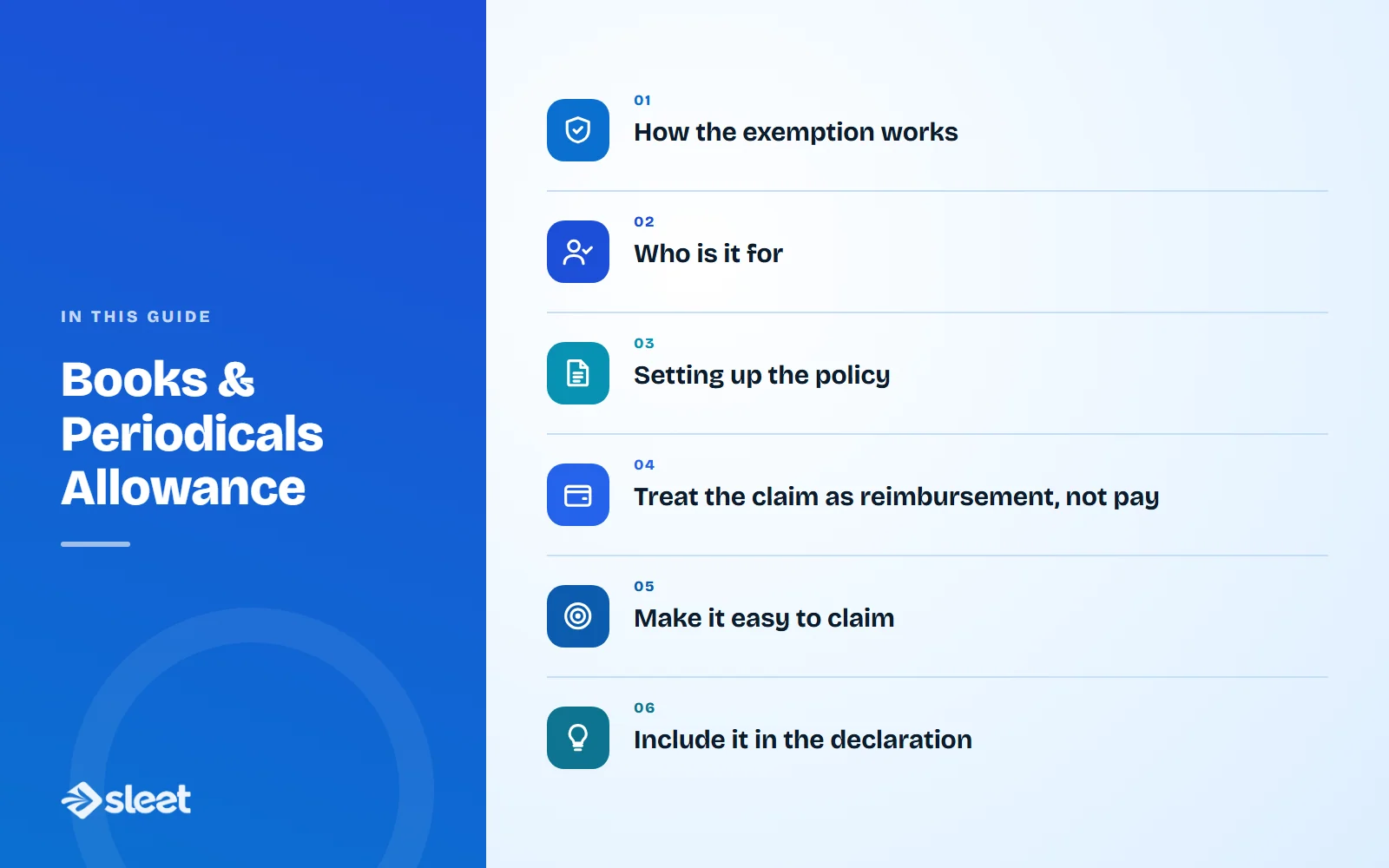
How the exemption works
- ✓Bill-based. The employee submits invoices for items bought during the year, and the employer reimburses actual spending.
- ✓No fixed statutory cap. The limit is set by company policy. Many employers choose a figure between ₹6,000 and ₹24,000 a year, depending on role and grade.
- ✓Old tax regime. The exemption is generally available when the employee follows the old tax regime. Most such exemptions are not available under the new regime, which is the default. Confirm how your payroll treats each employee.

Who is it for
It suits roles where reading is part of the job, such as finance, HR, legal, research, sales and engineering. A manager who wants a team to keep learning can use it as a low-cost way to support that.
Setting up the policy
- State who is eligible and the annual limit.
- List what counts: books, journals, newspapers, online subscriptions relevant to the role.
- Ask for a bill, with the item and date, and set a deadline for claims.
- Say what happens to unclaimed balances at the end of the year.
- Keep the bills for audit.

Treat the claim as reimbursement, not pay
If a fixed amount is paid every month with no bills, it is simply taxable salary. The documentation is what separates the two.
Make it easy to claim
Most employees do not use this benefit because it is a hassle: collecting a bill, filling in a form and waiting for approval. A claim in an app, with a photo of the bill and a quick approval, gets used.
Include it in the declaration
If you run a flexible benefits plan, ask employees to choose their allocation at the start of the year, and remind them in the second half. Unused amounts are a missed benefit for the employee and a wasted line in your structure.

Written by
HR Manager, Airwix Technologies (Sleet)
Nihit Dobariya is the HR Manager at Airwix Technologies in Ahmedabad, where he runs HR and payroll for the team behind Sleet. He writes about payroll, PF and ESIC, professional tax, the labour codes and everyday HR practice for Indian employers, and checks each rule against the official notification before it is published.
LinkedIn profile →