
TDS on Partners’ Salary and Interest: What Partnership Firms Must Do Now
Since 1 April 2025, firms and LLPs deduct 10% TDS on salary, remuneration, commission, bonus and interest paid or credited to a partner above ₹20,000 a year. Under the Income-tax Act, 2025 it sits in Section 393(3) with payment code 1067 and is reported in Form 140. Drawings and profit share are not covered.

Until March 2025, a partnership firm paid its partners' salary and interest without deducting tax. The partners paid tax on it in their own returns. From 1 April 2025 that changed, and many small firms only noticed when the first quarterly return was due.
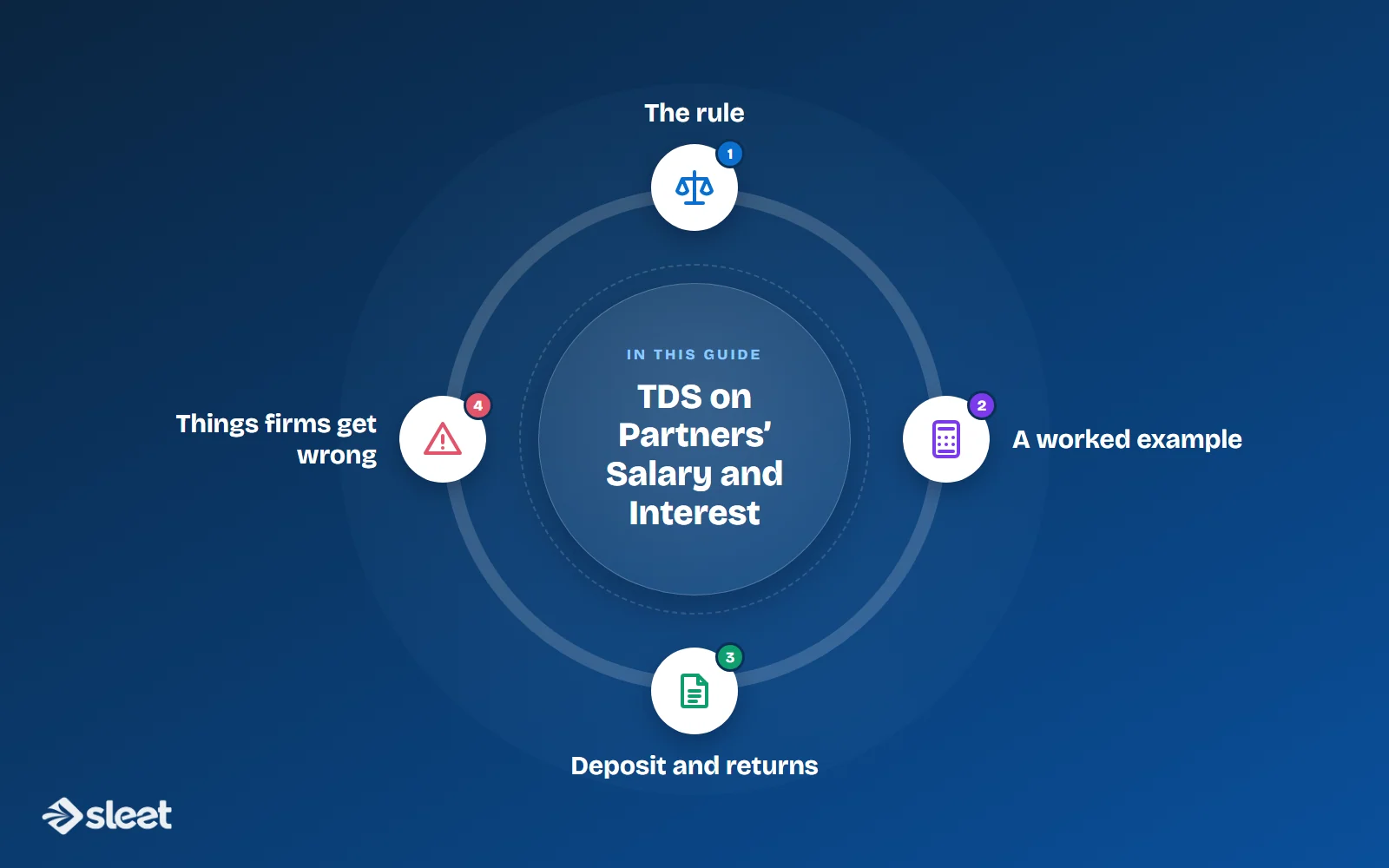
The rule
Section 194T of the Income-tax Act, 1961 required firms, including LLPs, to deduct TDS from payments to partners from 1 April 2025. Under the Income-tax Act, 2025, which applies from 1 April 2026, the same rule sits in the TDS table in Section 393(3).
| Point | Rule |
|---|---|
| Who deducts | Partnership firms and LLPs |
| Payments covered | Salary, remuneration, commission, bonus and interest to partners |
| Rate | 10% |
| Threshold | More than ₹20,000 to a partner in a year |
| When | When the amount is paid or credited to the partner's account, including the capital account, whichever is earlier |
| Not covered | Drawings and withdrawals of capital, and a partner's share of profit (exempt in the partner's hands) |
A worked example
A three-partner CA firm in Indore pays each partner ₹1,00,000 a month as remuneration and credits 12% interest on capital at year end.
| Partner | Remuneration for the year | Interest on capital | Total | TDS at 10% |
|---|---|---|---|---|
| A | ₹12,00,000 | ₹1,20,000 | ₹13,20,000 | ₹1,32,000 |
| B | ₹12,00,000 | ₹60,000 | ₹12,60,000 | ₹1,26,000 |
| C | ₹12,00,000 | ₹18,000 | ₹12,18,000 | ₹1,21,800 |
TDS on the monthly remuneration is deducted each month. TDS on interest is deducted when it is credited at year end. Year-end book entries that credit remuneration to capital accounts also trigger TDS on the date of credit.
Deposit and returns
- ✓Deposit by the 7th of the following month (30 April for amounts credited in March).
- ✓Under the Income-tax Act, 2025, the payment code for this TDS is 1067. Using the wrong code is one of the most common errors this year.
- ✓Report it in the quarterly TDS return for non-salary payments, Form 140 (earlier Form 26Q). The returns are due on 31 July, 31 October, 31 January and 31 May.
Things firms get wrong
- ✓Treating the partner's monthly withdrawals as the payment. TDS follows the remuneration credited, not the drawings.
- ✓Forgetting year-end credits. Interest and remuneration credited in March are subject to TDS that month.
- ✓Deducting on profit share. A partner's share of profit is exempt and needs no TDS.
- ✓Ignoring the deductible limits. The tax law still limits how much partner remuneration and interest the firm can deduct. TDS does not change those limits.
Frequently asked questions
Does the partner lose the TDS?
No. The partner claims it against their own tax, and it appears in their annual tax statement.
Does it apply to LLPs?
Yes. LLPs are treated as firms for this rule.
Can a partner give a declaration to avoid TDS?
No. There is no declaration route for this TDS.
Sources
- ✓Section 194T: TDS on payments by firms to partners, ClearTax
- ✓TDS on partner payments: Section 393(3) and Section 194T, CAclubindia
- ✓Income-tax Act, 2025: TDS rates, thresholds and payment codes, TaxGuru
This is a summary, not legal advice. Confirm with your chartered accountant before you rely on it.

Written by
Founder, Airwix Technologies (Sleet)
Vatsal Sutariya is the founder of Airwix Technologies in Ahmedabad, the company that builds Sleet: SleetHR for HR and payroll, and Sleet Accounting for GST billing and books. He writes about GST, invoicing, business tax and choosing software for Indian businesses, and checks each rule against the official notification before it is published.
LinkedIn profile →