
Shift Management: Best Practices for Rostering, Fairness and Compliance
Good shift management means fair rotation of nights and weekends, rosters published one to two weeks ahead, enough rest between shifts, staffing matched to demand and a simple swap process with manager approval. Check state rules on hours, overtime and night work, and link the roster to attendance and payroll so allowances are not worked out by hand.

If your business runs more than one shift, whether in a factory, a hospital, a retail chain or a support centre, rostering becomes one of the most time-consuming parts of operations. Poor shift management leads to burnout, absenteeism and compliance problems.
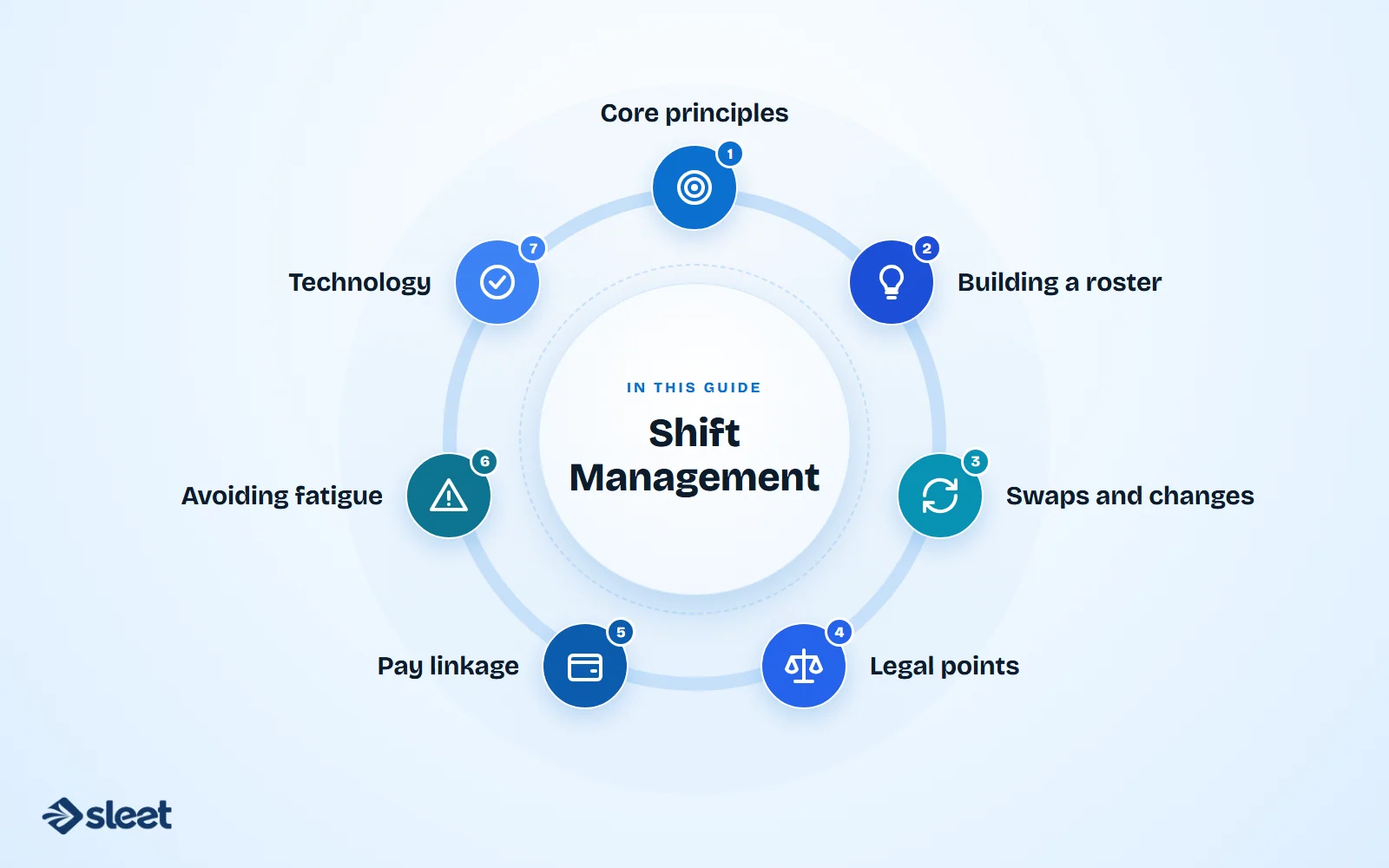
Core principles
- ✓Fairness: Share unpopular shifts, such as nights and weekends, evenly.
- ✓Predictability: Publish rosters well in advance, ideally one to two weeks.
- ✓Rest: Leave enough time between shifts and respect weekly off.
- ✓Coverage: Match staffing to demand, not to habit.
- ✓Compliance: Follow working-hour, overtime and night-shift rules.

Building a roster
- ✓Forecast demand by hour or day using historical data.
- ✓List the skills needed in each shift.
- ✓Collect availability, leave and preferences.
- ✓Rotate employees on a regular pattern.
- ✓Keep a bench or on-call pool for absence.
Swaps and changes
Create a simple process for swaps, where two employees agree and a manager approves through an app. Set a cut-off time and record every change for payroll accuracy.

Legal points
Many states have rules on maximum daily and weekly hours, spread-over, rest intervals, night work for women and overtime pay. Check the rules in each state where you operate, and ensure that women employees on night shifts have the safety measures that the rules require, such as transport and security.
Pay linkage
Shift allowance, night differential and overtime must be calculated from actual hours worked. Connect the roster to attendance and payroll, so the calculation does not rely on manual sheets.
Avoiding fatigue
- ✓Limit consecutive night shifts.
- ✓Avoid quick turnarounds, such as a late close followed by an early open.
- ✓Give time off after intense periods.
Technology
Scheduling tools can propose rosters, flag conflicts, send alerts and report on labour cost. Geo-fenced attendance and biometric devices make sure the roster reflects reality.
A good roster respects both the customer's demand and the employee's life.
Review roster data monthly to see overtime, absence and satisfaction by shift, and adjust the pattern accordingly.

Written by
HR Manager, Airwix Technologies (Sleet)
Nihit Dobariya is the HR Manager at Airwix Technologies in Ahmedabad, where he runs HR and payroll for the team behind Sleet. He writes about payroll, PF and ESIC, professional tax, the labour codes and everyday HR practice for Indian employers, and checks each rule against the official notification before it is published.
LinkedIn profile →