
Pay Revised From the 16th: Prorating Salary, PF, ESI and TDS for a Split Month
For a mid-month salary revision, pay each component at the old rate for the days before the effective date and at the new rate for the rest, using your policy's loss-of-pay day count. Then recompute PF on the month's PF wages, continue ESI to the end of the contribution period, and re-project the year's TDS.

Increments rarely take effect on the 1st. A promotion is approved from the 16th, a minimum wage revision applies from a mid-month date, or a new joiner's confirmation raise lands on the 20th. The payslip for that month has two rates in it, and every statutory deduction that depends on wages moves with it. This post sets out a method that holds up: prorate each component, then recheck PF, ESI and TDS.
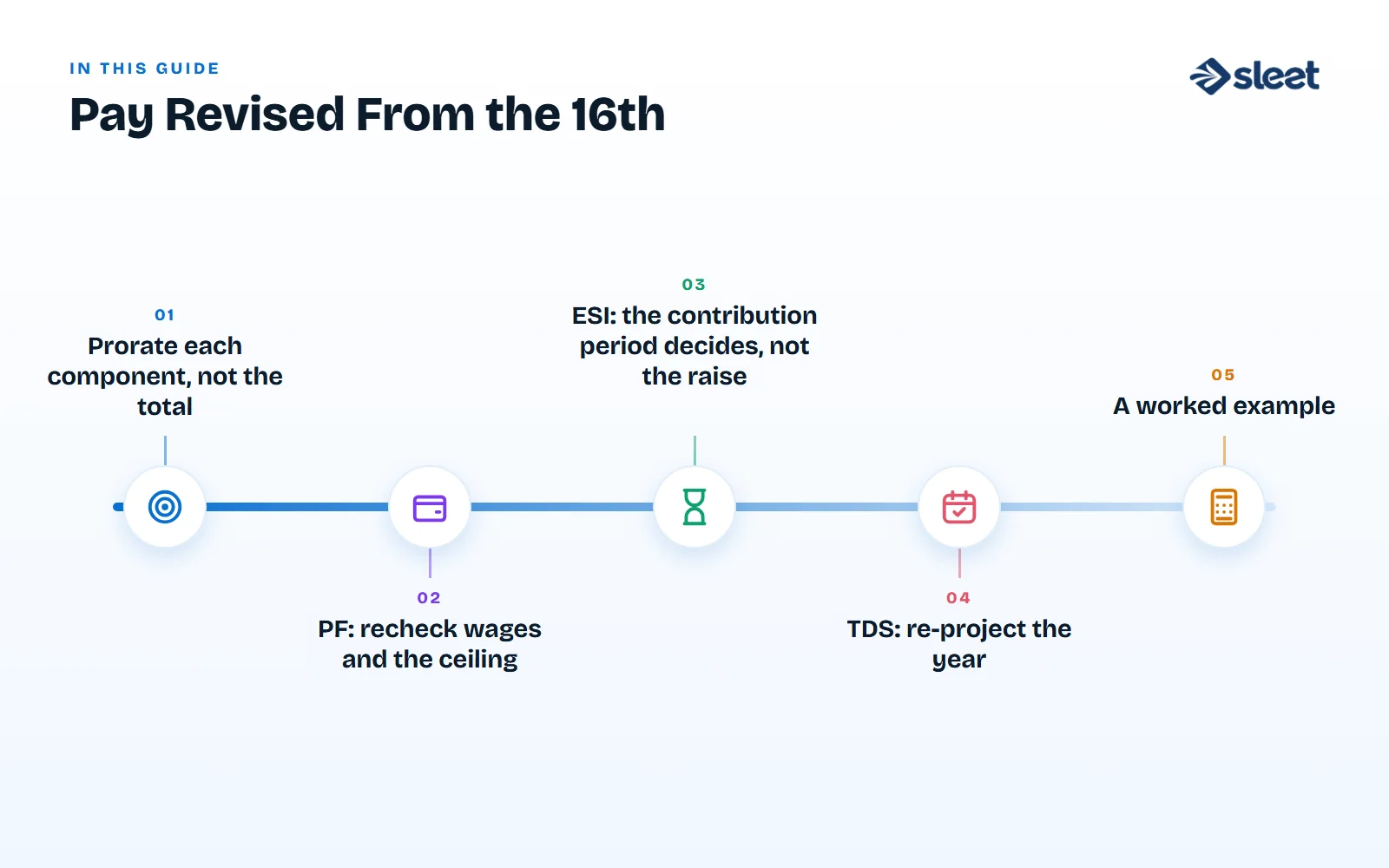
Prorate each component, not the total
Split the month into two parts and pay each component at its own rate for its own days:
Component for the month = old monthly rate × days before the change ÷ days in the month + new monthly rate × days from the change ÷ days in the month
Do this for basic, dearness allowance, HRA and each allowance separately. Prorating only the gross and then re-splitting it by percentages gives wrong PF and ESI wages whenever the structure itself changed.
Which day count? The Code on Wages does not fix one. Choose a method in your salary policy and use it for every proration: revisions, joiners, leavers and loss of pay.
| Method | Divisor | Effect |
|---|---|---|
| Calendar days | 28 to 31 | Daily rate changes month to month |
| Fixed 30 days | 30 | Simple; a 31-day month pays one day "free" |
| Working days | Working days in the month | Weekly offs fall outside the count |
Whatever you choose, check that the prorated pay still meets the minimum wage for the days worked.
Fixed amounts are different. A monthly reimbursement against bills, a fixed meal card or a mobile allowance can be paid at the new rate from the next month instead. Write the rule down so both halves of a split month are not argued over.
PF: recheck wages and the ceiling
PF wages are basic, dearness allowance and retaining allowance, with any excess added back when excluded allowances exceed 50% of total pay under the Code on Social Security. In the revision month:
- Prorate basic and DA as above.
- Apply the 50% test to the month's prorated figures.
- Compare PF wages with the ₹25,000 ceiling in force since 17 September 2026.
- Deduct 12% from the employee and pay 12% from the employer, with 8.33% of PF wages up to the ceiling going to EPS.
A revision that takes PF wages above ₹25,000 does not take an existing member out of PF. Whether contributions continue on the full wage or only on ₹25,000 depends on the option already in place for that employee. Do not change it silently because of a raise.
ESI: the contribution period decides, not the raise
ESI coverage is fixed at the start of each contribution period: 1 April to 30 September and 1 October to 31 March. If the revision takes ESI wages above ₹21,000 during a period, the employee stays covered and contributes on the actual wages until the period ends. Coverage stops from the next period, if wages are still above ₹21,000 on its first day.
Two points specific to a split month:
- ✓ESI is calculated on the month's prorated wages, at 0.75% employee and 3.25% employer, each rounded up to the next rupee.
- ✓ESI wages follow the Code's definition, as ESIC has applied it since its December 2025 circular. A raise mainly in HRA or other allowances may not change ESI wages at all, unless it pushes allowances past 50% of pay.
For the full contribution-period rules, see ESIC from 1 October.
TDS: re-project the year
Under section 392 (earlier section 192), the employer deducts TDS on the estimated salary for the whole tax year. After a revision:
- Add the salary already paid, the prorated revision month and the new salary for the remaining months.
- Recompute the year's tax under the employee's chosen regime.
- Subtract TDS already deducted.
- Divide the balance over the remaining months, including the revision month.
Revisions approved late, with arrears for earlier months, fall here too. Add the arrears to the year's salary, and if the arrears relate to an earlier tax year, the employee may claim relief on Form 39.
A worked example
A Ludhiana hosiery unit promotes a production supervisor from 16 November 2026. November has 30 days, and the unit prorates by calendar days, so 15 days are at the old rate and 15 at the new.
| Component | Old monthly | New monthly | November (15 + 15 days) |
|---|---|---|---|
| Basic | ₹15,000 | ₹22,000 | ₹7,500 + ₹11,000 = ₹18,500 |
| HRA | ₹4,000 | ₹6,000 | ₹2,000 + ₹3,000 = ₹5,000 |
| Special allowance | ₹3,000 | ₹5,000 | ₹1,500 + ₹2,500 = ₹4,000 |
| Gross | ₹22,000 | ₹33,000 | ₹27,500 |
50% test: allowances in November are ₹9,000, which is 32.7% of ₹27,500, so nothing is added back. PF and ESI wages are the basic: ₹18,500.
PF for November:
- ✓Employee: 12% × ₹18,500 = ₹2,220.
- ✓Employer: ₹2,220, of which EPS 8.33% × ₹18,500 = ₹1,541 and EPF ₹679.
- ✓From December, on ₹22,000: ₹2,640 each, with EPS ₹1,833 and EPF ₹807.
ESI: his ESI wages were ₹15,000 on 1 October 2026, so he is covered for the whole October to March period.
- ✓November, on ₹18,500: employee 0.75% = ₹138.75, rounded up to ₹139; employer 3.25% = ₹601.25, rounded up to ₹602.
- ✓December to March, on ₹22,000: employee ₹165, employer ₹715, even though wages are above ₹21,000.
- ✓From 1 April 2027, if ESI wages are still ₹22,000, he leaves ESI.
TDS: his projected salary is ₹22,000 × 7 + ₹27,500 + ₹33,000 × 4 = ₹1,54,000 + ₹27,500 + ₹1,32,000 = ₹3,13,500, below the new regime's nil band. No TDS.
For a higher earner, the re-projection matters. A manager in the same unit goes from ₹1,20,000 to ₹1,50,000 a month from 16 November, in the new regime:
- Old projection: ₹14,40,000 − ₹75,000 = ₹13,65,000; tax ₹20,000 + ₹40,000 + ₹24,750 = ₹84,750; with cess ₹88,140, or ₹7,345 a month. Deducted April to October: ₹51,415.
- New projection: ₹8,40,000 + ₹1,35,000 + ₹6,00,000 = ₹15,75,000; less ₹75,000 = ₹15,00,000; tax ₹1,05,000; with cess ₹1,09,200.
- Balance: ₹1,09,200 − ₹51,415 = ₹57,785, over November to March: ₹11,557 a month.
Frequently asked questions
Should the revision letter state the effective date or the payroll month?
The effective date. Payroll then prorates the month the date falls in, and the record matches the letter.
The revision was approved after the payroll closed. What now?
Pay the difference for the days missed as arrears in the next month, and run PF and ESI on those arrears in the month they are paid.
Does a mid-month revision change the gratuity base?
Gratuity uses the last drawn wages at exit, so a revision matters only if the employee leaves after it. Record the new wages from the effective date.
Sources
- ✓EPFO wage ceiling enhanced from ₹15,000 to ₹25,000 per month, PIB, 23 September 2026
- ✓EPF wage ceiling moves to ₹25,000: key changes and employer impact, Corporate Professionals
- ✓Labour codes: key social security clarifications, including ESIC wages, AMS Shardul
- ✓Form 39 and section 157 relief for salary arrears, TaxGuru
This is a summary, not legal advice. Confirm PF and ESI wages with the EPFO and ESIC portals, and your proration method with your payroll advisor.

Written by
HR Manager, Airwix Technologies (Sleet)
Nihit Dobariya is the HR Manager at Airwix Technologies in Ahmedabad, where he runs HR and payroll for the team behind Sleet. He writes about payroll, PF and ESIC, professional tax, the labour codes and everyday HR practice for Indian employers, and checks each rule against the official notification before it is published.
LinkedIn profile →