
How to Run Payroll in India: A Complete 7-Step Guide for 2025–26
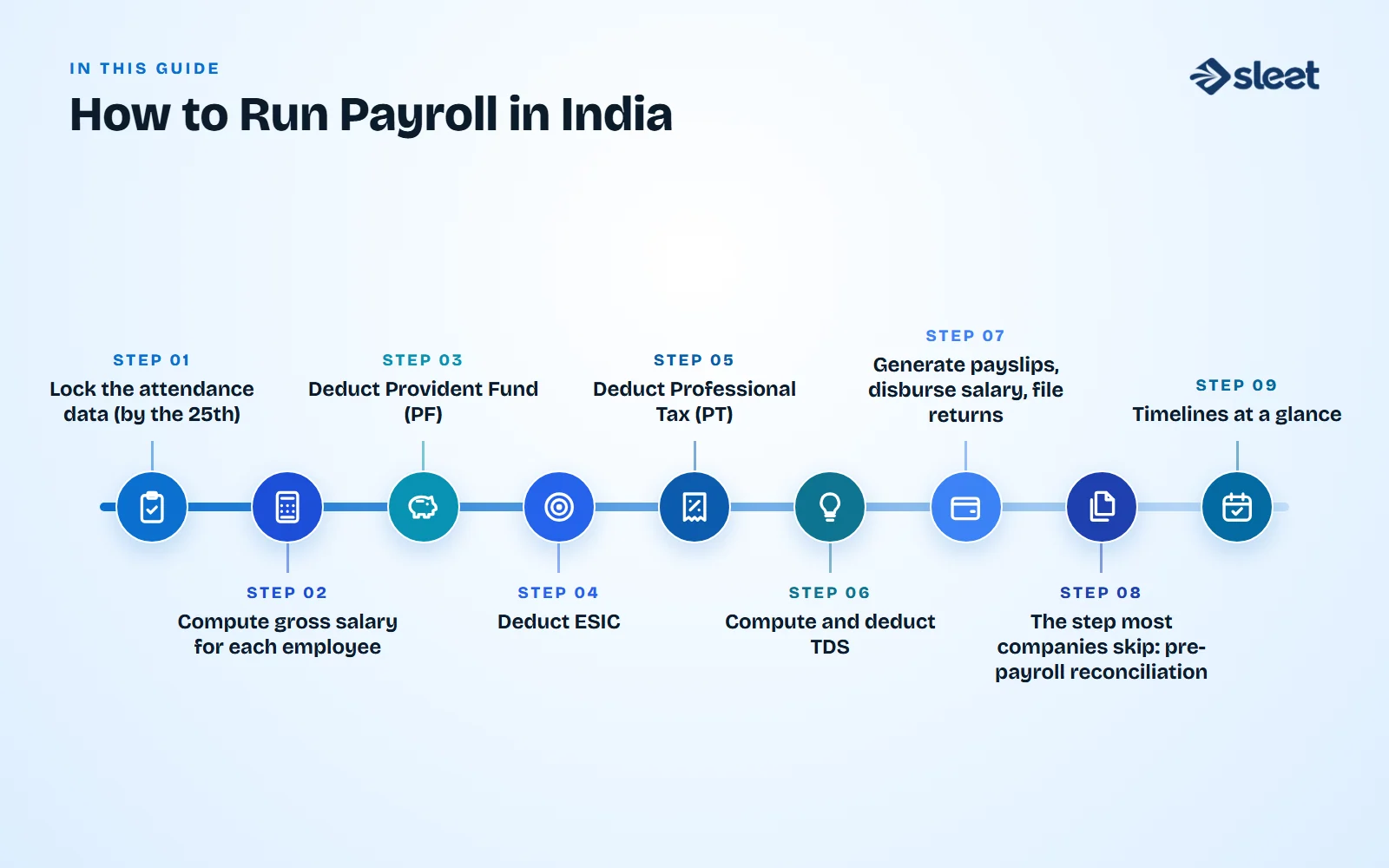
Run payroll in this order: lock attendance, work out gross pay, deduct PF, ESIC, Professional Tax, LWF and TDS, issue payslips, pay salaries, then file returns. PF and ESIC challans are due by the 15th of the next month. Closing attendance a few days before month-end leaves time for corrections.

Running payroll in India isn't complicated once you know the sequence. The mistakes most SMEs make come from skipping or reordering these steps — computing TDS before locking attendance, or generating payslips before PT is verified. This guide walks through the correct order, with the specific numbers you need.
Step 1: Lock the attendance data (by the 25th)
Before any salary calculation can begin, attendance data must be final. This means:
- ✓Close the attendance month on the 25th — not the 30th. This gives you buffer for corrections.
- ✓Reconcile biometric punch data against leave records: approved leaves count as present, unapproved absences result in LOP (Loss of Pay)
- ✓Process all pending attendance regularization requests from employees
- ✓Confirm the number of working days in the month (varies by branch and state holiday calendar)
Common mistake: Running payroll before attendance regularization is closed. This guarantees 5–10 employees will raise payslip disputes after salary is credited.

Step 2: Compute gross salary for each employee
Gross = Fixed components + Variable components − LOP deductions
Fixed: Basic, HRA, Conveyance, Special Allowance, Medical Allowance. Variable: Performance bonus, Incentives, Overtime pay, Shift allowance. LOP deduction: (Monthly gross ÷ working days in month) × number of LOP days.
For piece-rate or daily-wage workers: Gross = (Rate per piece × units produced) or (Daily wage × days worked).
Step 3: Deduct Provident Fund (PF)
Applies to all establishments with 20+ employees.
- ✓Employee deduction: 12% of (Basic + DA)
- ✓Employer contribution: 12% of (Basic + DA) — 8.33% to EPS, 3.67% to EPF
PF is computed on Basic + DA, not gross. Since 17 September 2026, the PF wage ceiling is ₹25,000 a month. Inflating non-PF components to reduce liability is a common structure that EPFO is increasingly scrutinizing.
Filing deadline: PF ECR + challan by the 15th of the following month.

Step 4: Deduct ESIC
Applies to employees earning ₹21,000/month or less (gross).
- ✓Employee: 0.75% of gross wages
- ✓Employer: 3.25% of gross wages
Once salary crosses ₹21,000, ESIC deductions stop from the next contribution period (not immediately).
Filing deadline: ESIC challan by the 15th of the following month.
Step 5: Deduct Professional Tax (PT)
PT is a state tax applicable in about 17 states and union territories (Odisha repealed it from 1 April 2026). Compute based on the employee's state of work and the monthly gross salary slab for that state.
Examples:
- ✓Maharashtra: ₹200/month for gross ≥ ₹7,501 (₹300 in February to hit the ₹2,500 annual cap)
- ✓Karnataka: ₹200/month for ₹15,001–₹24,999; ₹300/month for ≥ ₹25,000
- ✓Gujarat: ₹200/month for ₹12,000–₹17,999; ₹200 for ≥ ₹18,000
PT must be deposited with the state government by the last day of the month in most states.
Step 6: Compute and deduct TDS
TDS is an annual calculation divided over 12 months.
- Estimate annual gross taxable income (projected from current gross × 12, adjusted for variable components)
- Apply deductions: under the new regime (default from FY 2024–25), only ₹75,000 standard deduction. Under old regime: 80C, HRA, LTA, etc.
- Compute annual tax on taxable income
- Divide by 12 for monthly TDS
Recompute TDS every time gross pay changes (salary revision, bonus, declaration change).
Form 138 (earlier Form 24Q) filing: Quarterly, due on 31 July, 31 October, 31 January and 31 May.
Step 7: Generate payslips, disburse salary, file returns
Payslips: Must show all components and deductions itemised. Digital payslips on WhatsApp or a mobile app are valid under the Wages Code 2019 (as notified by states).
Salary transfer: Direct bank NEFT/RTGS. Many payroll systems generate a salary file for bulk upload to the bank.
Monthly filings:
- ✓PF ECR + challan: by 15th
- ✓ESIC challan: by 15th
- ✓PT payment: by last day of month
- ✓LWF: varies by state (Maharashtra: December 31 and June 30; some states monthly)
Quarterly: Form 24Q (TDS return): 31 days after quarter end
Annual: Form 130 (Form 16) to employees by 15 June following the financial year
The step most companies skip: pre-payroll reconciliation
Before disbursing salary, run a comparison between the current month and the previous month. Flag any employee where gross pay or net pay changed by more than 15%. This catches data entry errors before money leaves the account.
Most HRMS systems offer this as a "payroll comparison" or "variance report." If yours doesn't, build a pivot table in Excel — it takes 15 minutes and prevents 90% of payroll disputes.
Timelines at a glance
| Action | Deadline |
|---|---|
| Attendance lock | 25th of the month |
| Payroll processing | 27th–28th |
| Salary disbursement | Last working day |
| PF ECR + payment | 15th of next month |
| ESIC payment | 15th of next month |
| PT deposit | Last day of month (most states) |
| Form 24Q (TDS return) | 31 days after quarter end |
| Form 130 (Form 16) | 15 June (annual) |

Written by
Founder, Airwix Technologies (Sleet)
Vatsal Sutariya is the founder of Airwix Technologies in Ahmedabad, the company that builds Sleet: SleetHR for HR and payroll, and Sleet Accounting for GST billing and books. He writes about GST, invoicing, business tax and choosing software for Indian businesses, and checks each rule against the official notification before it is published.
LinkedIn profile →