
Perquisites in Income Tax: What Counts & How They Are Taxed
A perquisite is a benefit from the employer on top of salary, and most are taxable, valued by set rules rather than actual cost. Examples are rent-free housing, a company car, cheap loans, ESOPs and club memberships. Taxable perquisites are itemised on Form 123 (earlier Form 12BA) and flow into Form 130, and wrong valuation exposes the employer to short-deduction penalties.
A perquisite, or perk, is a benefit an employee gets from the employer on top of salary. Under the Income Tax Act, most perquisites are taxable. They are valued by set rules and not by what they cost the employer, and this is one of the areas where payroll teams make the most mistakes.
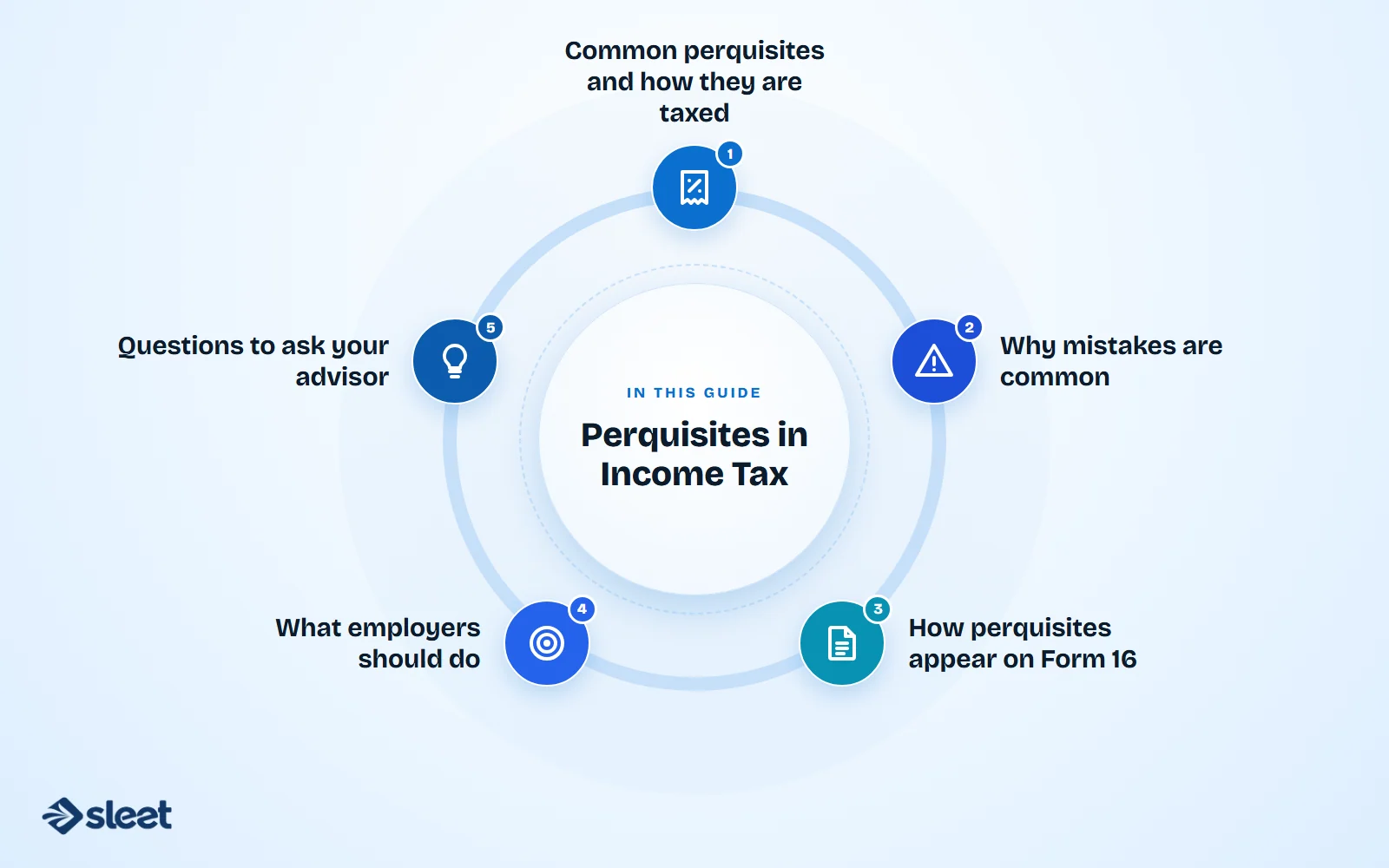
Common perquisites and how they are taxed
| Perquisite | How it is valued |
|---|---|
| Rent-free or concessional housing | A percentage of salary that depends on the size of the city, or the rent the employer actually pays for leased housing |
| Company car | A notional monthly amount that depends on engine size and on who pays running costs |
| Interest-free or cheap loans | The gap between the interest charged and the SBI benchmark rate, with some small-loan exceptions |
| ESOPs | Fair market value on the date of exercise minus the exercise price |
| Club memberships, gym | Generally taxable unless used wholly for official purposes |
| Gifts | Small gifts up to a set annual limit are exempt, and anything above is taxed |
Valuation rules change, so check the current rules and your employee's tax regime before you apply any figure.

Why mistakes are common
The rules differ by benefit. There is no single formula to apply to everything, so each type needs its own calculation, and the details shift with city size, car type or loan amount.
How perquisites appear on Form 16
Every taxable perquisite must be listed and valued on Form 123 (earlier Form 12BA), which feeds into Part B of the employee's Form 130 (earlier Form 16). If it is wrong, the employee may receive a tax notice, and the employer faces short-deduction penalties when the return is assessed.

What employers should do
- Make a list of every non-cash benefit you give, including small ones.
- Decide, for each one, whether it is taxable and how it is valued.
- Set up payroll to calculate and add the taxable value each month, so TDS reflects it.
- Tell employees what is taxable before they accept a benefit.
- Review the list each year after the Budget.
Questions to ask your advisor
- ✓Does this benefit change under the new tax regime?
- ✓Who bears the tax, the employer or the employee?
- ✓Is there a reimbursement design that gives the same benefit with less tax?

Written by
HR Manager, Airwix Technologies (Sleet)
Nihit Dobariya is the HR Manager at Airwix Technologies in Ahmedabad, where he runs HR and payroll for the team behind Sleet. He writes about payroll, PF and ESIC, professional tax, the labour codes and everyday HR practice for Indian employers, and checks each rule against the official notification before it is published.
LinkedIn profile →