
Overtime Pay in India: Rules, Rate and How to Calculate It
Where the law applies, overtime is paid at twice the ordinary rate of wages, which includes basic, DA and certain allowances. Under the Factories Act an adult should not work more than 9 hours a day or 48 a week. For example, a ₹26,000 monthly wage gives ₹125 an hour, so overtime is ₹250 an hour.

Overtime is work done beyond the normal daily or weekly hours. In India, the law protects covered workers by requiring extra pay for it. Getting the calculation wrong is a common cause of wage disputes, especially in factories, retail and services. To work out overtime pay at double rate, use the free calculator.
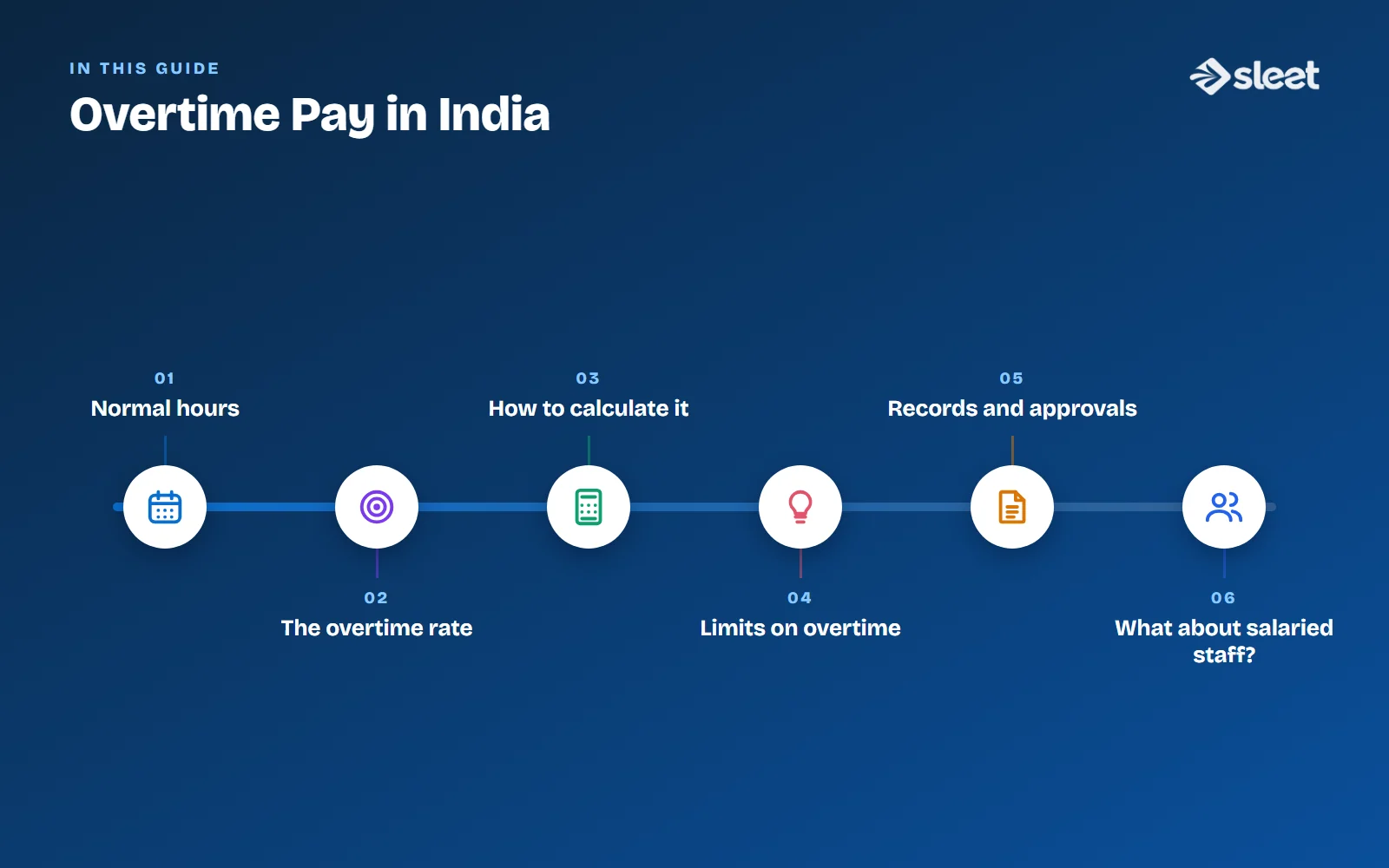
Normal hours
Under the Factories Act, an adult worker should not work more than 9 hours a day or 48 hours a week. State shops and establishments acts set similar limits for shops, offices and commercial units. Some managerial or supervisory roles are excluded, so check how your state defines the covered workforce.

The overtime rate
Where the law applies, overtime is paid at twice the ordinary rate of wages. The ordinary rate includes basic wages, dearness allowance and certain allowances, not only the basic.
How to calculate it
- ✓Step 1: Find the monthly wage that counts, for example basic plus DA.
- ✓Step 2: Divide by the number of working days and by the standard hours in a day to find the hourly rate.
- ✓Step 3: Multiply by two for the overtime rate.
- ✓Step 4: Multiply by the overtime hours worked.
For example, if the monthly wage is ₹26,000 over 26 days with 8-hour days, the hourly rate is ₹125. Overtime is ₹250 an hour. Four hours of overtime earns ₹1,000.

Limits on overtime
State laws also cap the total overtime hours in a quarter, and the weekly rest day must be respected. Employers who push staff beyond these limits risk both penalties and burnout.
Records and approvals
- ✓Capture clock-in and clock-out data accurately, ideally from a biometric or mobile app.
- ✓Require manager approval for overtime before it is paid.
- ✓Keep a register of overtime hours as the law requires.
- ✓Show overtime as a separate earning line on the payslip.
What about salaried staff?
Employees outside the coverage of these laws may be paid compensatory time off or a company-defined rate. Whatever your policy, write it down and apply it evenly.
The cheapest overtime is the overtime that never happens because work was planned properly.
With attendance feeding straight into payroll, overtime is calculated from real hours and not from a manager's estimate at the end of the month.

Written by
HR Manager, Airwix Technologies (Sleet)
Nihit Dobariya is the HR Manager at Airwix Technologies in Ahmedabad, where he runs HR and payroll for the team behind Sleet. He writes about payroll, PF and ESIC, professional tax, the labour codes and everyday HR practice for Indian employers, and checks each rule against the official notification before it is published.
LinkedIn profile →