
Labour Law Compliance Checklist for Indian Employers
A core labour compliance set covers registrations (Shops and Establishments, EPF, ESI, professional tax, LWF), appointment letters and employee records, minimum wages and wage registers, correct PF and ESI deposits, a gratuity provision, an Internal Committee under the POSH Act if you have ten or more employees, and a proper exit process.

Labour law in India sits across central and state statutes, and the labour codes are changing how some of them are organised. Whatever the final shape, an employer needs a core set of registrations, registers and practices. Use this checklist to find gaps.
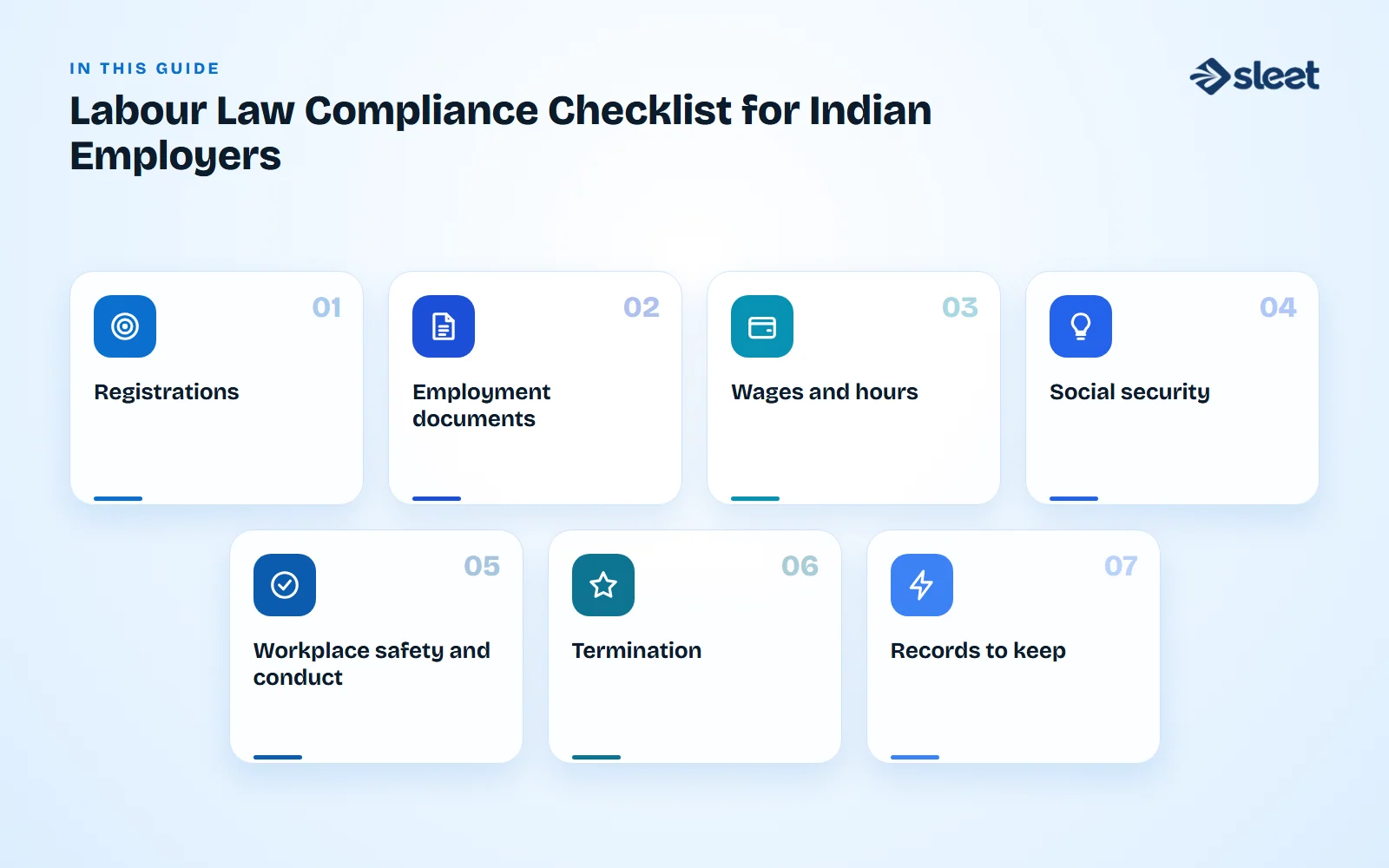
Registrations
- ✓Shops and Establishments registration in each state of operation.
- ✓EPF and ESI registration once you cross the thresholds, with employees enrolled.
- ✓Professional tax registration where applicable.
- ✓Labour Welfare Fund registration in states that require it.
- ✓Contract labour licence if you engage contractors.

Employment documents
- ✓Appointment letters for every employee, stating role, pay and terms.
- ✓Employee records with identity, address and bank details.
- ✓Policies for leave, attendance, code of conduct and grievance handling.
- ✓A signed acknowledgement of the employee handbook.
Wages and hours
- ✓Pay at least the applicable minimum wage for the state and category.
- ✓Pay wages on time, within the due dates in the law.
- ✓Maintain muster rolls, wage registers and overtime records.
- ✓Respect working-hour limits and weekly rest days.

Social security
- ✓Deduct and deposit PF and ESI correctly.
- ✓Maintain a gratuity provision once employees reach five years of service.
- ✓Provide maternity benefits as per the Maternity Benefit Act.
Workplace safety and conduct
- ✓Constitute an Internal Committee under the POSH Act where you have ten or more employees.
- ✓Follow safety rules relevant to your sector, such as fire safety and first aid.
- ✓Display required notices and abstracts of the law.
Termination
- ✓Follow the notice period and process in the contract and law.
- ✓Settle final dues within the permitted time.
- ✓Issue relieving and experience letters.
Records to keep
Registers, challans, returns and acknowledgements should be kept for the period the law prescribes, and accessible if an inspector visits.
Compliance is cheaper when it is built into everyday HR than when it is rebuilt after a notice.
Rules differ by state, industry and company size, and the codes are being phased in. Review this list with a legal advisor at least once a year.

Written by
HR Manager, Airwix Technologies (Sleet)
Nihit Dobariya is the HR Manager at Airwix Technologies in Ahmedabad, where he runs HR and payroll for the team behind Sleet. He writes about payroll, PF and ESIC, professional tax, the labour codes and everyday HR practice for Indian employers, and checks each rule against the official notification before it is published.
LinkedIn profile →