
Best HR Software in India (2026): How to Choose the Right HRMS
The best HR software in India is the one that gets PF, ESI, TDS and Professional Tax right for every state you operate in, fits your headcount, and is simple enough that staff actually use it. Ask for a demo on your own salary structure, check coverage state by state, and run one parallel payroll before you commit.

HR software, also called an HRMS (Human Resource Management System), is a cloud platform that runs the repetitive parts of people operations: attendance, leave, payroll, statutory compliance, onboarding and employee records. For Indian businesses, the best HR software is the one that handles PF, ESI, TDS and Professional Tax correctly out of the box, fits your team size, and is simple enough that employees and managers actually use it.
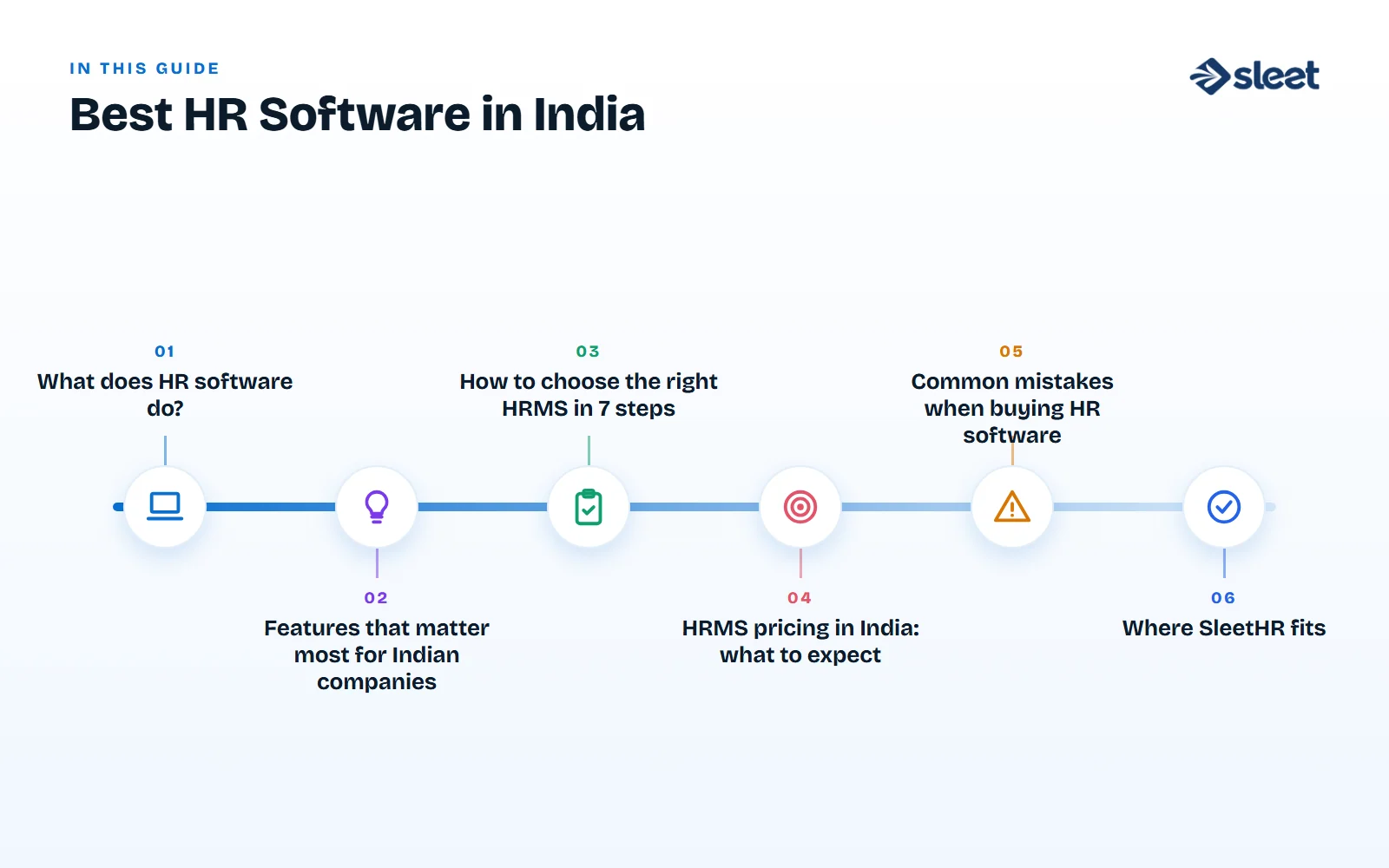
What does HR software do?
- ✓Attendance: biometric, mobile GPS geofencing, shift rosters and overtime.
- ✓Leave management: policies, balances, approvals and holiday calendars per state.
- ✓Payroll: salary structures, arrears, reimbursements, payslips and bank transfer files.
- ✓Compliance: PF and ESI returns, TDS and Form 130 (Form 16), Professional Tax and Labour Welfare Fund.
- ✓Employee lifecycle: onboarding, documents, letters, full and final settlement.
- ✓Self-service: a mobile app where employees view payslips, apply for leave and mark attendance.
Features that matter most for Indian companies
Global HR tools often miss local rules. When you evaluate HRMS software in India, check these first:
| Requirement | What to look for |
|---|---|
| PF and ESI | Auto-calculated contributions, ECR file generation, wage-ceiling handling |
| TDS | Old and new tax regime, investment declarations, Form 130 (Form 16) and 24Q data |
| Professional Tax | State-wise slabs for every state you operate in |
| Labour codes | Support for the new wage definition and gratuity rules |
| Attendance | GPS geofence, selfie or face check, biometric device integration |
| Data protection | DPDP Act-aligned consent, role-based access, encrypted storage in India |
How to choose the right HRMS in 7 steps
- List your must-haves: payroll accuracy, attendance method, number of branches and states.
- Count your employees. Pricing is usually per employee per month, so model the cost at your headcount today and in 12 months.
- Ask for a demo using your own salary structure, not a sample company.
- Check statutory coverage for every state where you have staff.
- Test the employee mobile app yourself. Adoption fails when the app is clumsy.
- Confirm data migration support, onboarding time and who your support contact will be.
- Run one parallel payroll before committing to an annual plan.

HRMS pricing in India: what to expect
Most vendors charge per employee per month, often with a minimum monthly fee, and some add implementation or module charges. Compare the all-in monthly cost, including payroll, attendance and compliance modules, rather than the headline per-user rate. SleetHR plans start from Rs 19 per employee per month with a free trial so you can test payroll on real data first.
Common mistakes when buying HR software
- ✓Choosing on features lists instead of a live payroll test.
- ✓Ignoring state-specific rules such as Professional Tax and Labour Welfare Fund.
- ✓Paying for a bundle of modules the team will never use.
- ✓Skipping employee-app testing, then fighting low adoption later.
Where SleetHR fits
SleetHR is an AI-powered HRMS built for Indian businesses. It combines GPS and biometric attendance, 10-minute payroll runs, PF, ESI, TDS and Professional Tax compliance, leave management and an employee mobile app in one platform, with WhatsApp-based approvals for managers. Teams can book a demo or start a free trial and run a parallel payroll before switching.
FAQs
What is the difference between HR software and HRMS? The terms are used interchangeably. HRMS usually implies a fuller suite covering payroll, attendance and compliance, while HR software can also mean a single-purpose tool.
Which is the best HR software in India? There is no single best option. The right choice depends on headcount, industries, states and budget. Use the checklist above and test payroll on your own data.
How long does HRMS implementation take? Small and mid-sized teams commonly go live within one to two weeks, including data migration.
Is HR software worth it for a small business? Yes, once you have roughly 10 or more employees. It removes spreadsheet payroll errors and keeps PF, ESI and TDS filings on time.

Written by
Founder, Airwix Technologies (Sleet)
Vatsal Sutariya is the founder of Airwix Technologies in Ahmedabad, the company that builds Sleet: SleetHR for HR and payroll, and Sleet Accounting for GST billing and books. He writes about GST, invoicing, business tax and choosing software for Indian businesses, and checks each rule against the official notification before it is published.
LinkedIn profile →