
How HRMS Automates Statutory Compliance (PF, ESI, PT, TDS)
An HRMS automates PF and ESI at the correct rates, state-wise professional tax slabs, TDS under both tax regimes, and filing-ready ECR files and challans. It matters most past a few hundred employees across several states, where tracking PT slabs and LWF rules by hand is unmanageable and a mid-quarter rate change is easily missed.

Indian payroll compliance covers Provident Fund, ESI, state-wise Professional Tax, Labour Welfare Fund and TDS under two possible tax regimes, each with its own due dates and rate revisions. Tracking all of it by hand is where most payroll penalties begin. A good HRMS applies the rules for you.
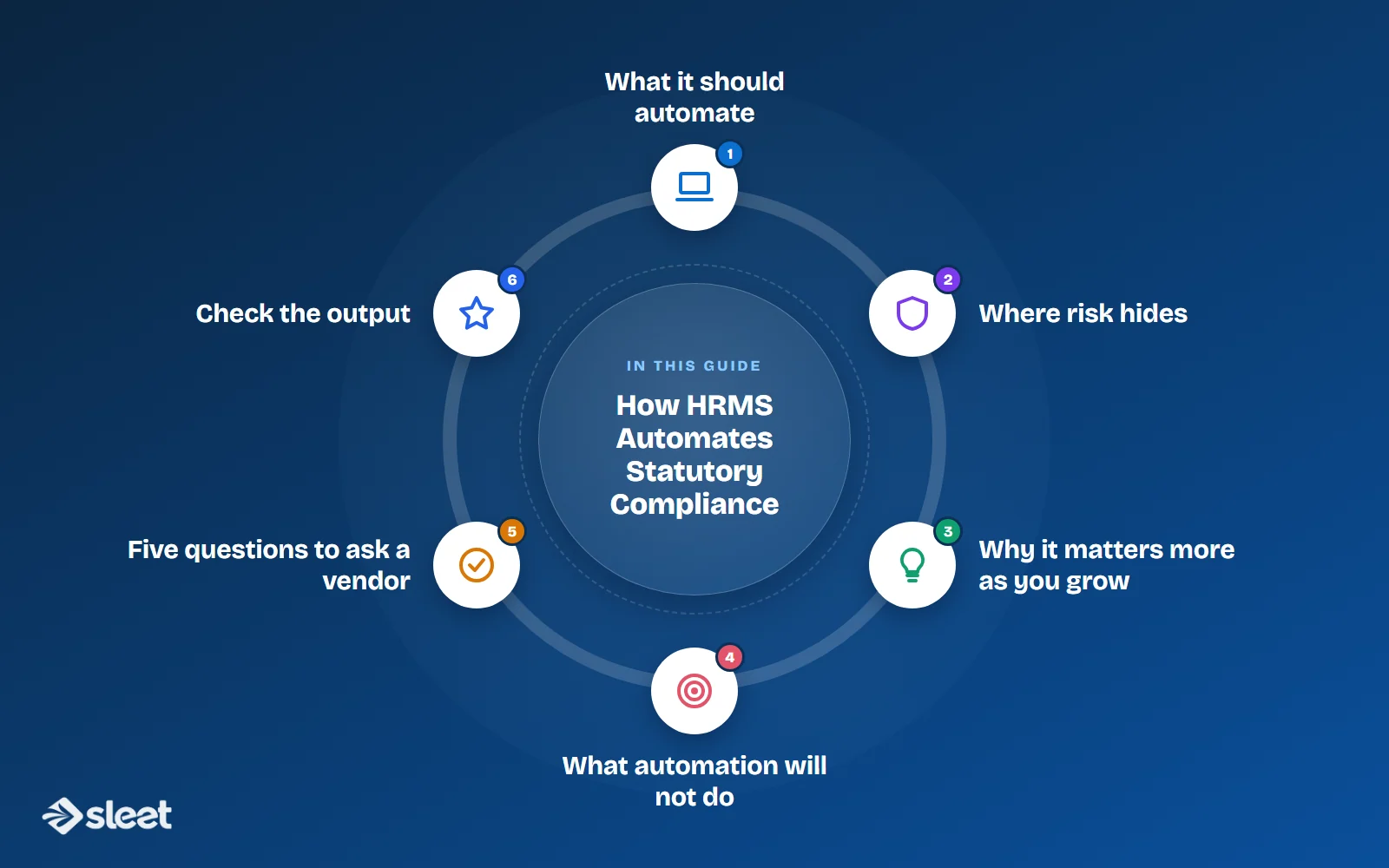
What it should automate
| Area | What the system does |
|---|---|
| PF and ESI | Calculates contributions at the right rate on eligible wages, and handles ceilings |
| Professional tax | Applies the slab for each employee's work state, and updates when a state revises it |
| Labour Welfare Fund | Computes and reminds you of the contribution due in each state |
| TDS | Calculates under old and new regimes, and recalculates when pay changes |
| Filings | Generates the ECR, ESIC and TDS return data in the required formats |
| Calendar | Reminds you of due dates |

Where risk hides
Compliance risk seldom comes from not knowing the rules. It comes from a rate change landing mid-quarter and nobody updating the formula that uses it. Automation helps most when it comes with a clear process for updates.
Why it matters more as you grow
With a handful of employees in one state, manual tracking is annoying but manageable. With a few hundred across several states, differing professional tax slabs and welfare fund rules make it hard to track manually, and one missed update repeats for everyone.

What automation will not do
- ✓Decide how to classify an allowance or a worker. That needs judgement and advice.
- ✓Fix wrong inputs. If attendance or salary data is wrong, the output will be wrong.
- ✓Replace someone who owns compliance and reviews the results.
Five questions to ask a vendor
- How do you learn about rate changes, and how fast do you update?
- Can I see the change log for the last few updates?
- Which states and which acts are supported today?
- What do you do when a state notification is unclear?
- Who is responsible if the software computes something wrongly?
Check the output
Each month, compare a sample of employees with a manual calculation, and match deductions to the challans you pay. Reconciling monthly beats finding errors at year end.

Written by
HR Manager, Airwix Technologies (Sleet)
Nihit Dobariya is the HR Manager at Airwix Technologies in Ahmedabad, where he runs HR and payroll for the team behind Sleet. He writes about payroll, PF and ESIC, professional tax, the labour codes and everyday HR practice for Indian employers, and checks each rule against the official notification before it is published.
LinkedIn profile →