
ROI of HRMS: How to Calculate the Real Cost Savings
Calculate HRMS ROI in four buckets: admin hours reclaimed (hours times loaded hourly cost), payroll errors avoided, compliance penalties avoided and early attrition. Measure HR and finance hours on one payroll close before switching, measure again after three months, and compare the saving with the monthly cost per employee.

"It saves time" is true, but it is not specific enough to put in a budget request. A better case breaks the benefit into four parts you can measure and compare with what the system costs per employee per month.
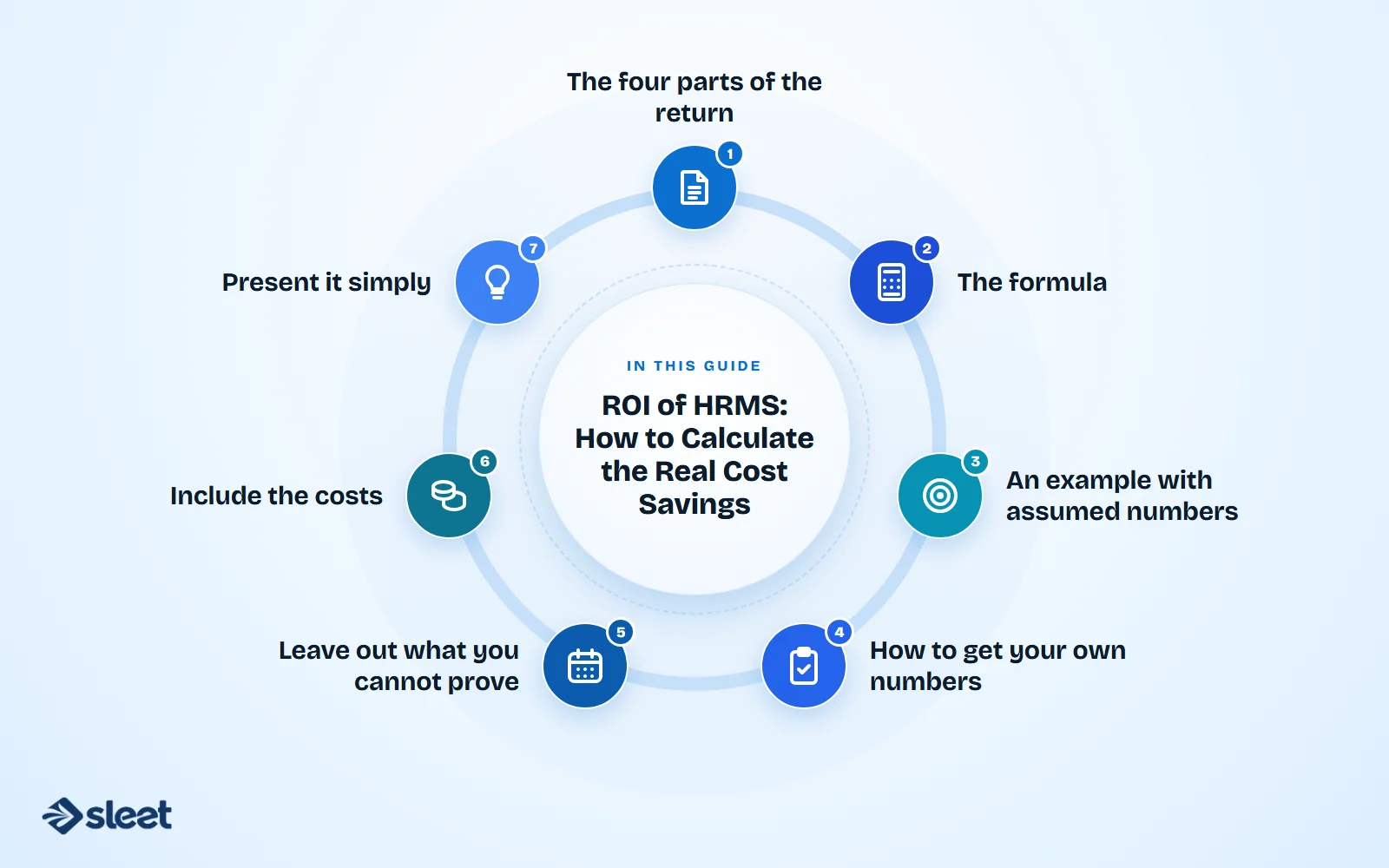
The four parts of the return
- Admin hours saved. Hours that HR, finance and managers spend on payroll, attendance fixes and approvals, times their cost per hour.
- Payroll errors avoided. The cost of corrections, off-cycle payments and rework.
- Penalties avoided. Late fees, interest and notices linked to manual PF, ESI, PT and TDS work.
- Early attrition. Faster onboarding and reliable self-service improve new hires' first months, which may reduce early exits.

The formula
ROI = (annual benefit − annual cost) ÷ annual cost
An example with assumed numbers
These numbers are for illustration only. Replace them with your own.
| Item | Assumption | Per month |
|---|---|---|
| Hours on payroll close before | 40 hours at ₹500 an hour | ₹20,000 |
| Hours on payroll close after | 12 hours at ₹500 an hour | ₹6,000 |
| Time saved | 28 hours | ₹14,000 |
| Correction and rework avoided | Estimated from last year's log | ₹3,000 |
| Total monthly benefit | ₹17,000 | |
| Subscription for 150 employees | ₹60 per employee | ₹9,000 |
| Net monthly benefit | ₹8,000 |
Annual benefit is ₹2,04,000 against an annual cost of ₹1,08,000, so ROI is about 89 percent in this example. If your own numbers do not support a case, that is useful to know before you buy.

How to get your own numbers
- ✓Track the hours your team spends on one full payroll close before you switch.
- ✓Count payroll corrections and off-cycle payments for the last twelve months.
- ✓Add any penalties or interest paid in the same period.
- ✓Measure again after three months on the new system.
Leave out what you cannot prove
Do not count a vague "productivity gain". A smaller number that finance trusts is better than a large number it questions.
Include the costs
Add the subscription, set-up, data migration, training and the time your team spends in the first months. A realistic cost makes your estimate credible.
Present it simply
Show current cost, expected cost and the difference, with the assumptions listed. Offer to review the actual figures after a quarter.

Written by
HR Manager, Airwix Technologies (Sleet)
Nihit Dobariya is the HR Manager at Airwix Technologies in Ahmedabad, where he runs HR and payroll for the team behind Sleet. He writes about payroll, PF and ESIC, professional tax, the labour codes and everyday HR practice for Indian employers, and checks each rule against the official notification before it is published.
LinkedIn profile →