
HR Metrics Every Small Team Should Track (With Formulas)
A small HR team can track a handful of metrics: attrition rate (leavers divided by average headcount, times 100), time to hire, cost per hire, offer acceptance rate, absenteeism rate, payroll accuracy and on-time statutory filings. Pick five to eight, define each in writing, review monthly for trends and break them down by team.

You do not need a data science team to benefit from HR analytics. A handful of well-chosen metrics, tracked consistently, will show where your people processes are strong and where they are struggling.
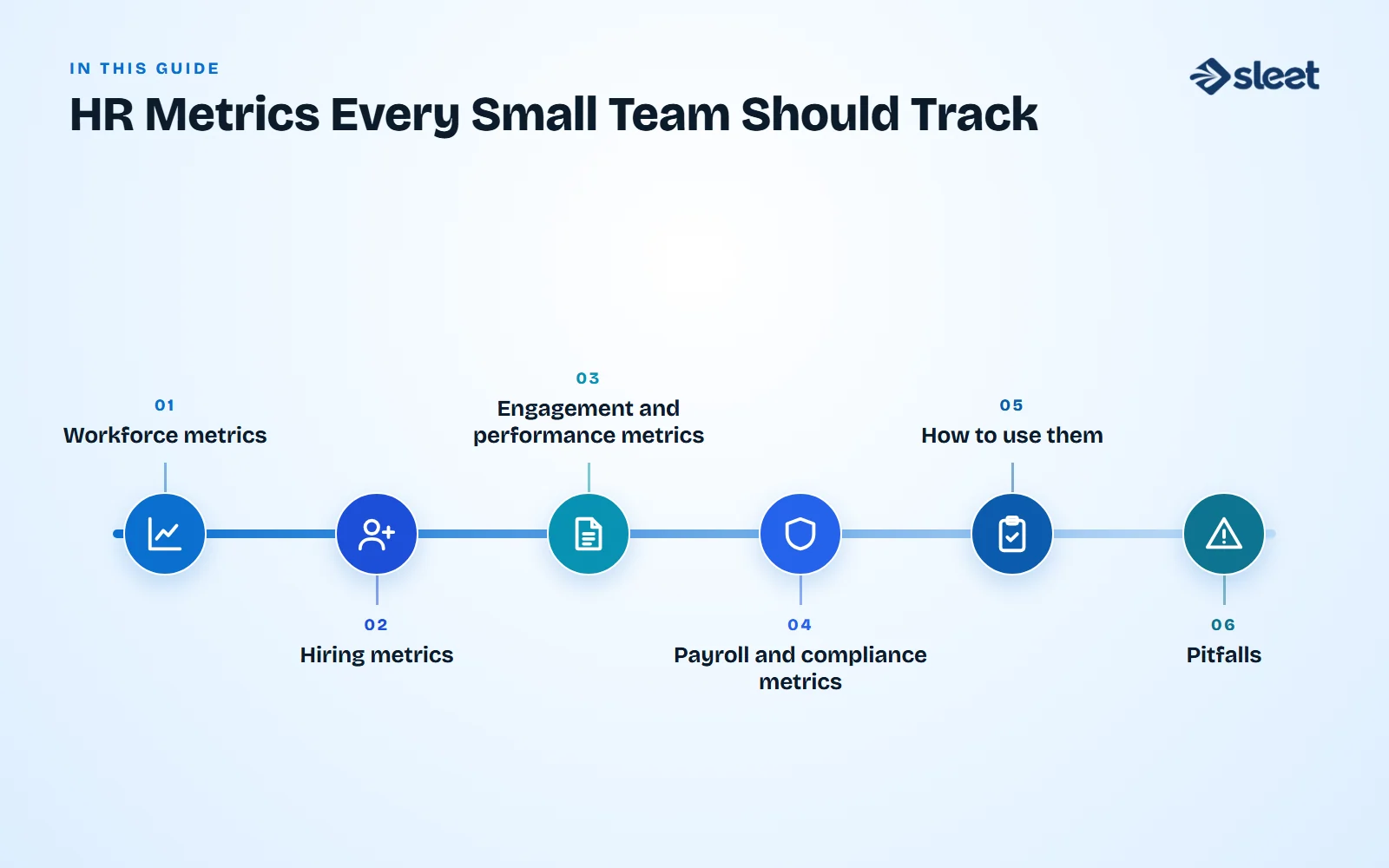
Workforce metrics
- ✓Headcount: Number of employees at a point in time, by department and location.
- ✓Attrition rate: Employees who left in a period divided by average headcount, multiplied by 100.
- ✓Retention rate: The share of employees who stayed over a period.
- ✓Tenure: Average length of service, useful for spotting early exits.

Hiring metrics
- ✓Time to hire: Days from job opening to offer acceptance.
- ✓Cost per hire: Total recruitment cost divided by number of hires.
- ✓Offer acceptance rate: Offers accepted divided by offers made.
- ✓Quality of hire: Performance and retention of new hires after six to twelve months.
Engagement and performance metrics
- ✓Engagement score: From regular pulse surveys.
- ✓Absenteeism rate: Unplanned absence days divided by working days.
- ✓Training hours per employee.
- ✓Goal completion rate.

Payroll and compliance metrics
- ✓Payroll accuracy: Payslips without corrections divided by total payslips.
- ✓On-time statutory filings: Returns filed by the due date.
- ✓Cost to company per employee, and payroll as a share of revenue.
How to use them
- ✓Pick five to eight metrics that match your current priorities.
- ✓Define each one in writing so that everyone calculates it the same way.
- ✓Review monthly and look at trends, not just single numbers.
- ✓Break down by team, location and tenure to find hot spots.
- ✓Pair numbers with stories from managers and employees.
Pitfalls
- ✓Collecting too many metrics.
- ✓Using numbers to blame instead of learn.
- ✓Ignoring data quality, which makes the results unreliable.
- ✓Comparing yourself with benchmarks that do not fit your industry or size.
What gets measured gets discussed, so measure what you want to improve.
A dashboard connected to your HR system updates metrics automatically and gives leaders a single view of the workforce.

Written by
HR Manager, Airwix Technologies (Sleet)
Nihit Dobariya is the HR Manager at Airwix Technologies in Ahmedabad, where he runs HR and payroll for the team behind Sleet. He writes about payroll, PF and ESIC, professional tax, the labour codes and everyday HR practice for Indian employers, and checks each rule against the official notification before it is published.
LinkedIn profile →