
Experience Letter Format: Sample & Key Clauses
An experience letter states the role, department, dates of employment and main responsibilities, with a neutral or positive line on conduct if one is warranted, on letterhead with an authorised signature. Future employers rely on it in reference checks. Issue it with the final settlement so the details match the resume and nobody has to chase it months later.

An experience letter certifies the role an employee held, the period they worked and, often, a short comment on their work or conduct. A relieving letter confirms that someone has left, whereas an experience letter is the one future employers rely on during reference checks.
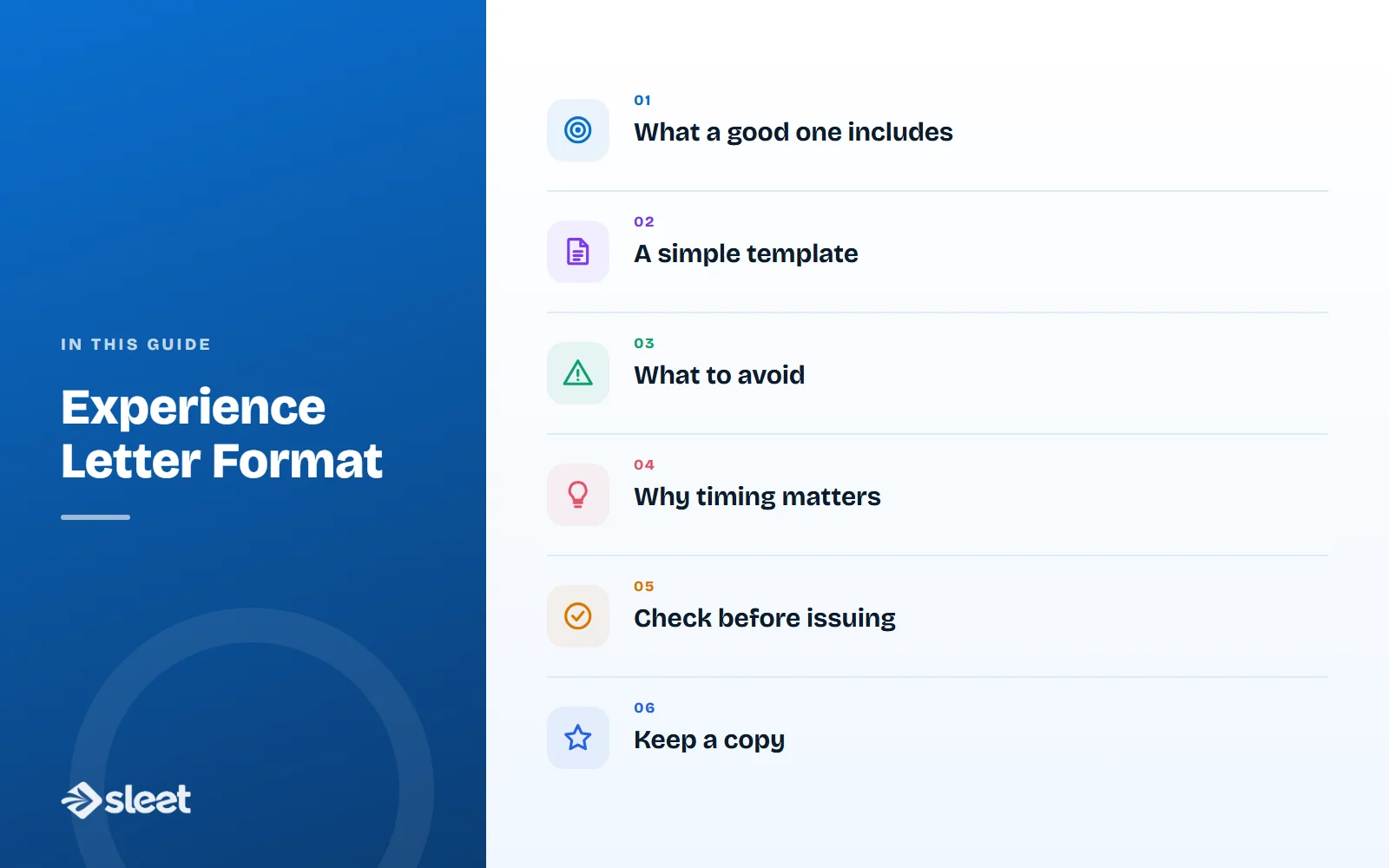
What a good one includes
- ✓Role and department. The exact designation, matching what the employee puts on their resume.
- ✓Dates. Precise joining and last working dates.
- ✓Responsibilities. A short, factual summary of the scope of the job.
- ✓Conduct. A neutral or positive line. If it cannot be positive, leave it out and do not write negatives.
- ✓Letterhead and signature of an authorised person.

A simple template
[Company letterhead]
Date: [date]
To whom it may concern
This is to certify that [Name] worked with [Company] as [designation] in the [department] team from [joining date] to [last working day]. In this role, [Name] was responsible for [two or three main duties]. During this period, [Name]'s conduct was professional.
We wish [Name] the best in future work.
[Name and designation of signatory]
What to avoid
- ✓Exaggerated titles or responsibilities
- ✓Comments on performance that you cannot support
- ✓Personal remarks or anything that could be read as defamatory
- ✓Dates that differ from payroll records

Why timing matters
If someone asks for the letter a year after they left, the manager who knew their work may have moved on, and the details are harder to confirm. Issue it with the full and final settlement, instead of waiting for a request. That also cuts the number of requests from former employees.
Check before issuing
| Check | Source |
|---|---|
| Designation and department | HR master record |
| Joining and last dates | Payroll |
| Responsibilities | Job description and manager |
| Signature | Authorised signatory |
Keep a copy
Store a copy of every letter issued. When a new employer calls to verify one, you can confirm it in minutes and the facts will match.

Written by
HR Manager, Airwix Technologies (Sleet)
Nihit Dobariya is the HR Manager at Airwix Technologies in Ahmedabad, where he runs HR and payroll for the team behind Sleet. He writes about payroll, PF and ESIC, professional tax, the labour codes and everyday HR practice for Indian employers, and checks each rule against the official notification before it is published.
LinkedIn profile →