
Employee Benefits in India: Statutory and Voluntary Benefits Explained
Statutory benefits in India include provident fund, ESI for covered employees, gratuity after five years of service, maternity benefit (26 weeks for eligible women for the first two children), paid leave and holidays, and statutory bonus. Common voluntary benefits are group health insurance, term life cover, wellness support, learning budgets, flexibility and ESOPs.

Benefits are the part of the compensation package beyond salary. Some are required by law, while others are offered by employers to attract and retain talent. A thoughtful mix can make a pay offer far more compelling.
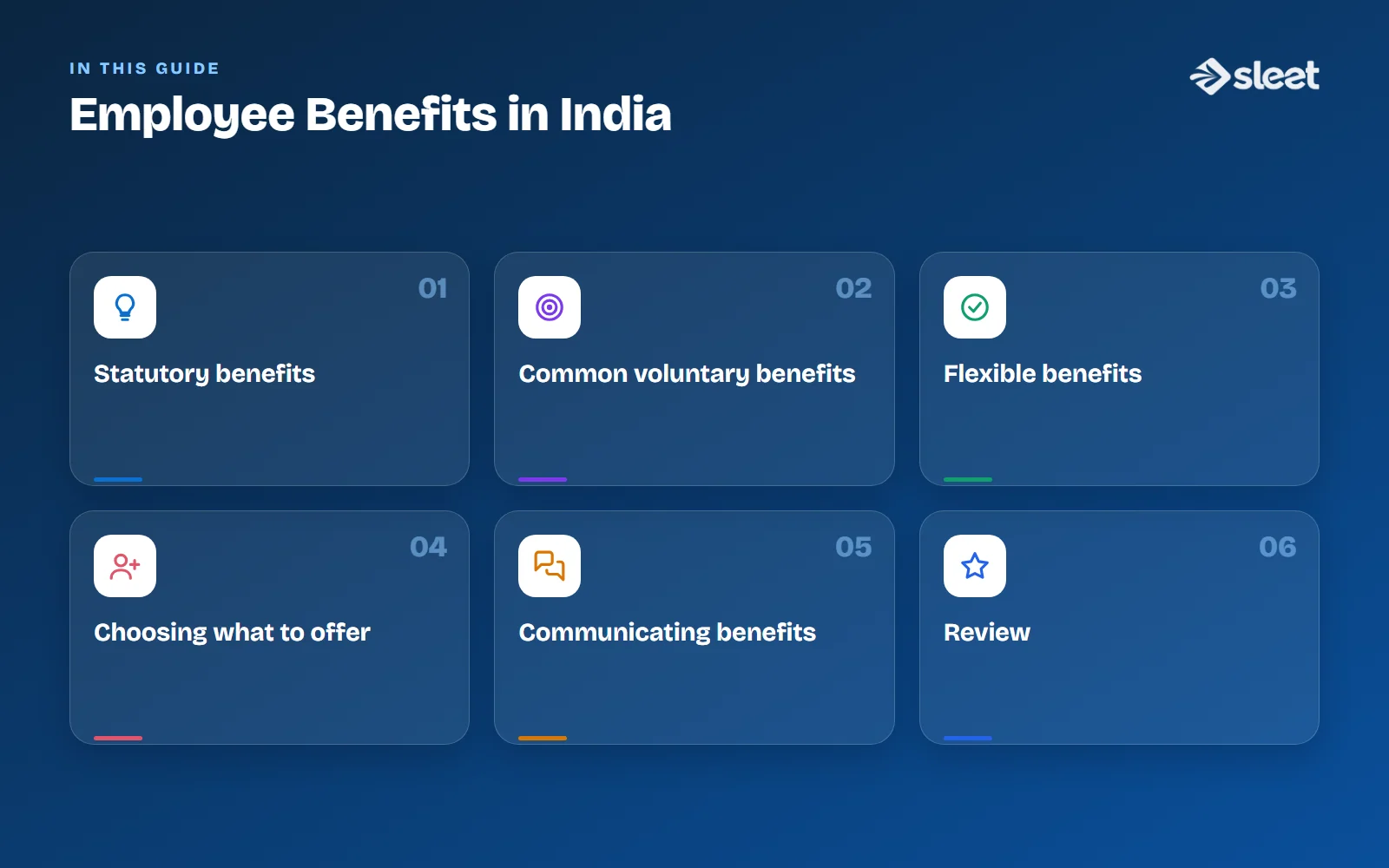
Statutory benefits
- ✓Provident Fund: Retirement savings with contributions from employee and employer.
- ✓Employees' State Insurance: Medical and cash benefits for covered employees with wages within the ceiling.
- ✓Gratuity: A lump sum for employees who complete five years of service.
- ✓Maternity benefit: Paid leave, 26 weeks for eligible women for the first two children, along with other provisions.
- ✓Paid leave and holidays: As per state law and company policy.
- ✓Statutory bonus: For eligible employees under the Payment of Bonus Act.

Common voluntary benefits
- ✓Group health insurance covering the employee and often family members.
- ✓Term life and accident cover.
- ✓Meal and transport support.
- ✓Wellness programmes, gym memberships and counselling.
- ✓Learning and certification budgets.
- ✓Flexible work and extra leave.
- ✓Employee stock options.
- ✓Child care support and parental leave beyond the law.
Flexible benefits
Flexible benefit plans let employees choose how to use a portion of their pay, for example for meal cards, books or fuel. Some are tax efficient under the old regime, so design them with a tax adviser.

Choosing what to offer
- ✓Survey employees on what they value.
- ✓Consider age and life stage; younger staff may prefer learning and flexibility, older staff may value family health cover.
- ✓Check cost and administrative effort.
- ✓Make sure the benefits are inclusive and equitable.
Communicating benefits
Many employees do not know what they have. Share a simple total rewards statement showing salary, benefits and employer contributions. Remind people before enrolment periods.
Review
Look at claims data, usage and satisfaction every year, and switch providers if service is poor.
Benefits matter most on the day an employee needs them, so make them easy to use.
Combine statutory compliance with a few well-chosen extras, and track the impact on retention and satisfaction.

Written by
HR Manager, Airwix Technologies (Sleet)
Nihit Dobariya is the HR Manager at Airwix Technologies in Ahmedabad, where he runs HR and payroll for the team behind Sleet. He writes about payroll, PF and ESIC, professional tax, the labour codes and everyday HR practice for Indian employers, and checks each rule against the official notification before it is published.
LinkedIn profile →