
Taxable, Non-Taxable and Partly Taxable Salary Components Explained
Salary components fall into three groups. Basic, DA, special allowance, bonus, commission, arrears and leave encashment during service are fully taxable. HRA, LTA and gratuity are partly exempt, with HRA and LTA available only under the old regime. Bill-backed reimbursements and employer PF within limits are tax-free.

Not every rupee on a payslip is taxed the same way. Understanding which components are fully taxable, partly taxable and tax free helps employers compute TDS correctly and helps employees plan their investments.
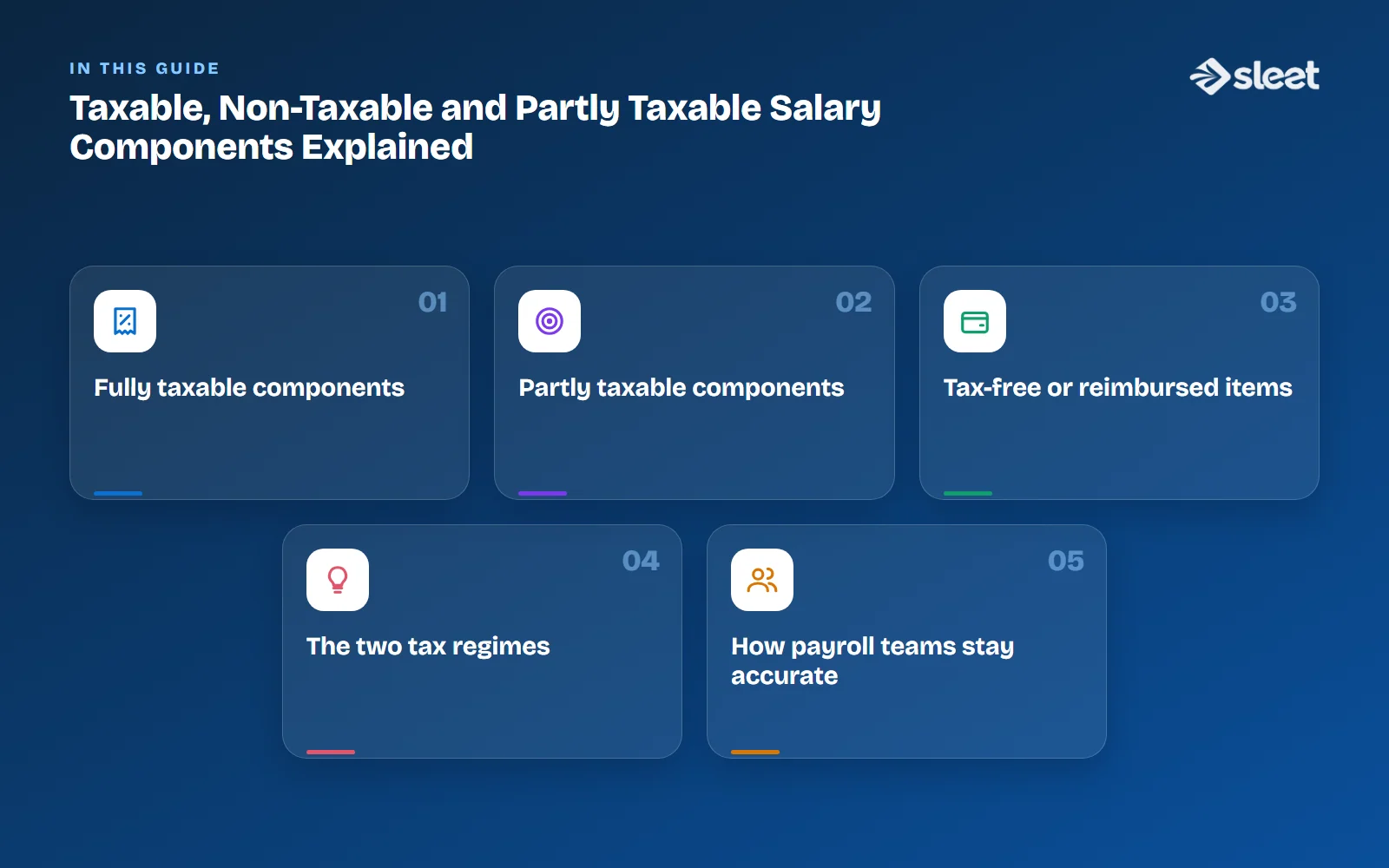
Fully taxable components
- ✓Basic salary and dearness allowance
- ✓Special allowance and most fixed allowances
- ✓Bonus, incentives and commission
- ✓Leave encashment received during service
- ✓Arrears of salary
These are added to taxable income in the month they are paid or become due.

Partly taxable components
- ✓HRA: Exempt up to the least of actual HRA received, rent paid minus 10 percent of salary, and 50 or 40 percent of salary depending on the city. Available only under the old regime.
- ✓Leave travel allowance: Exempt for actual travel costs within India for a limited number of journeys in a block of years, under the old regime.
- ✓Gratuity: Exempt up to the statutory limit on retirement or resignation after five years of service.
- ✓Leave encashment on retirement: Exempt up to a ceiling set by the law.
Tax-free or reimbursed items
- ✓Reimbursements supported by bills, such as internet, books, or phone for business use, when paid as reimbursements and not as fixed pay.
- ✓Employer contribution to PF within the limit.
- ✓Certain meal vouchers within the prescribed amount.
- ✓Gifts below the annual limit.

The two tax regimes
The new tax regime offers lower slab rates but removes most exemptions and deductions, including HRA and LTA. The old regime keeps them. Employees should compare both each year, and payroll software should compute TDS under whichever regime the employee chooses.
How payroll teams stay accurate
- ✓Collect declarations early in the year and proofs before the final quarter.
- ✓Pay reimbursements against bills, so the exemption can be defended.
- ✓Review the exemption list every Budget, because limits change.
- ✓Keep a record of the regime each employee selected.
A tax-free component without paperwork is only tax-free until the first audit.
Always confirm current limits with a qualified tax professional, since figures and rules change from one financial year to the next.

Written by
HR Manager, Airwix Technologies (Sleet)
Nihit Dobariya is the HR Manager at Airwix Technologies in Ahmedabad, where he runs HR and payroll for the team behind Sleet. He writes about payroll, PF and ESIC, professional tax, the labour codes and everyday HR practice for Indian employers, and checks each rule against the official notification before it is published.
LinkedIn profile →