
Succession Planning: A Practical Process for Growing Companies
Succession planning prepares people to step into key roles when current holders leave. Identify critical roles, define what each needs, assess possible successors, label their readiness (now, one to two years, three to five), build development plans, create a talent pool and review twice a year. Plan external options for the riskiest roles.

Succession planning is the process of preparing people to step into key roles when the current holders leave, retire or move on. It is insurance against sudden gaps, and it is also a retention tool, because employees stay when they can see a path forward.
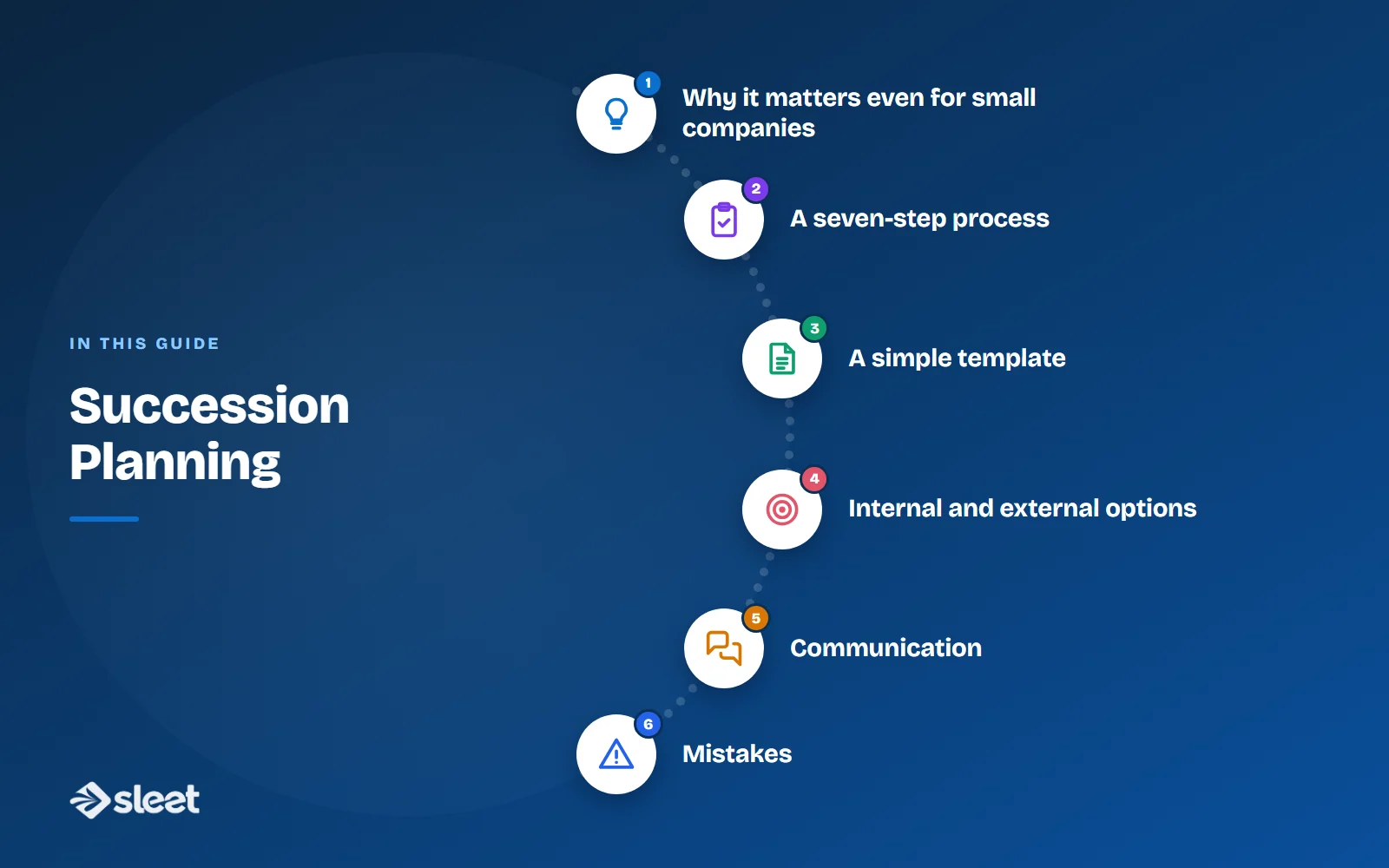
Why it matters even for small companies
When a founder, head of finance or lead engineer leaves unexpectedly, work stalls and customers notice. A basic plan, even a simple one, reduces the shock.

A seven-step process
- ✓Step 1, identify critical roles: Choose roles where a vacancy would seriously harm operations, such as leadership, scarce skills and single points of failure.
- ✓Step 2, define what the role needs: Skills, experience and behaviours that matter for success.
- ✓Step 3, assess potential successors: Use performance data, potential assessments and manager input.
- ✓Step 4, check readiness: Label candidates as ready now, ready in one to two years, or ready in three to five years.
- ✓Step 5, build development plans: Stretch assignments, mentoring, rotations and training.
- ✓Step 6, create a talent pool: A group of people prepared for several roles, which offers flexibility.
- ✓Step 7, review regularly: Revisit twice a year, since people and strategy change.
A simple template
For each critical role, record the current holder, risk of leaving, possible successors, readiness level and the main development actions for each successor.

Internal and external options
Plan for both. Not every role will have an internal successor, and sometimes bringing in outside talent is the right choice. Keep a list of potential external candidates for the highest-risk roles.
Communication
Be careful about how you tell people they are on a succession list. Some firms share development plans openly without promising a promotion. Avoid creating expectations you cannot meet.
Mistakes
- ✓Naming a single obvious successor and ignoring alternatives.
- ✓Choosing people who look like the current leader.
- ✓Planning without a development budget.
- ✓Doing it once and never updating.
Succession is a development plan with a destination.
Link your succession plan with performance data and the talent grid, and use software to keep the information current and confidential.

Written by
HR Manager, Airwix Technologies (Sleet)
Nihit Dobariya is the HR Manager at Airwix Technologies in Ahmedabad, where he runs HR and payroll for the team behind Sleet. He writes about payroll, PF and ESIC, professional tax, the labour codes and everyday HR practice for Indian employers, and checks each rule against the official notification before it is published.
LinkedIn profile →