
Salary Disbursement in India: NEFT, RTGS, UPI and Bulk Payment Compared
Employers typically pay salaries through a bank bulk-upload file using NEFT, with RTGS for large amounts (usually above ₹2 lakh) and IMPS or UPI for quick corrections. Wages are due within roughly 7 to 10 days after the wage period, depending on size. Verify accounts, use two-person approval and reconcile on the same day.

Calculating salaries correctly is only useful if the money reaches each employee's bank account on time. Disbursement deserves its own process, since small errors here lead to angry messages on the pay date.
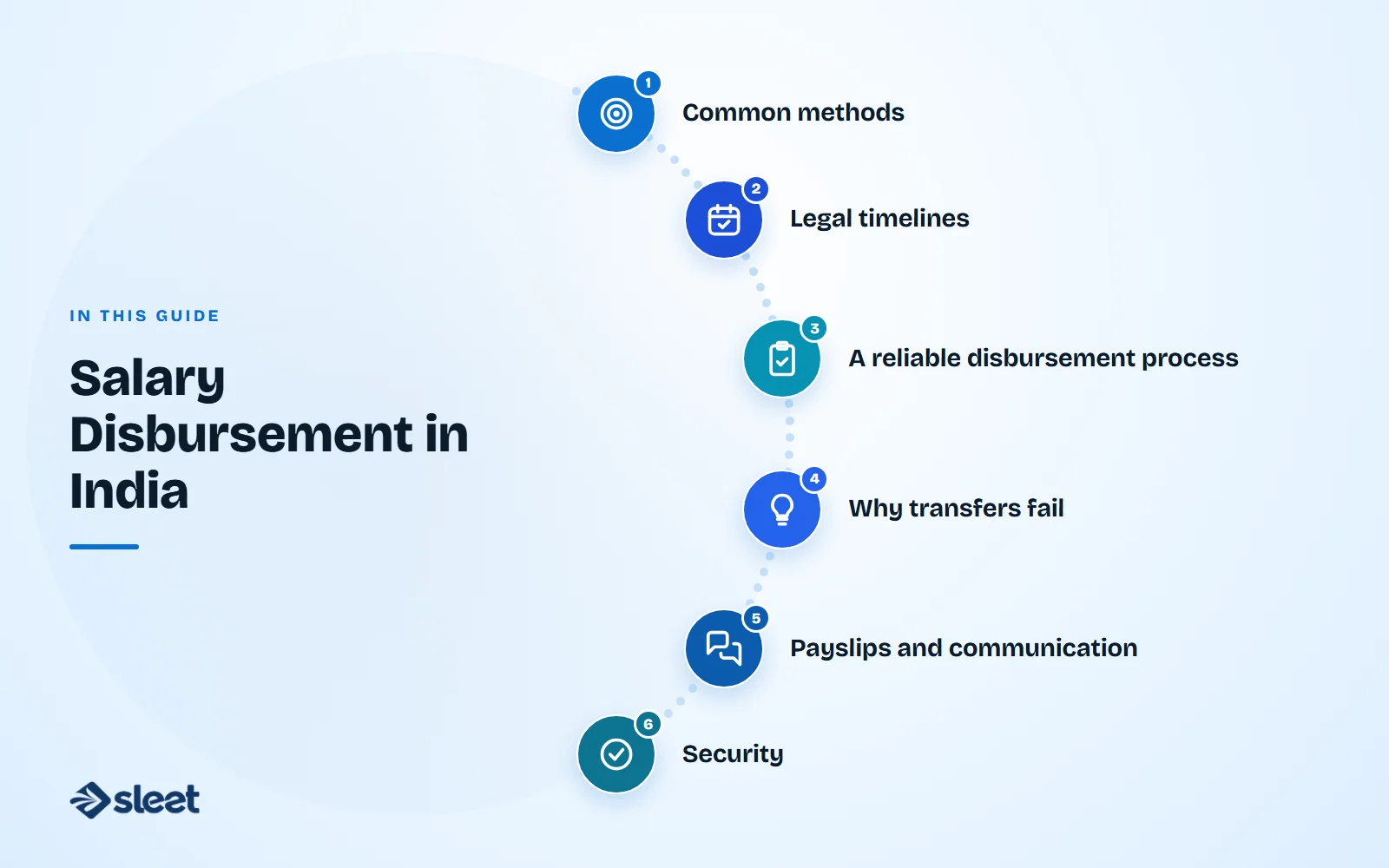
Common methods
- ✓NEFT: Batch-based electronic transfer, widely used for monthly salary and available round the clock.
- ✓RTGS: Real-time settlement for larger amounts, usually above ₹2 lakh, suited to senior payouts.
- ✓IMPS and UPI: Instant transfers, useful for corrections and small off-cycle payments.
- ✓Bank bulk upload: A file in the bank's format uploaded to the corporate banking portal to pay all employees at once.
- ✓Cheque and cash: Largely avoided now, and cash wages bring record-keeping and legal concerns.

Legal timelines
The law requires wages to be paid within a set number of days after the wage period ends. For many establishments this is the 7th of the following month, or the 10th for larger ones. The labour codes follow a similar approach. Delays can bring penalties and employee complaints, so build the due date into your payroll calendar.
A reliable disbursement process
- ✓Verify bank account details for every new joiner, ideally with a small penny-drop test.
- ✓Generate the bank file from the approved payroll and avoid editing it by hand.
- ✓Use dual authorisation, so one person uploads and another approves.
- ✓Reconcile the debit and credits with the bank statement on the same day.
- ✓Keep a list of failed credits and re-pay them quickly.

Why transfers fail
- ✓Closed or dormant accounts.
- ✓Wrong IFSC codes.
- ✓Names that do not match the account.
- ✓Daily limit breaches in the corporate account.
Payslips and communication
Send payslips by email or an app the moment salaries are credited. Employees who see a payslip right away have fewer questions and are less likely to suspect an error.
Security
- ✓Restrict who can access bank files.
- ✓Use encryption and audit logs.
- ✓Never send bank details over personal messaging apps.
Salary day is the one day employees notice HR more than any other.
Choose payroll software that connects to your bank formats, tracks failed payments and stores proof of payment in the employee record.

Written by
HR Manager, Airwix Technologies (Sleet)
Nihit Dobariya is the HR Manager at Airwix Technologies in Ahmedabad, where he runs HR and payroll for the team behind Sleet. He writes about payroll, PF and ESIC, professional tax, the labour codes and everyday HR practice for Indian employers, and checks each rule against the official notification before it is published.
LinkedIn profile →