
The Payroll Process, Step by Step: From Attendance Data to Bank Transfer
A payroll cycle has seven steps: freeze inputs, validate data, compute, review and approve, disburse, make statutory payments and post to accounts. Someone other than the preparer should review it. Deposit TDS by the 7th and PF and ESI by the 15th. Most errors come from changes slipped in after approval.

A payroll cycle looks like one big task on the last day of the month, but it is really a chain of smaller steps. If each link is clean, the end result takes care of itself.
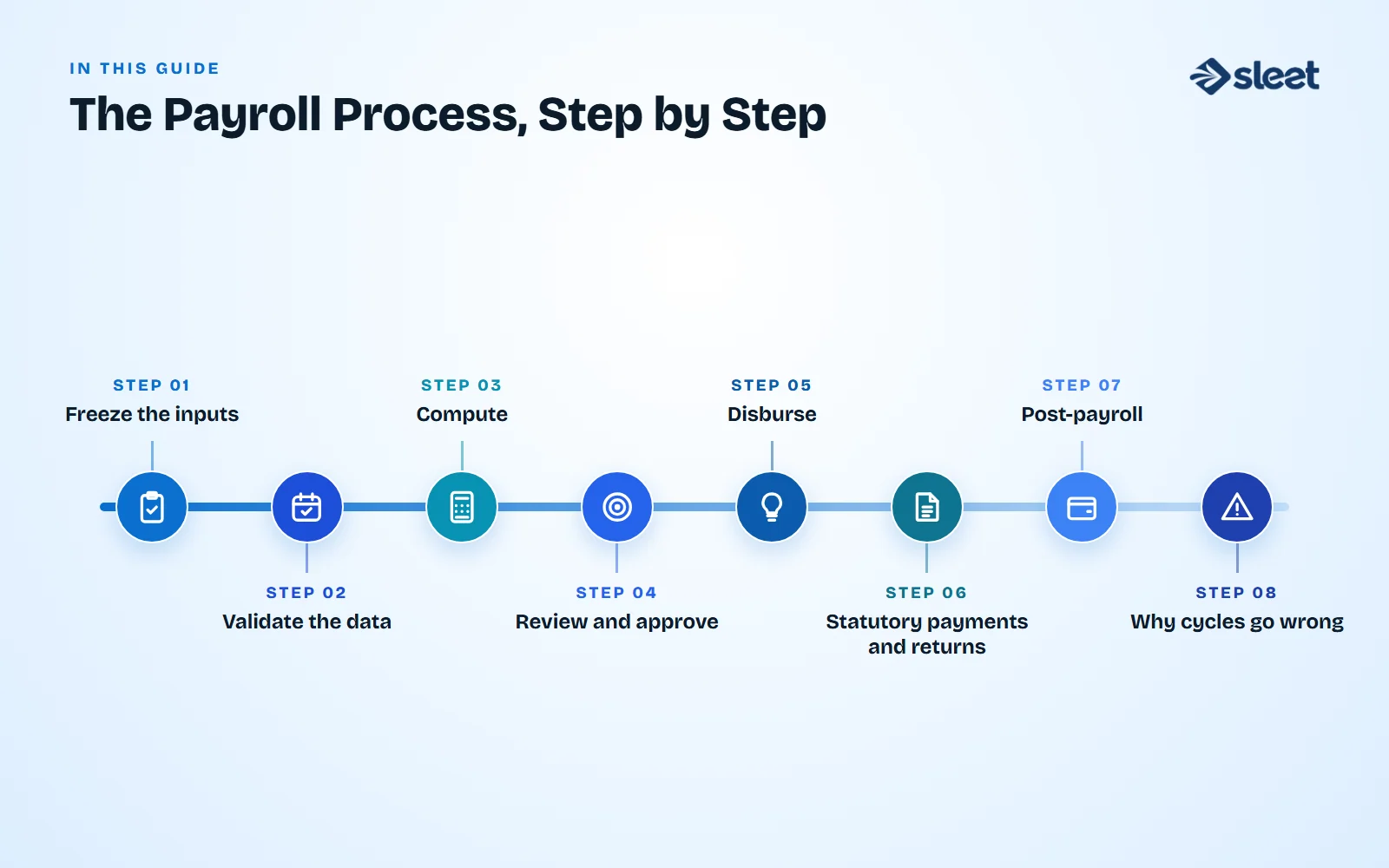
Step 1: Freeze the inputs
Gather everything that changes pay for the month: joiners and leavers, attendance and leave, overtime, new salary revisions, bonuses, loans, reimbursements and tax declarations. Set a cut-off date so that late changes move to the next cycle or are handled as a clearly marked adjustment.

Step 2: Validate the data
- ✓Match attendance to approved leave.
- ✓Check new joiners have complete bank and PAN details.
- ✓Confirm exits have a final settlement flag.
- ✓Compare headcount with the previous month and investigate differences.
Step 3: Compute
The system calculates earnings, then statutory and other deductions, then net pay. Review the variance report to see employees whose net pay moved by more than a set percentage.

Step 4: Review and approve
Payroll should be checked by someone other than the person who prepared it. Finance usually approves the total cost and bank transfer amount.
Step 5: Disburse
Generate the bank file and transfer salaries using NEFT, RTGS or a bulk payment facility. Employees should receive payslips on or around the pay date.
Step 6: Statutory payments and returns
- ✓Deposit TDS by the 7th.
- ✓Pay PF and ESI and file returns by the 15th.
- ✓Pay professional tax and other state levies on the state's schedule.
Step 7: Post-payroll
Post journal entries to accounting, reconcile bank transfers and archive the registers. Log any queries and use them to improve the next cycle.
Why cycles go wrong
- ✓Late changes slipped in after approval.
- ✓Bank details that were never verified.
- ✓Attendance corrections arriving after the freeze.
- ✓No second check on large variances.
A good payroll cycle is boring: same dates, same checks, same result.
Automating the data flow from attendance to payslip removes the most error-prone manual steps. Document each stage with an owner and a deadline so that the process survives staff changes.

Written by
HR Manager, Airwix Technologies (Sleet)
Nihit Dobariya is the HR Manager at Airwix Technologies in Ahmedabad, where he runs HR and payroll for the team behind Sleet. He writes about payroll, PF and ESIC, professional tax, the labour codes and everyday HR practice for Indian employers, and checks each rule against the official notification before it is published.
LinkedIn profile →