
Comp-Off for Working on a Weekly Off or Holiday: When the Law Requires It and When It Can Lapse
Under the OSH Code, a worker who loses a weekly off must get a compensatory holiday within that month or the next two months. Work on a festival holiday brings double wages or a substitute holiday under state law, and in Maharashtra both. Comp-off granted in place of a statutory right should not simply lapse; pay it out instead.

Comp-off is usually run as a goodwill policy: work a Sunday, get a day off later, use it within 30 or 60 days or lose it. That works for managers, but for workers covered by labour law, the comp-off may be a legal entitlement that cannot simply expire. This post separates the two, and sets out approval flows and payroll treatment.
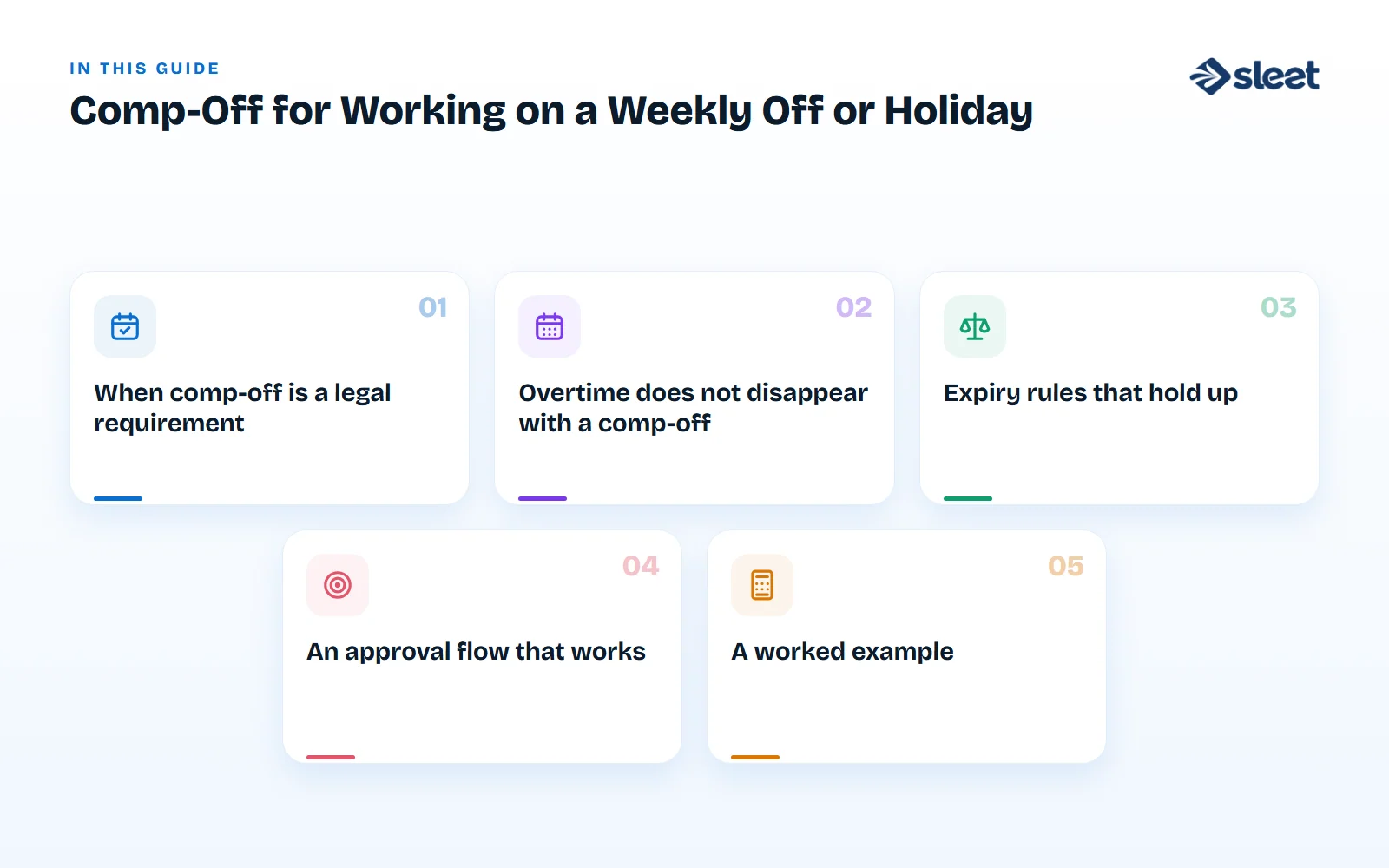
When comp-off is a legal requirement
Weekly off (OSH Code). Section 26 of the Occupational Safety, Health and Working Conditions Code, 2020 says no worker shall work more than six days in a week. Where an exemption allows a worker to lose weekly holidays, Section 26(3) requires compensatory holidays of equal number, within the month in which they were due or within the two months immediately following.
Festival and national holidays (state laws). Holiday work is governed by state law, and the remedy is double wages, a substitute holiday, or both.
| Situation | Law | What the worker gets |
|---|---|---|
| Works on weekly off | OSH Code, Section 26 | Compensatory holiday within that month or the next two months |
| Works on a national or festival holiday, Karnataka | Karnataka National and Festival Holidays Act, 1963 | Double wages, or the day's wages plus a substituted holiday |
| Works on a national or festival holiday, Tamil Nadu | Tamil Nadu National and Festival Holidays Act, 1958 | Twice the wages, or the day's wages plus a substituted holiday |
| Works on a festival holiday, Maharashtra shop or establishment | Maharashtra Shops and Establishments Act, 2017, Section 18 | Double the daily average wages and a substitute holiday |
| Weekly hours go above 48 | OSH Code | Overtime at twice the ordinary rate of wages, whatever comp-off is given |
Who counts as a worker matters. The OSH Code excludes people employed mainly in a managerial or administrative capacity, and those in a supervisory capacity earning more than ₹18,000 a month. For them, comp-off is a contractual benefit your policy can define freely.
Overtime does not disappear with a comp-off
A comp-off replaces a lost rest day; it does not undo the hours. If a worker does six 8-hour days and then works the seventh, that week has 56 hours. The 8 hours above 48 are overtime at twice the ordinary rate, even if a comp-off is given the following week. Many payrolls miss this.
Expiry rules that hold up
- Statutory weekly-off comp-off: schedule it within the OSH Code window: the same month or the next two months. Treat the deadline as the employer's duty to grant, not the employee's duty to claim.
- Holiday comp-off chosen instead of double wages: if the substituted holiday is not given, the worker has received neither remedy. Pay the extra day's wages at month-end of the expiry period.
- Contractual comp-off for managers: a lapse period such as 60 or 90 days is fine if written into the policy and applied consistently.
- Do not convert comp-off into earned leave. The OSH Code earned-leave rules count days worked; comp-off balances should sit in a separate leave type.
An approval flow that works
- Pre-approval: the manager requests weekend or holiday work in the HRMS before the day, with a reason.
- Attendance proof: the punch or timesheet for the day confirms the hours.
- Credit: the system credits comp-off automatically for approved, attended days, with the expiry date set by type: statutory or contractual.
- Overtime check: weekly hours above 48 are flagged for overtime pay separately.
- Reminder: the employee and manager get an alert 15 days before expiry.
- Month-end sweep: expired statutory comp-offs move to payroll for payment; expired contractual comp-offs lapse as per policy.
- Records: keep the holiday-work record, as state rules may require you to notify the inspector or maintain registers for holiday work.
A worked example
A Mysuru warehouse pays pickers ₹20,280 a month for 26 working days, an ordinary wage of ₹780 a day and ₹97.50 an hour for an 8-hour day (₹780 ÷ 8).
Diwali peak: 8 pickers work their weekly off on Sunday after a full 48-hour week, under an exemption from the weekly-holiday rule.
- ✓Weekly hours: 48 + 8 = 56. Overtime: 56 − 48 = 8 hours each.
- ✓Overtime pay: 8 hours × ₹97.50 × 2 = ₹1,560 per picker.
- ✓For 8 pickers: 8 × ₹1,560 = ₹12,480.
- ✓Each picker also gets 1 compensatory holiday, to be given within the same month or the next two months.
Kannada Rajyotsava, 1 November: 3 pickers work and choose a substituted holiday instead of double wages.
- ✓They receive the day's wages (already in their monthly salary) and a substituted holiday.
- ✓One picker's substituted holiday is never scheduled before the policy deadline. Payroll pays the extra day: ₹780, so he receives the double-wage remedy he gave up.
Frequently asked questions
Can an employee choose cash instead of a comp-off for a weekly off?
The OSH Code requires a compensatory holiday, not cash. Paying cash does not replace the rest day, though overtime must still be paid on hours above 48.
Is comp-off taxable when encashed?
Yes. Any payment for a lapsed comp-off is salary and is taxed as such in that month's payroll.
Can a half-day of weekend work earn a half-day comp-off?
For contractual comp-offs, yes, if your policy says so. For statutory weekly-off comp-offs, losing the rest day earns a full compensatory holiday.
Sources
- ✓OSH Code, 2020, Section 26: weekly and compensatory holidays, ICAI Palakkad Branch
- ✓Maharashtra Shops and Establishments Act, 2017, Section 18, LawGist
- ✓Karnataka national and festival holidays, Simpliance
- ✓Tamil Nadu national and festival holidays, Simpliance
This is a summary, not legal advice. Confirm your state's holiday-work rules and OSH Code exemptions with the state labour department or a labour-law professional.

Written by
Founder, Airwix Technologies (Sleet)
Vatsal Sutariya is the founder of Airwix Technologies in Ahmedabad, the company that builds Sleet: SleetHR for HR and payroll, and Sleet Accounting for GST billing and books. He writes about GST, invoicing, business tax and choosing software for Indian businesses, and checks each rule against the official notification before it is published.
LinkedIn profile →