
Collecting Overdue Invoices: A Receivables Process That Gets You Paid Without Losing Customers
Set credit terms and interest on every quotation and invoice, send reminders before and on the due date, call at 7 days overdue, escalate at 15 and 30 days, and fix the real cause of delay. Micro and small suppliers can cite the 45-day rule and use the MSME ODR portal.

Indian businesses routinely wait 60 to 120 days for payment on 30-day terms. Most late payments are not disputes. They are the result of nobody asking at the right time. A simple process fixes much of it.
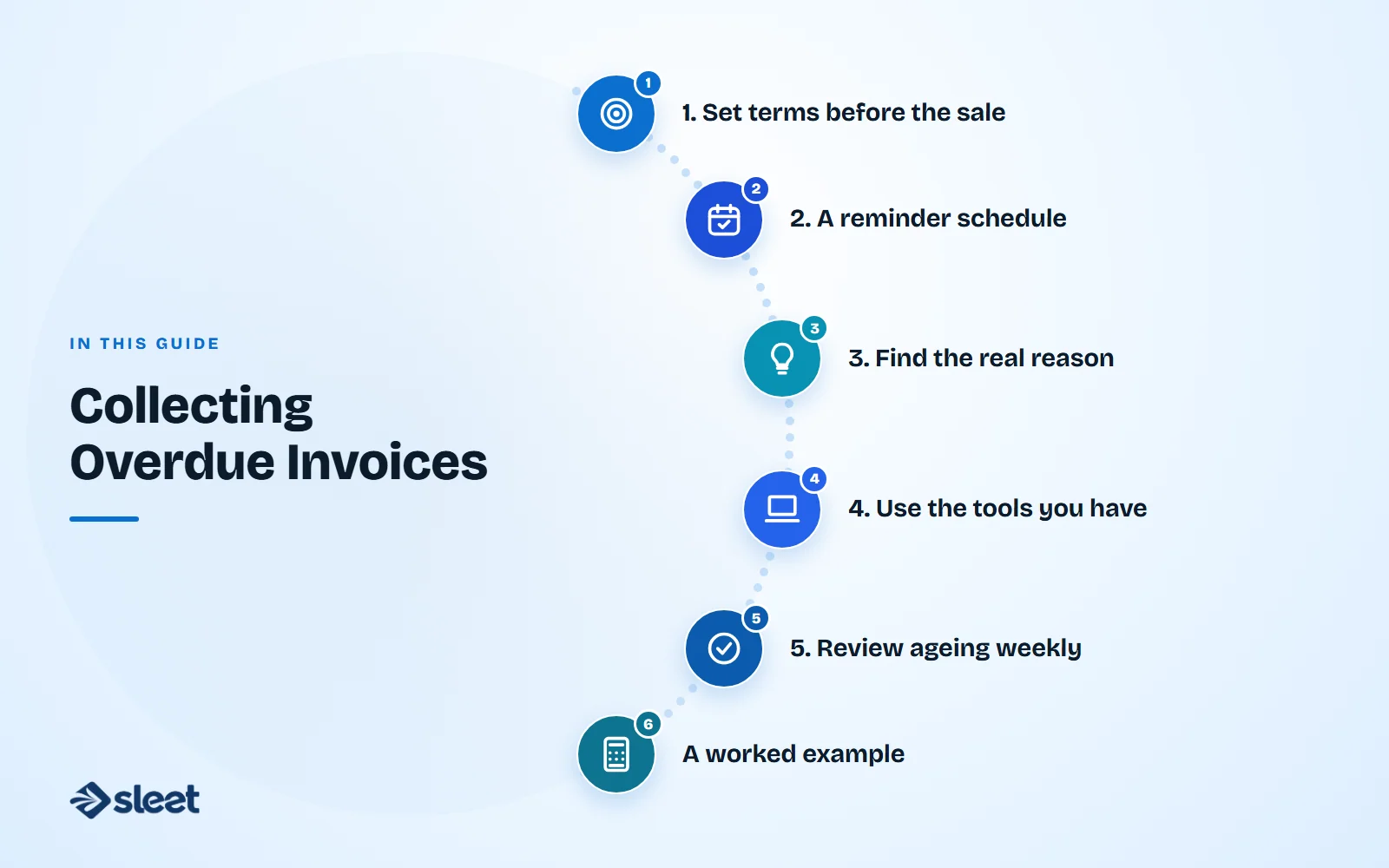
1. Set terms before the sale
- ✓Write the credit period, interest on late payment and the bank details on the quotation, order confirmation and invoice.
- ✓Set a credit limit per customer, and review it when payments slip.
- ✓For new customers, ask for an advance or a shorter credit period until they build a record.
2. A reminder schedule
| Day | Action |
|---|---|
| Invoice day | Send invoice with a payment link or UPI QR |
| 7 days before due | Friendly reminder with the invoice attached |
| Due date | "Payment due today" message |
| 7 days overdue | Call the accounts contact; confirm any issue |
| 15 days overdue | Email from a senior person; stop new credit if needed |
| 30 days overdue | Formal letter; hold further supplies |
| 60 days overdue | Legal notice or recovery route |
Automate the first three. Make the calls personal.
3. Find the real reason
Most delays have a simple cause: a missing purchase order number, a GST mismatch, an invoice rejected in IMS, goods not received, or the invoice sent to the wrong person. Fix it fast and payment follows.
4. Use the tools you have
- ✓Interest on late payment as per your terms.
- ✓MSME protection: if you are a micro or small enterprise registered on Udyam (not a trader), buyers must pay within 45 days, owe compound interest at three times the RBI bank rate after that, and lose their tax deduction if they pay late. Many buyers pay faster once reminded.
- ✓MSME ODR portal for delayed payment cases.
- ✓Legal notice, and civil recovery or insolvency routes for large unpaid debts, with legal advice.
5. Review ageing weekly
Sort receivables into 0-30, 31-60, 61-90 and 90+ days. Assign each overdue account to a person, with a next action and date.
A worked example
A Rajkot engineering supplier had ₹1.8 crore in receivables, 40% over 60 days. It added payment links to invoices, automated reminders, and made the sales team responsible for collections from their own accounts. It also wrote its MSME status and the 45-day rule on every invoice. Within four months, receivables over 60 days fell to 15%.
Frequently asked questions
Should we charge interest on every late payment?
State it on every invoice. Whether you enforce it is a commercial choice, but stating it changes behaviour.
Can we stop supplies to a customer who owes us?
Yes, subject to your contract. It is often the most effective step.
When do we write off a bad debt?
When recovery is unlikely and efforts are documented. GST already paid on the invoice is not refunded on a bad debt.
Sources
This is a practical guide, not legal advice.

Written by
Founder, Airwix Technologies (Sleet)
Vatsal Sutariya is the founder of Airwix Technologies in Ahmedabad, the company that builds Sleet: SleetHR for HR and payroll, and Sleet Accounting for GST billing and books. He writes about GST, invoicing, business tax and choosing software for Indian businesses, and checks each rule against the official notification before it is published.
LinkedIn profile →