
Shutting Down the Business: GST Cancellation in REG-16, Credit on Leftover Stock and the GSTR-10 Final Return
To close a business under GST, file Form REG-16 within 30 days of closing, listing your stock and capital goods. You must pay back the input credit on that stock, or the tax on its value if higher. After the cancellation order, file the GSTR-10 final return within three months. A late GSTR-10 costs ₹200 a day, capped at ₹10,000.

Closing a shop or a firm does not close its GST registration. Until you cancel it, returns keep falling due and late fees keep adding up. Cancelling also has a cost of its own, because the credit you took on goods still lying in the godown has to be paid back.
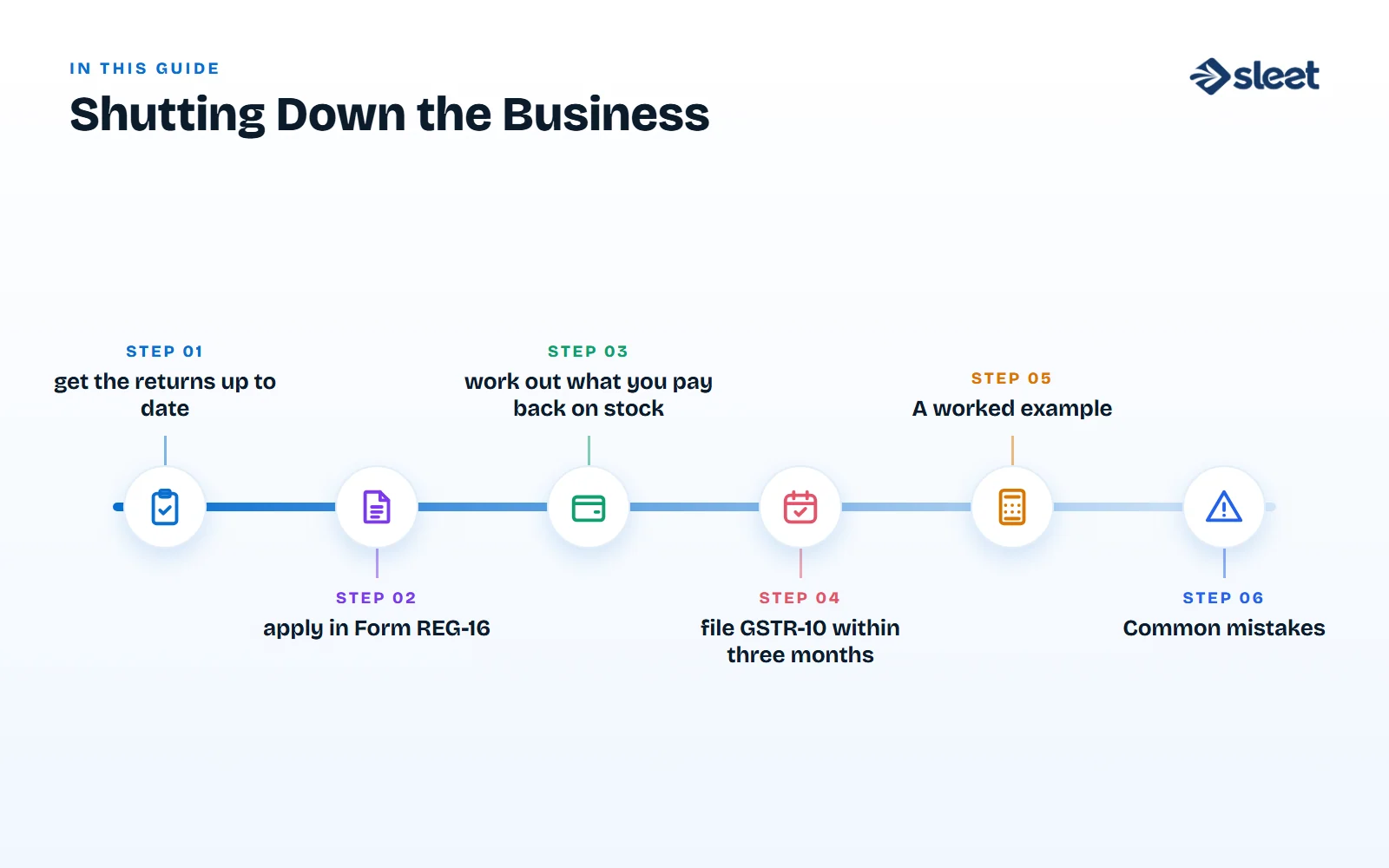
Step 1: get the returns up to date
Before you apply, file every GSTR-1 and GSTR-3B due up to the date you stop business. The portal will not accept the final return while earlier returns are pending, and any late fee or interest still unpaid on earlier GSTR-3Bs is collected through the final return.
Also finish the year-end items you still owe: GSTR-9 for a closed year if your turnover requires it, ITC-04 if you have goods with job workers, and credit notes you plan to issue.
Step 2: apply in Form REG-16
Rule 20 of the CGST Rules requires the application within 30 days of the event that warrants cancellation, here the closure or discontinuance of business. In REG-16 you give:
- ✓the reason and the date from which cancellation is sought;
- ✓the value of inputs held in stock, inputs contained in semi-finished and finished goods, and capital goods on that date;
- ✓the tax payable on them and any payment already made.
The old rule that a voluntary registrant could not cancel within one year was omitted in 2018. The proper officer reviews the application and issues the cancellation order (Form REG-19), or asks for clarification first. Revocation of cancellation is meant for registrations cancelled by the officer on their own; if you cancel voluntarily and later restart, you apply for a fresh registration.
Step 3: work out what you pay back on stock
Section 29(5) of the CGST Act says that on cancellation you must pay the higher of:
- ✓the input tax credit on inputs in stock, inputs in semi-finished and finished goods, and capital goods; or
- ✓the output tax payable on those goods.
For capital goods, the credit is reduced for the time they were used, or you pay tax on their transaction value, whichever is higher. Rule 44 sets the method:
| Item | How the credit is worked out |
|---|---|
| Inputs, semi-finished and finished goods in stock | Proportionately, from the purchase invoices on which credit was taken |
| Capital goods | Credit × remaining useful life in months ÷ 60, taking useful life as 5 years and ignoring part months |
| No purchase invoices available | Estimated at the prevailing market price, certified by a practising chartered or cost accountant |
Work this out separately for CGST, SGST/UTGST and IGST. The amount is part of your output liability and is reported in GSTR-10, with credit for anything already paid with REG-16.
Selling or returning stock before the cancellation date is often cheaper. If you sell it, you charge tax on the sale and the credit stays legitimate.
Step 4: file GSTR-10 within three months
The final return, Form GSTR-10, is due within three months of the effective date of cancellation or the date of the cancellation order, whichever is later. It is a statement of the stock held on the day before cancellation took effect, and the tax on it.
- ✓It cannot be revised once filed, and the full liability must be paid before filing.
- ✓Composition taxpayers, input service distributors, non-resident taxable persons, TDS deductors, TCS collectors and OIDAR suppliers do not file it.
- ✓File it at Services > Returns > Final Return on the GST portal, signed with DSC or EVC.
Late fee. Section 47(1) of the CGST Act charges ₹100 a day, up to ₹5,000, for a late return. The same applies under the state or UT Act, so the total is ₹200 a day, up to ₹10,000. Past amnesty schemes reduced this for a set window; check whether any waiver notification applies when you file.
If you do not file at all, the officer can issue a notice and then assess your liability on the best information available.
A worked example
An electronics retailer in Lucknow decides to close. Its registration is cancelled with effect from 1 December 2026, so stock is counted on 30 November 2026. The cancellation order is dated 20 December 2026.
Stock in hand. Televisions and appliances bought for ₹6,00,000, on which 18% credit of ₹1,08,000 was taken. If sold today, they would fetch ₹5,00,000, so output tax at 18% would be ₹90,000.
- ✓Higher of ₹1,08,000 and ₹90,000 = ₹1,08,000.
Capital goods. Two air conditioners for the showroom, put to use on 1 April 2025, with credit of ₹28,000.
- Used from 1 April 2025 to 30 November 2026 = 20 months.
- Remaining useful life = 60 − 20 = 40 months.
- Credit attributable = ₹28,000 × 40 ÷ 60 = ₹18,667.
- Tax on transaction value if sold for ₹60,000 at 18% = ₹10,800.
- Higher of the two = ₹18,667.
Total to pay: ₹1,08,000 + ₹18,667 = ₹1,26,667, split equally between CGST and SGST. The firm has ₹30,000 left in its credit ledger, so it pays the remaining ₹96,667 in cash.
Due date. The later of 1 December 2026 and 20 December 2026 is 20 December, so GSTR-10 is due by 20 March 2027. If the accountant files on 20 April 2027, that is 31 days late: 31 × ₹200 = ₹6,200 late fee, under the ₹10,000 cap.
Common mistakes
- ✓Waiting months to apply. Returns and late fees keep accruing until the effective date, and the 30-day rule is breached.
- ✓Declaring nil stock to avoid the reversal. The officer can compare it with your purchases and the last balance sheet.
- ✓Forgetting GSTR-10 after the cancellation order. Many closed businesses get notices for exactly this.
- ✓Closing the bank account first. Refunds of any balance in the cash ledger go to that account.
Keep the books and records for 72 months from the due date of the annual return for the last year, as Section 36 requires.
Frequently asked questions
Can the date of cancellation be earlier than the application date?
You can ask for a cancellation date from when business actually stopped. The officer decides the effective date in the order.
Is GSTR-10 needed if I had no stock at all?
Yes, every person whose registration is cancelled files it, except the excluded categories. A nil return is allowed if the facts support it.
Can I use my credit ledger balance to pay the reversal amount?
The amount forms part of output tax liability, so the credit ledger can be used, subject to the normal set-off order. Any balance is paid in cash.
What if the business is transferred, not closed?
A sale, merger or transfer of the business is a different route: the transferee takes registration and unused credit can move in Form ITC-02, so you do not reverse the credit as on closure.
Sources
- ✓Rule 20: application for cancellation of registration, CBIC tax information portal
- ✓Rule 44: manner of reversal of credit, CBIC tax information portal
- ✓FAQs on Form GSTR-10 (final return), GST portal
This is a summary, not legal advice. Confirm your figures and dates on gst.gov.in and with your jurisdictional GST officer.

Written by
Founder, Airwix Technologies (Sleet)
Vatsal Sutariya is the founder of Airwix Technologies in Ahmedabad, the company that builds Sleet: SleetHR for HR and payroll, and Sleet Accounting for GST billing and books. He writes about GST, invoicing, business tax and choosing software for Indian businesses, and checks each rule against the official notification before it is published.
LinkedIn profile →