
Business Made a Loss? Carrying It Forward for Eight Tax Years Under the Income-tax Act, 2025
A business loss is first set off against other income of the same year, except salary. What remains is carried forward for up to eight tax years and set off only against business profits (section 112, earlier 72). The return must be filed by the due date, or the loss lapses. Unabsorbed depreciation carries forward with no time limit.

A bad year leaves a tax loss that can cut tax in the good years that follow, but only if you follow three rules: set it off in the right order, use it within eight years, and file the return on time. Under the Income-tax Act, 2025, the numbers are new and the substance is mostly the same.
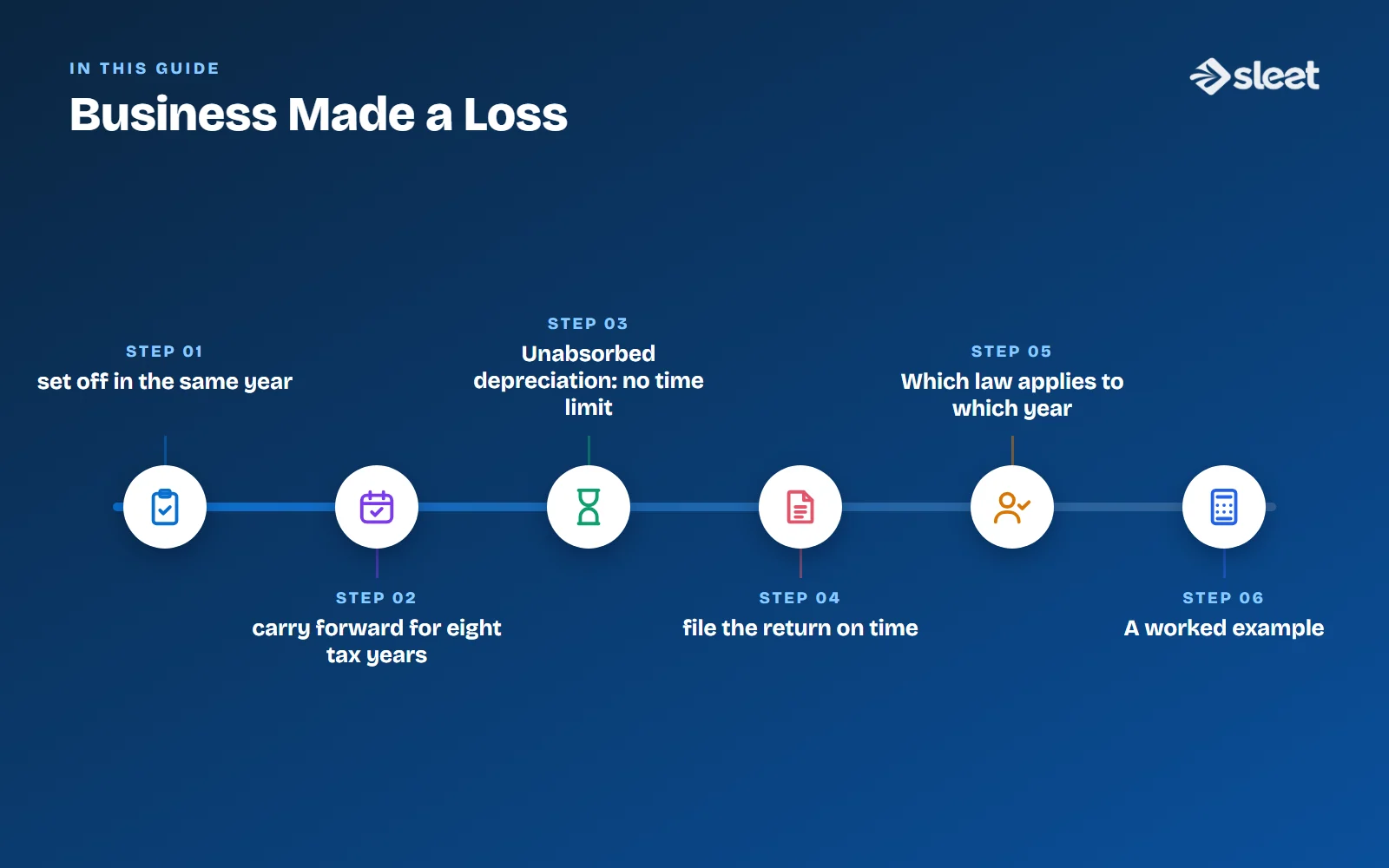
Step 1: set off in the same year
Section 109 (earlier 71) lets a business loss reduce income under other heads in the same tax year, with limits.
| Other income in the same year | Can the business loss reduce it? |
|---|---|
| Salary | No |
| Income from house property | Yes |
| Capital gains | Yes |
| Income from other sources (interest, etc.) | Yes |
| Speculation business profit | Yes |
A speculation loss is different: it can be set off only against speculation profit, and it has its own, shorter carry-forward period under section 113.
Step 2: carry forward for eight tax years
Section 112 (earlier 72) carries forward the business loss that could not be set off in the same year.
- ✓It can be set off only against profits of a business or profession, not against house property, capital gains or other income.
- ✓The business that made the loss need not be the one that earns the profit.
- ✓It can be carried forward for no more than eight tax years immediately after the year in which the loss was first computed. A loss of tax year 2026-27 must be used by tax year 2034-35.
- ✓Older losses are used first.
Unabsorbed depreciation: no time limit
Depreciation works differently under section 33(11) of the 2025 Act (earlier 32(2)).
- ✓Depreciation for the year is allowed only up to the business profit before depreciation. If that profit is itself a loss, no depreciation is allowed for the year.
- ✓The depreciation not allowed is added to the next year's depreciation, and so on, with no time limit.
- ✓Under section 112(3), the brought-forward business loss is set off first, before carried-forward depreciation.
This is a change of mechanics from the 1961 Act, where current-year depreciation could add to a loss that was then set off against other heads of income. Under section 33(11) as worded, it waits for business profit. If your business has rental or interest income, ask your adviser how this affects the year's computation.
Step 3: file the return on time
Section 121 (earlier 80) says a loss is carried forward only if it is determined in a return filed under section 263(1), that is, by the due date.
- ✓A belated return keeps your income on record but loses the carried-forward business loss of that year, along with speculation and capital losses.
- ✓Unabsorbed depreciation under section 33(11) is not in section 121's list, so it survives a late return.
- ✓Losses already brought forward from earlier years are not lost because the current year's return is late; only the current year's new loss is.
Which law applies to which year
| Loss year | Law | Return due date |
|---|---|---|
| FY 2025-26 (AY 2026-27) | Sections 72, 32(2), 80 of the 1961 Act | 31 August 2026 for non-audit business returns (passed); 21 November 2026 for audit cases, as extended by CBDT |
| Tax year 2026-27 onwards | Sections 112, 33(11), 121 of the 2025 Act | The section 263(1) date for your category, in 2027 |
Losses from years before 1 April 2026 are carried into the new Act and keep their original eight-year clock.
If your business is audited and your FY 2025-26 accounts show a loss, the return due on 21 November 2026 is the one that protects it.
A worked example
A Ludhiana hosiery maker, run as a proprietorship, has these figures for tax year 2026-27:
- ✓Business result before depreciation: loss of ₹4,00,000
- ✓Depreciation on machinery: ₹3,00,000
- ✓Rent from a shop: ₹3,00,000, taxable at ₹2,10,000 after the 30% standard deduction
Tax year 2026-27
- Business profit before depreciation is a loss, so no depreciation is allowed this year. Unabsorbed depreciation carried forward: ₹3,00,000.
- Business loss: ₹4,00,000.
- Set off against house property income: ₹4,00,000 − ₹2,10,000 = ₹1,90,000. Taxable income: nil.
- Business loss carried forward: ₹1,90,000, usable up to tax year 2034-35, provided the return is filed by the due date.
Tax year 2027-28
- ✓Business profit before depreciation: ₹9,00,000. Current depreciation: ₹2,50,000.
- Brought-forward business loss first: ₹9,00,000 − ₹1,90,000 = ₹7,10,000.
- Depreciation allowable: ₹2,50,000 + ₹3,00,000 = ₹5,50,000, within the ₹7,10,000 available.
- Business income: ₹7,10,000 − ₹5,50,000 = ₹1,60,000, plus the rent of ₹2,10,000.
If the 2026-27 return had been filed late, the ₹1,90,000 loss would have lapsed. Business income for 2027-28 would have been ₹9,00,000 − ₹5,50,000 = ₹3,50,000 instead of ₹1,60,000.
Frequently asked questions
Can a revised return save a loss if the original was late?
No. A revised return of a belated return is still a belated return for this purpose. The loss needs an original return filed by the due date.
Can the loss be set off against my salary from another job?
No. Section 109 bars setting off a business loss against salary, in the same year or later.
Does a company lose its losses on a change in shareholding?
For closely held companies, a change in shareholding beyond the limit set in the Act can stop old losses being carried forward. Check this before a share sale or restructuring.
Is unabsorbed depreciation also limited to eight years?
No. It carries forward without a time limit until it is fully used against business profits.
Sources
- ✓Section 112, carry forward and set off of business loss, Income Tax Department
- ✓Section 121, submission of return for losses, Income Tax Department
- ✓Section 33, deduction for depreciation, Income Tax Department
- ✓CBDT extends due dates for tax audit reports and returns, TaxHeal
This is a summary, not legal advice. Confirm your return due date on incometax.gov.in and the loss computation with your tax adviser.

Written by
Founder, Airwix Technologies (Sleet)
Vatsal Sutariya is the founder of Airwix Technologies in Ahmedabad, the company that builds Sleet: SleetHR for HR and payroll, and Sleet Accounting for GST billing and books. He writes about GST, invoicing, business tax and choosing software for Indian businesses, and checks each rule against the official notification before it is published.
LinkedIn profile →