
Bonus Set-On and Set-Off: Carrying Surplus or Shortfall Forward Four Years Under the Code on Wages
Yes. If allocable surplus is more than the 20% maximum bonus, the excess (capped at 20% of the year's wages) is set on for up to four later years. If it is less than the 8.33% minimum, you still pay the minimum and set off the gap against the next four years' surplus.

A good year leaves profits that the 20% bonus cap cannot absorb. A bad year still forces you to pay the 8.33% minimum. The Code on Wages, 2019 links the two through set-on and set-off, and most small employers either ignore it or keep no record of it. This post explains how the carry-forward works, the four-year window, and the payment deadline that falls on 30 November for a March year end.
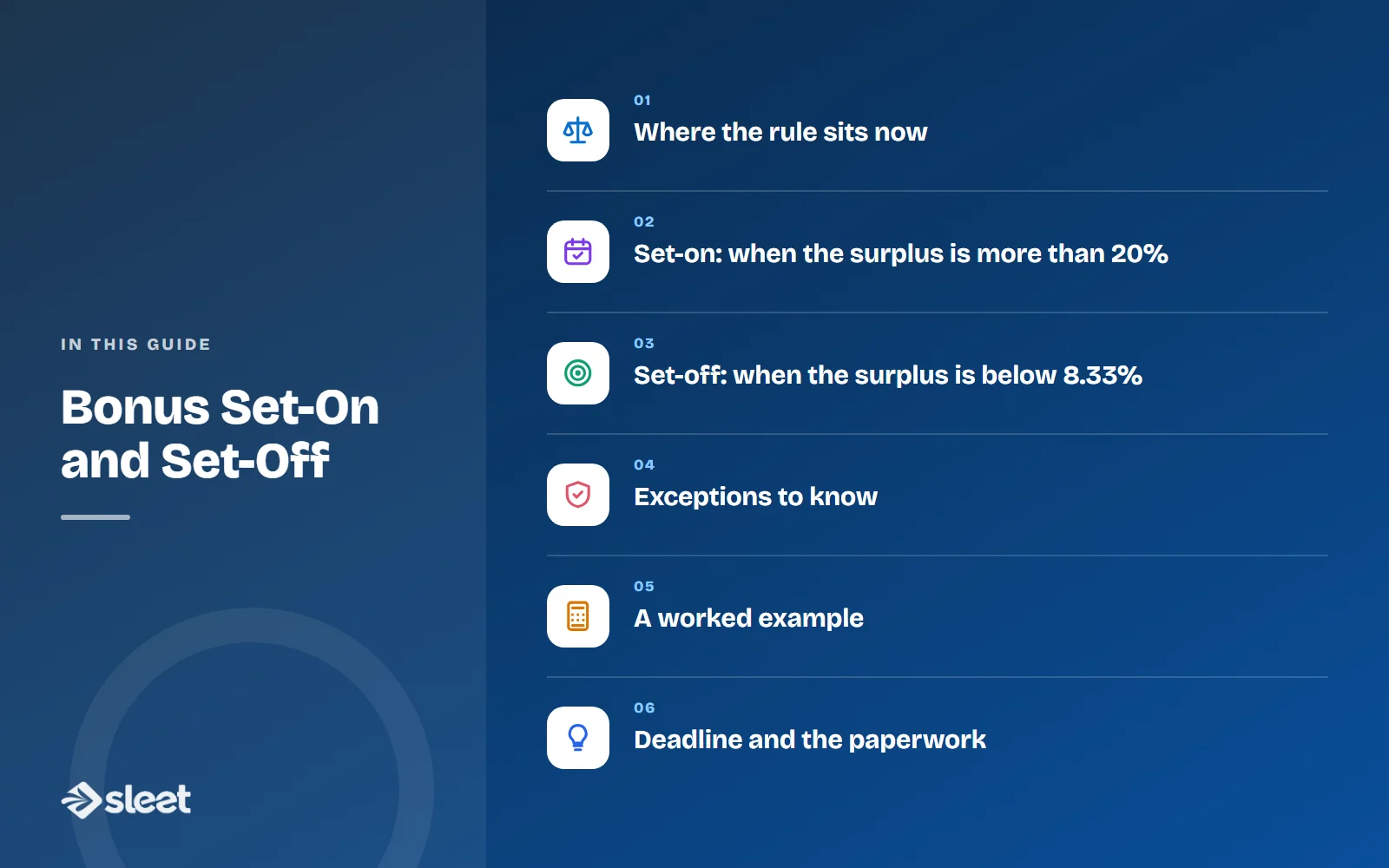
Where the rule sits now
Statutory bonus moved from the Payment of Bonus Act, 1965 into Chapter IV of the Code on Wages, 2019 (sections 26 to 41) when the labour codes came into force on 21 November 2025.
| Point | Rule under the Code |
|---|---|
| Who must pay | Establishments with 20 or more persons on any day of the accounting year (section 41) |
| Who gets it | Employees with at least 30 working days in the year, earning up to the notified ceiling |
| Eligibility ceiling (central sphere) | ₹21,000 a month, S.O. 4711(E) dated 25 August 2026, effective 21 November 2025 |
| Calculation ceiling (central sphere) | Wages above ₹7,000 treated as ₹7,000 or the minimum wage, whichever is higher, S.O. 4710(E) |
| Minimum bonus | 8.33% of wages or ₹100, whichever is higher, payable even without profit |
| Maximum bonus | 20% of wages |
| Allocable surplus | 67% of available surplus (60% for banking companies) |
| Payment deadline | Within 8 months of the close of the accounting year (section 39) |
The two ceilings above are central notifications. If your state government is the appropriate government, check the state's own notification.
Set-on: when the surplus is more than 20%
Section 36(1) applies when allocable surplus for a year is more than the maximum bonus payable. The excess is carried forward and set on in the following years:
- ✓the carried amount is capped at 20% of the total salary or wage of employees for that year;
- ✓it can be used in the next year and so on up to and including the fourth accounting year;
- ✓whatever is left after the fourth year lapses.
Set-on is not optional generosity. In a later year, you add the set-on balance to that year's allocable surplus before deciding the bonus percentage.
Set-off: when the surplus is below 8.33%
Section 36(2) covers the reverse. When there is no available surplus, or the allocable surplus is below the minimum bonus, and there is no set-on balance to cover the gap:
- ✓you still pay the minimum 8.33%;
- ✓the full minimum (where there was no surplus) or the deficiency is carried forward and set off against allocable surplus of later years;
- ✓again, only up to and including the fourth accounting year.
Section 36(4) fixes the order: the balance from the earliest year is used first. Keep a year-wise register so the oldest balance is used before it lapses.
Exceptions to know
- ✓New establishments. In the first five accounting years, bonus is payable only in a year that makes a profit, and set-on and set-off do not apply. Modified rules apply in the sixth and seventh years, and section 36 applies in full from the eighth.
- ✓Customary or advance bonus. A Diwali or puja bonus, or part of the statutory bonus paid early, can be deducted from that year's statutory bonus (section 37).
- ✓Misconduct loss. A loss caused by an employee found guilty of misconduct can be deducted from that year's bonus only (section 38).
- ✓Old balances. Section 69 keeps actions taken under the repealed 1965 Act alive where they do not conflict with the Code, so do not discard set-on or set-off registers kept before November 2025.
A worked example
A Ludhiana hosiery manufacturer, more than eight years old, has 60 eligible employees. Its wages for bonus (after the calculation ceiling) are ₹60,00,000 a year, held level here to keep the arithmetic simple.
- ✓Minimum bonus: 8.33% × ₹60,00,000 = ₹4,99,800
- ✓Maximum bonus: 20% × ₹60,00,000 = ₹12,00,000
| Year | Allocable surplus | Set-on / set-off used | Bonus paid | Carried forward |
|---|---|---|---|---|
| 2026-27 | ₹16,00,000 | None | ₹12,00,000 (20%) | Set-on ₹4,00,000 |
| 2027-28 | ₹2,00,000 | + ₹4,00,000 set-on | ₹6,00,000 (10%) | Nil |
| 2028-29 | ₹1,99,800 | None available | ₹4,99,800 (8.33%) | Set-off ₹3,00,000 |
| 2029-30 | ₹9,00,000 | − ₹3,00,000 set-off | ₹6,00,000 (10%) | Nil |
Step by step:
- 2026-27: ₹16,00,000 − ₹12,00,000 = ₹4,00,000 excess. The set-on cap is 20% of ₹60,00,000 = ₹12,00,000, so all ₹4,00,000 is carried.
- 2027-28: ₹2,00,000 + ₹4,00,000 = ₹6,00,000. That is 10% of wages, between the minimum and maximum, so the bonus is ₹6,00,000.
- 2028-29: Surplus ₹1,99,800 is below the ₹4,99,800 minimum. The minimum is paid and the gap of ₹4,99,800 − ₹1,99,800 = ₹3,00,000 is set off.
- 2029-30: ₹9,00,000 − ₹3,00,000 = ₹6,00,000, again 10%.
Bonus for 2026-27 must be credited to bank accounts by 30 November 2027.
Deadline and the paperwork
- ✓Eight months. For a 31 March year end, bonus is due by 30 November. The 2025-26 bonus is due by 30 November 2026.
- ✓Bank credit. Section 39 requires payment by credit to the employee's bank account.
- ✓Extension. The appropriate government can extend the period on the employer's application for sufficient reasons, but the total extension cannot exceed two years.
- ✓Disputes. If a dispute is pending, bonus is due within one month of the award or settlement, but the undisputed 8.33% must still be paid within eight months.
Keep the computation of gross profit, available surplus, allocable surplus and the set-on/set-off register for each year. An inspector will ask for the working, not just the payout.
Frequently asked questions
Can we skip set-on and just pay the maximum bonus next year?
You can pay more than the Code requires, but you cannot ignore a set-on balance that would raise employees' bonus in a later year. Use it in the year it falls due.
Does a set-off balance let us pay less than 8.33%?
No. The minimum is always payable. Set-off only reduces the allocable surplus of later profitable years.
What happens to a set-on balance that is unused after four years?
It lapses. Section 36 allows the carry-forward only up to and including the fourth accounting year.
Is a festival bonus counted towards statutory bonus?
Yes, if it is a customary bonus paid in that year. Section 37 allows it to be deducted from the statutory bonus for the same year.
Sources
- ✓Code on Wages, 2019 (Gazette text, sections 26 to 41), Ministry of Labour and Employment
- ✓Code on Wages, 2019, text as passed (sections 26-41, 36, 39, 69), PRS India
- ✓Section 36, Code on Wages: set on and set off of allocable surplus, AdvocateKhoj
- ✓Bonus under the Code on Wages 2019: allocable surplus, set-on and set-off, Taxmann
- ✓Centre notifies bonus eligibility and calculation ceilings, SCC Online
This is a summary, not legal advice. Confirm the ceilings and any state notification with your labour law adviser or the Ministry of Labour and Employment before you finalise this year's bonus.

Written by
HR Manager, Airwix Technologies (Sleet)
Nihit Dobariya is the HR Manager at Airwix Technologies in Ahmedabad, where he runs HR and payroll for the team behind Sleet. He writes about payroll, PF and ESIC, professional tax, the labour codes and everyday HR practice for Indian employers, and checks each rule against the official notification before it is published.
LinkedIn profile →